• Produktbild: Communicating COVID-19
  • Produktbild: Communicating COVID-19

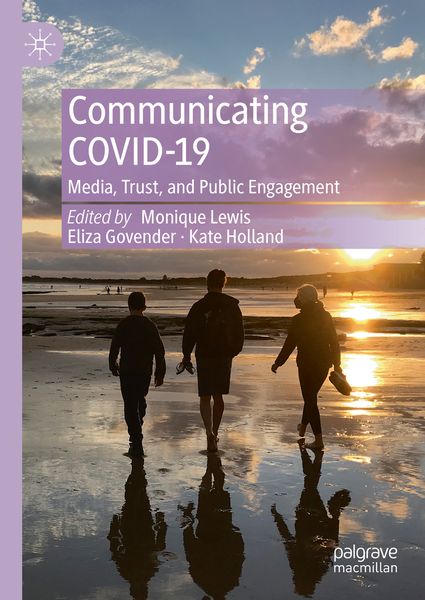
Communicating COVID-19 Media, Trust, and Public Engagement

Fr. 181.00

inkl. gesetzl. MwSt., Versandkostenfrei


Beschreibung

Produktdetails

Einband

Gebundene Ausgabe

Erscheinungsdatum

05.01.2024

Herausgeber

Monique Lewis + weitere

Verlag

Springer

Seitenzahl

501

Maße (L/B/H)

21.6/15.3/3.4 cm

Gewicht

798 g

Sprache

Englisch

ISBN

978-3-031-41236-3

Beschreibung

Portrait

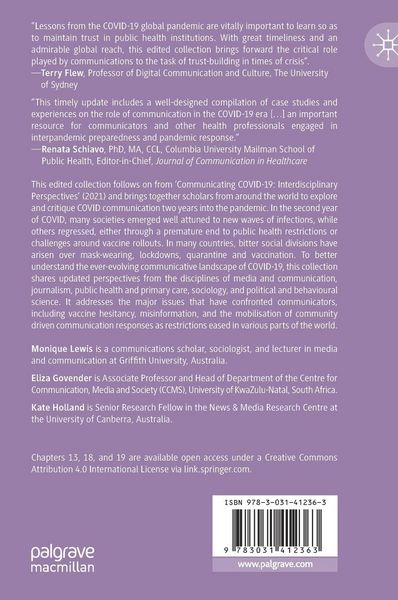
Monique Lewis  is a communications scholar, sociologist, and lecturer in media and communication at Griffith University, Australia.

Eliza Govender  is Associate Professor and Head of Department of the Centre for Communication, Media and Society (CCMS), University of KwaZulu-Natal, South Africa.

Kate Holland  is Senior Research Fellow in the News & Media Research Centre at the University of Canberra, Australia.

Produktdetails

Einband

Gebundene Ausgabe

Erscheinungsdatum

05.01.2024

Herausgeber

Verlag

Springer

Seitenzahl

501

Maße (L/B/H)

21.6/15.3/3.4 cm

Gewicht

798 g

Sprache

Englisch

ISBN

978-3-031-41236-3

Herstelleradresse

Springer-Verlag GmbH
Tiergartenstr. 17
69121 Heidelberg
DE

Email: ProductSafety@springernature.com

Kundinnen und Kunden meinen

0 Bewertungen

Informationen zu Bewertungen

Zur Abgabe einer Bewertung ist eine Anmeldung im Konto notwendig. Die Authentizität der Bewertungen wird von uns nicht überprüft. Wir behalten uns vor, Bewertungstexte, die unseren Richtlinien widersprechen, entsprechend zu kürzen oder zu löschen.

Die Bewertungen sind nach Format, Anzahl Sterne und Datum sortiert.

Verfassen Sie die erste Bewertung zu diesem Artikel

Helfen Sie anderen Kund*innen durch Ihre Meinung

Kundinnen und Kunden meinen

0 Bewertungen filtern

  • Produktbild: Communicating COVID-19
  • Produktbild: Communicating COVID-19
  • Chapter 1: Introduction. Monique Lewis, Eliza Govender, Kate Holland.  Section 1: Public Interest Journalism, News, and Community Media.-  Chapter 2: Community Radio in the Covid-19 Crisis: Lessons from global dialogues. Vinod Pavarala. Chapter 3: Answering Questions: Explanatory journalism and podcast 'liveness' during COVID. Mia Lindgren and Dylan Bird. Chapter 4: 'We're Losing Our Bread and Butter Like Never Before': Journalism in the face of Covid-19 pandemic. Shaharior Rahman Razu. Chapter 5: The Covid-19 Pandemic in Portuguese Journalism. Rita Araujo et al. Chapter 6: Impact of Covid-19 on Journalistic Practices in Emerging Democracies. Sayyed Fawad Ali Shah and Faizullah Jah. Chapter 7: COVID and the Future of Journalism. David Nolan et al. Chapter 8: Media Depictions of Remote General Practice Care in a Protracted Pandemic. Gilly Mroz and Trish Greenhalgh. Section2: Risk Communication and Community Engagement. Chapter 9: Perceptions of Risk and Self-Efficacy About COVID messaging in South African Townships. Mpume Gumede and Eliza Govender. Chapter 10. Rethinking Community Engagement For Research in Pandemic Times: Lessons from the future. Theresa Rossouw et al. Chapter 11: Application of the Extended Paralax Process Model in Cote D'Ivoire. Danielle Naugle. Chapter 12: 'What's Up, Fellow Deadly Diseases?': Creative arts and communicating Covid-19 in Ghana. Ama de-Graft Aikins. Chapter 13: Much Ado about Covid-19 Vaccines: Understanding perceptions and experiences of vaccines among health care workers and its influence on patient COVID-19 communication in Eswatini hospitals. Nqobile Ndinzisa and Eliza Govender. Section 3: Vaccine Communication and Digital Technologies. Chapter 14: COVID-19 and Aboriginal and Torres Strait Islander People in Australia: Can rhetoric equal action?. Kalinda Griffiths. Chapter 15: Far-right Political Extremism and the Radicalization of the Anti-vaccine Movement in Canada. Sibo Chen. Chapter 16: Harnessing Interpersonal Communication and Trusted Leadership to Increase COVID-19 Vaccination Uptake in Hard-to-Reach Wildlife Communities in Uganda. Barbara Natifu. Chapter 17: Function Creep of Covid-19 of Big-Data Surveillance in China. Ausma Bernot and Susan Trevaskes. Chapter 18: Identifying Novel COVID-19 Rumors Through a Multi-Channel Approach. Natalie Tibbels. Chapter 19: Creating Demand for COVID-19 Vaccines Through a Coordinated Social Media Campaign: Religious leaders and health experts. Stella Babalola. Section 4: Theoretical and Philosophical Concepts for Understanding Covid Communication. Chapter 20: Values, Worldviews, Ideology and Reactance: Communication in a pandemic. Claire Hooker and Mat Marques. Chapter 21: Communicating Ableism in a Pandemic: Compassion, vulnerability and the violence of care. Michael Orsini. Chapter 22: Critical Health Literacy and Scientific Literacy as a Basis for Individual Appraisals of Health Information During Public Health Emergencies. Sarah Rubinelli et al. Chapter 23: TBC. Mark Davis. Chapter 24: Conclusion.