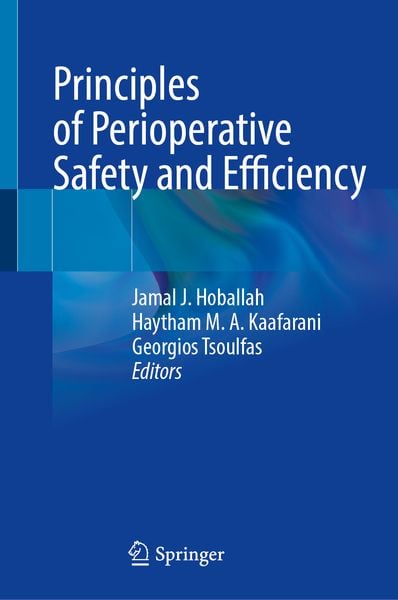
Principles of Perioperative Safety and Efficiency
-
- Hardcover ausgewählt
- Taschenbuch
- eBook
-
Sprache:Englisch
Fr. 218.00
inkl. gesetzl. MwSt.,
Beschreibung
Produktdetails
Einband
Gebundene Ausgabe
Erscheinungsdatum
03.05.2024
Herausgeber
Jamal J. Hoballah + weitereVerlag
SpringerSeitenzahl
416
Maße (L/B/H)
24.1/16/2.8 cm
Gewicht
902 g
Auflage
2024
Sprache
Englisch
ISBN
978-3-031-41088-8
Perioperative safety continues to be a global challenge. It is estimated that approximately 200 million surgical procedures are performed annually worldwide, and despite various national and global safety initiatives, perioperative adverse event rates remain alarmingly high. Although hospitals and governmental agencies impose safety standards and certification by organizations such as the Joint Commission, which can address issues of perioperative safety, many hospitals in developed, developing or underdeveloped countries lack the resources or knowhow to decrease perioperative adverse events. There is a great opportunity for improving perioperative safety worldwide especially in underdeveloped or developing countries.
Filling a gap in the literature, this book teaches healthcare providers the basic principles of perioperative safety and efficiency, including checklists and processes to reduce adverse events. Presented here are the basics of intraoperativemonitoring and safety measures to reduce patient adverse events, including wrong site surgery, electric burn injury, deep venous thrombosis, surgical site infection and foreign body retention. Emphasis is given toward developing awareness into measures preventing occupational injuries, such as sharp injury, radiation exposure, laser exposure and smoke hazard. It also addresses dealing and reporting adverse events and disruptive behaviors in the operating rooms as well as new measures for enhanced recovery following surgery and anesthesia.
Principles of Perioperative Safety and Efficiency is a valuable resource and reference for all operating room personnel including surgeons, surgical residents, medical students and nurses.
Filling a gap in the literature, this book teaches healthcare providers the basic principles of perioperative safety and efficiency, including checklists and processes to reduce adverse events. Presented here are the basics of intraoperativemonitoring and safety measures to reduce patient adverse events, including wrong site surgery, electric burn injury, deep venous thrombosis, surgical site infection and foreign body retention. Emphasis is given toward developing awareness into measures preventing occupational injuries, such as sharp injury, radiation exposure, laser exposure and smoke hazard. It also addresses dealing and reporting adverse events and disruptive behaviors in the operating rooms as well as new measures for enhanced recovery following surgery and anesthesia.
Principles of Perioperative Safety and Efficiency is a valuable resource and reference for all operating room personnel including surgeons, surgical residents, medical students and nurses.
Kundinnen und Kunden meinen
Verfassen Sie die erste Bewertung zu diesem Artikel
Helfen Sie anderen Kund*innen durch Ihre Meinung