Gutscheinbedingungen

*Gültig bis 07.06.2026 auf (fast) alles. Ausgeschlossen sind Smartboxen, Zeitschriften, Tickets, Lebensmittel, Gaming-Elektroartikel, Tinte/Toner, Gutscheine, Geschenkkarten, Blumen und Abos | Einlösbar in allen Buchhandlungen von Orell Füssli, Barth Bücher, Buchladen Rapunzel, Schuler Orell Füssli, Stauffacher und ZAP unter Vorweisung des Gutscheins, auf www.orellfüssli.ch durch Eingabe des Gutscheincodes. Beim Service „eBooks verschenken“ und bei eBook-Käufen via eReader nicht einlösbar | Mindesteinkaufswert: Fr. 100.- | Nicht mit anderen Rabatten kumulierbar.

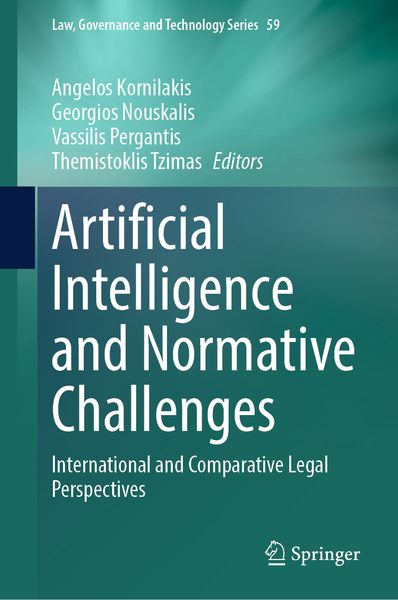
  • Produktbild: Artificial Intelligence and Normative Challenges
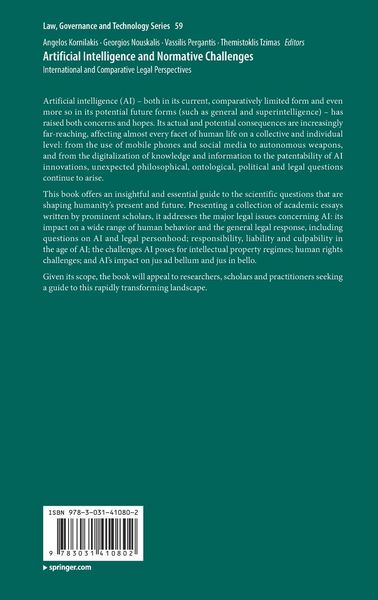
  • Produktbild: Artificial Intelligence and Normative Challenges
Band 59

Artificial Intelligence and Normative Challenges International and Comparative Legal Perspectives

Fr. 218.00

inkl. gesetzl. MwSt., Versandkostenfrei


Beschreibung

Produktdetails

Einband

Gebundene Ausgabe

Erscheinungsdatum

21.11.2023

Herausgeber

Angelos Kornilakis + weitere

Verlag

Springer

Seitenzahl

279

Maße (L/B/H)

24.1/16/2.2 cm

Gewicht

600 g

Sprache

Englisch

ISBN

978-3-031-41080-2

Beschreibung

Portrait

Angelos Kornilakis is an associate professor of civil law, Faculty of Law, Aristotle University of Thessaloniki, holding a PhD from JW Goethe Universität, Frankfurt am Main. He has taught in Greek, German and Swiss Universities and his research interests include the theory of private law, economics of law, digital economy & private law. He has published extensively in this field, in Greek, English and German. He is a Coordinator of the Research Team on “Digital Economy & Private Law”, Faculty of Law, Aristotle University of Thessaloniki.

Georgios Nouskalis is Assistant Professor of Criminal Law at the Law School of the Aristotle University of Thessaloniki. He is a S upreme Court Lawyer (1992-2023) and a member of the Volunteer Lawyers' Network of Therapy Center for Dependent People (KETHEA). He has published extensively on computer related crimes.  


Vassilis Pergantis is an assistant professor of public international law, Law Faculty, Aristotle University of Thessaloniki and academic coordinator of a Jean Monnet Project on “EU Responsibility in the International System [EURIS]”. His fields of interest focus on the theory of international law and the sources doctrine, the law of international organisations, international responsibility, as well as human rights. He has published extensively in English, French and Greek.

Themis Tzimas is adjunct lecturer at the School of Political Sciences of the Democritus University of Thrace. He introduced and taught the module “Artificial Intelligence, Political Theories and International Relations”. He currently teaches "Public Policies".

Produktdetails

Einband

Gebundene Ausgabe

Erscheinungsdatum

21.11.2023

Herausgeber

Verlag

Springer

Seitenzahl

279

Maße (L/B/H)

24.1/16/2.2 cm

Gewicht

600 g

Sprache

Englisch

ISBN

978-3-031-41080-2

Herstelleradresse

Springer-Verlag GmbH
Tiergartenstr. 17
69121 Heidelberg
DE

Email: ProductSafety@springernature.com

Kundinnen und Kunden meinen

0 Bewertungen

Informationen zu Bewertungen

Zur Abgabe einer Bewertung ist eine Anmeldung im Konto notwendig. Die Authentizität der Bewertungen wird von uns nicht überprüft. Wir behalten uns vor, Bewertungstexte, die unseren Richtlinien widersprechen, entsprechend zu kürzen oder zu löschen.

Die Bewertungen sind nach Format, Anzahl Sterne und Datum sortiert.

Verfassen Sie die erste Bewertung zu diesem Artikel

Helfen Sie anderen Kund*innen durch Ihre Meinung

Kundinnen und Kunden meinen

0 Bewertungen filtern

  • Produktbild: Artificial Intelligence and Normative Challenges
  • Produktbild: Artificial Intelligence and Normative Challenges
  • Introduction.-  Part I - AI and Questions of Personhood and Ethics.-  The Peculium of the Robot: Artificial Intelligence and Slave Law.-  Legal Personhood for Autonomous AI: Practical Consequences in Private Law.- Artificial Intelligence’s Black box: Posing New Ethical and Legal Challenges on Modern Societies.-   Part II - AI and Civil Liability.-  The role of the autonomous machines at the conclusion of a contract: Contractual responsibility according to current rules of private law and prospects.-  Understanding the risks of Artificial Intelligence as a precondition for sound liability regulation.-  Part III - AI and Issues of Responsibility and Adjudication.-  Attributing Conduct of Autonomous Software Agents with Legal Personality under International Law on State Responsibility.- Algorithmic criminal justice: Is it just a science fiction plot idea?.-  Part IV - Intellectual Property Protection and Patentability of AI.-  The patentability of AI-related subject matter according to the EPC as implemented by the EPO.- International perspectives on regulatory frameworks: AI through the lens of patent law.-  Part V - AI and Human Rights.-  What role for social rights during the leap to post or “enhanced” humanism?.- Artificial Intelligence vs Data Protection: How the GDPR Can Help to Develop a Precautionary Regulatory Approach to AI?.-  Part VI - AI and Jus ad Bellum-Jus in Bello Questions.-  The Use of AI Weapons in Outer Space: Regulatory Challenges.- Performance or explainability? A law of Armed Conflict Perspective