Gutscheinbedingungen

*Gültig bis 07.06.2026 auf (fast) alles. Ausgeschlossen sind Smartboxen, Zeitschriften, Tickets, Lebensmittel, Gaming-Elektroartikel, Tinte/Toner, Gutscheine, Geschenkkarten, Blumen und Abos | Einlösbar in allen Buchhandlungen von Orell Füssli, Barth Bücher, Buchladen Rapunzel, Schuler Orell Füssli, Stauffacher und ZAP unter Vorweisung des Gutscheins, auf www.orellfüssli.ch durch Eingabe des Gutscheincodes. Beim Service „eBooks verschenken“ und bei eBook-Käufen via eReader nicht einlösbar | Mindesteinkaufswert: Fr. 100.- | Nicht mit anderen Rabatten kumulierbar.

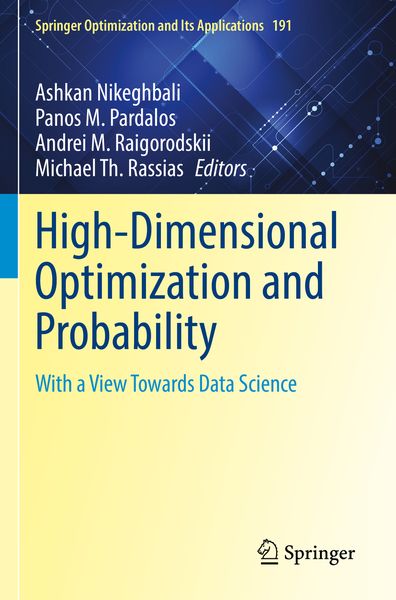
  • Produktbild: High-Dimensional Optimization and Probability
  • Produktbild: High-Dimensional Optimization and Probability
Band 191

High-Dimensional Optimization and Probability With a View Towards Data Science

Fr. 119.00

inkl. gesetzl. MwSt., Versandkostenfrei


Beschreibung

Produktdetails

Einband

Taschenbuch

Erscheinungsdatum

05.08.2023

Herausgeber

Ashkan Nikeghbali + weitere

Verlag

Springer

Seitenzahl

417

Maße (L/B/H)

23.5/15.5/2.4 cm

Gewicht

645 g

Auflage

1st ed. 2022

Sprache

Englisch

ISBN

978-3-031-00834-4

Beschreibung

Portrait

Ashkan Nikeghbali is currently Chair of the department of quantitative finance at the University of Zürich. His fields of research include finance mathematics, number theory, random matrices, and stochastic processes. Since 2016 Prof. Nikeghbali has been a member of the Scientific Advisory Board of swissQuant and a member of the Advisory Board of EVMTech.

Panos M. Pardalos  serves as distinguished professor of industrial and systems engineering at the University of Florida. Additionally, he is the Paul and Heidi Brown Preeminent Professor of industrial and systems engineering. Professor Pardalos is also an affiliated faculty member of the computer and information science department, the Hellenic Studies Center, and the biomedical engineering program. Additionally, he serves as the director of the Center for Applied Optimization. Professor Pardalos is a world leading expert in global and combinatorial optimization. His recent research interests include network design problems, optimization in telecommunications, ecommerce, data mining, biomedical applications, and massive computing. Panos Pardalos is a prolific author who lectures all over the world. He is the recipient of a multitude of fellowships and awards, the most recent of which is the Humboldt Research Award (2018).

Andrei Raigorodskii is a Federal Professor of Mathematics at the Moscow Institute of Physics and Technology (MIPT) where he is the Director of the Phystech-School of Applied Mathematics and Computer Science, the Head of the Discrete Mathematics Department, the Head of the Laboratory of Advanced Combinatorics and Network Applications, as well as the Head of the Laboratory of Applied Research MIPT-Sberbank. He is also the Head of the Caucasus Mathematical Center. He lectures at MIPT, MSU, HSE and has published about 200 papers and 20 books. He is the Editor-in-Chief of the Moscow Journal of Combinatorics and Number Theory. In 2011,he was awarded the 2011 Russian President's Prize in Science and Innovation for young scientists.

Michael Th. Rassias is a Research Fellow at the University of Zürich and a visiting researcher at the Institute for Advanced Study, Princeton. While conducting postdoctoral research at the Department of Mathematics of Princeton University in 2014-2015, he prepared with John F. Nash, Jr. the volume "Open Problems in Mathematics", Springer, 2016. He has received several awards in mathematical problem-solving competitions, including a Silver medal at the International Mathematical Olympiad of 2003 in Tokyo. In 2014 he was awarded with the Notara Prize by the Academy of Athens. He has authored and edited several books with Springer. His current research interests lie in mathematical analysis, analytic number theory, and more specifically the Riemann Hypothesis, Goldbach’s conjecture, the distribution of prime numbers, approximation theory, functional equations andanalytic inequalities.

Produktdetails

Einband

Taschenbuch

Erscheinungsdatum

05.08.2023

Herausgeber

Verlag

Springer

Seitenzahl

417

Maße (L/B/H)

23.5/15.5/2.4 cm

Gewicht

645 g

Auflage

1st ed. 2022

Sprache

Englisch

ISBN

978-3-031-00834-4

Herstelleradresse

Springer-Verlag KG
Sachsenplatz 4-6
1201 Wien
AT

Email: ProductSafety@springernature.com

Kundinnen und Kunden meinen

0 Bewertungen

Informationen zu Bewertungen

Zur Abgabe einer Bewertung ist eine Anmeldung im Konto notwendig. Die Authentizität der Bewertungen wird von uns nicht überprüft. Wir behalten uns vor, Bewertungstexte, die unseren Richtlinien widersprechen, entsprechend zu kürzen oder zu löschen.

Die Bewertungen sind nach Format, Anzahl Sterne und Datum sortiert.

Verfassen Sie die erste Bewertung zu diesem Artikel

Helfen Sie anderen Kund*innen durch Ihre Meinung

Kundinnen und Kunden meinen

0 Bewertungen filtern

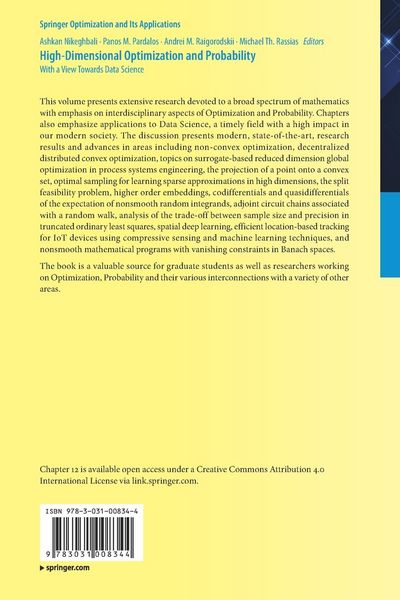
  • Produktbild: High-Dimensional Optimization and Probability
  • Produktbild: High-Dimensional Optimization and Probability
  • Projection of a point onto a convex set via Charged Balls Method (E. Abbasov ).- Towards optimal sampling for learning sparse approximations in high dimensions (Adcock).- Recent Theoretical Advances in Non-Convex Optimization (Gasnikov).- Higher Order Embeddings for the Composition of the Harmonic Projection and Homotopy Operators (Ding).- Codifferentials and Quasidifferentials of the Expectation of Nonsmooth Random Integrands and Two-Stage Stochastic Programming (M.V. Dolgopolik).- On the Expected Extinction Time for the Adjoint Circuit Chains associated with a Random Walk with Jumps in Random Environments (Ganatsiou).- A statistical learning theory approach for the analysis of the trade-off between sample size and precision in truncated ordinary least squares (Raciti).- Recent theoretical advances in decentralized distributed convex optimization (Gasnikov).- On training set selection in spatial deep learning (M.T. Hendrix).- Surrogate-Based Reduced Dimension Global Optimizationin Process Systems Engineering (Xiang Li).- A viscosity iterative method with alternated inertial terms for solving the split feasibility problem (Rassias).- Efficient Location-Based Tracking for IoT Devices Using Compressive Sensing and Machine Learning Techniques (Aboushelbaya).- Nonsmooth Mathematical Programs with Vanishing Constraints in Banach Spaces (Singh).