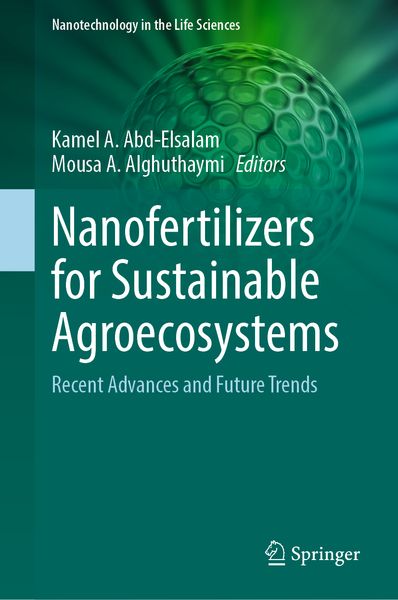
Nanofertilizers for Sustainable Agroecosystems Recent Advances and Future Trends
-
- Hardcover ausgewählt
- Taschenbuch
- eBook
-
Sprache:Englisch
Fr. 209.00
inkl. gesetzl. MwSt.,
Beschreibung
Produktdetails
Einband
Gebundene Ausgabe
Erscheinungsdatum
29.11.2023
Herausgeber
Kamel A. Abd-Elsalam + weitereVerlag
SpringerSeitenzahl
573
Maße (L/B/H)
24.1/16/3.8 cm
Gewicht
1051 g
Auflage
1st edition 2024
Sprache
Englisch
ISBN
978-3-031-41328-5
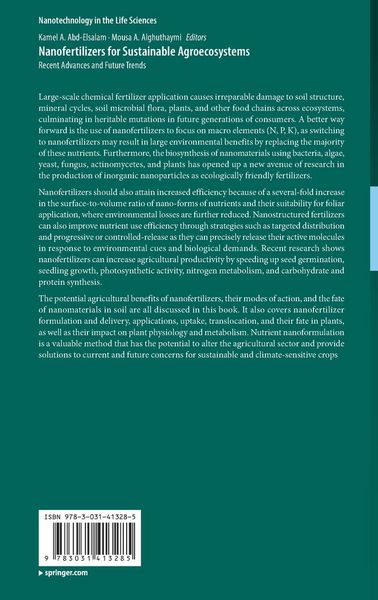
Large-scale chemical fertilizer application causes irreparable damage to soil structure, mineral cycles, soil microbial flora, plants, and other food chains across ecosystems, culminating in heritable mutations in future generations of consumers. A better way forward is the use of nanofertilizers to focus on macro elements (N, P, K), as switching to nanofertilizers may result in large environmental benefits by replacing the majority of these nutrients. Furthermore, the biosynthesis of nanomaterials using bacteria, algae, yeast, fungus, actinomycetes, and plants has opened up a new avenue of research in the production of inorganic nanoparticles as ecologically friendly fertilizers.
Nanofertilizers should also attain increased efficiency because of a several-fold increase in the surface-to-volume ratio of nano-forms of nutrients and their suitability for foliar application, where environmental losses are further reduced. Nanostructured fertilizers can also improve nutrient useefficiency through strategies such as targeted distribution and progressive or controlled-release as they can precisely release their active molecules in response to environmental cues and biological demands. Recent research shows nanofertilizers can increase agricultural productivity by speeding up seed germination, seedling growth, photosynthetic activity, nitrogen metabolism, and carbohydrate and protein synthesis.
The potential agricultural benefits of nanofertilizers, their modes of action, and the fate of nanomaterials in soil are all discussed in this book. It also covers nanofertilizer formulation and delivery, applications, uptake, translocation, and their fate in plants, as well as their impact on plant physiology and metabolism. Nutrient nanoformulation is a valuable method that has the potential to alter the agricultural sector and provide solutions to current and future concerns for sustainable and climate-sensitive cropsKundinnen und Kunden meinen
Verfassen Sie die erste Bewertung zu diesem Artikel
Helfen Sie anderen Kund*innen durch Ihre Meinung