• Produktbild: The Cambridge Handbook of Slavic Linguistics
  • Produktbild: The Cambridge Handbook of Slavic Linguistics

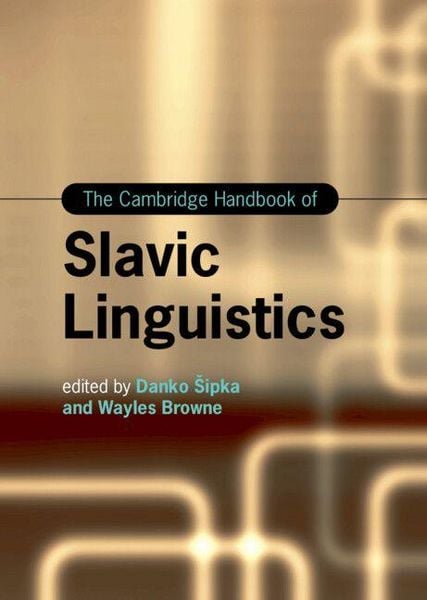
The Cambridge Handbook of Slavic Linguistics

Fr. 213.00

inkl. gesetzl. MwSt., Versandkostenfrei


Beschreibung

Produktdetails

Einband

Gebundene Ausgabe

Erscheinungsdatum

23.05.2024

Herausgeber

Danko Sipka + weitere

Verlag

Cambridge University Press

Seitenzahl

800

Maße (L/B/H)

24.4/17/4.3 cm

Gewicht

1461 g

Sprache

Englisch

ISBN

978-1-108-83267-0

Beschreibung

Produktdetails

Einband

Gebundene Ausgabe

Erscheinungsdatum

23.05.2024

Herausgeber

Verlag

Cambridge University Press

Seitenzahl

800

Maße (L/B/H)

24.4/17/4.3 cm

Gewicht

1461 g

Sprache

Englisch

ISBN

978-1-108-83267-0

Herstelleradresse

Libri GmbH
Europaallee 1
36244 Bad Hersfeld
DE

Email: gpsr@libri.de

Kundinnen und Kunden meinen

0 Bewertungen

Informationen zu Bewertungen

Zur Abgabe einer Bewertung ist eine Anmeldung im Konto notwendig. Die Authentizität der Bewertungen wird von uns nicht überprüft. Wir behalten uns vor, Bewertungstexte, die unseren Richtlinien widersprechen, entsprechend zu kürzen oder zu löschen.

Die Bewertungen sind nach Format, Anzahl Sterne und Datum sortiert.

Verfassen Sie die erste Bewertung zu diesem Artikel

Helfen Sie anderen Kund*innen durch Ihre Meinung

Kundinnen und Kunden meinen

0 Bewertungen filtern

Die Leseprobe wird geladen.
  • Produktbild: The Cambridge Handbook of Slavic Linguistics
  • Produktbild: The Cambridge Handbook of Slavic Linguistics
  • Slavic linguistics introduction Wayles Browne; 1. Word stress Draga Zec; 2. Vocalism: the vowels Irena Sawicka; 3. Consonantism: the consonants Peter Jurgec; 4. Syllable structure Alexei Kochetov; 5. Phonologically conditioned alternations Darya Kavitskaya; 6. Prosodic reflexes of information structure Radek Simík; 7. Inflectional endings: declensions Marek Majer; 8. Inflectional endings: conjugation Ian Press; 9. Tense and mood forms Hagen Pitsch; 10. Aspect in verbs Stephen M. Dickey; 11. Lexical derivation Frank Y. Gladney; 12. Lexical composition Mate Kapović; 13. Agreement Jana Willer gold; 14. Wh-constructions and wh-dependencies Barbara Citko; 15. Coordination and subordination in slavic languages Milan Mihaljević; 16. Numerals and quantity expressions Steven Franks; 17. Placement and ordering of the (en)clitics Lanko Marušič, Petra Mišmaš and Rok Zaucer; 18. Secondary predication Nerea Madariaga; 19. Negation and polarity Luka Szucsich; 20. Null subjects Alina Lsraeli; 21. Voice Jasmina Milićević; 22. Morphosyntactic reflexes of information structure Elena Titov; 23. The structure of the lexicon Valentina Apresjan and Alexei Shmelev; 24. Lexical semantics (insights from lexicology) Rajna Dragićević; 25. Lexical borrowing Rajna Dragićević; 26. Sociolinguistic variation in slavic languages Serge Sharoff; 27. False cognates Danko Šipka and Mladen Uhlik; 28. Dialectal fragmentation Joseph Schallert; 29. Language contacts Dieter Stern; 30. The slavic literary micro-languages Motoki Nomachi; 31. Heritage language forms Oksana Laleko; 32. Scripts Daniel Bunčić; 33. Orthographies Daniel Bunčić; 34. Psycholinguistics and language acquisition Tanya Ivanova-Sullivan and Irina A. Sekerina; 35. Natural language processing Tomaž Erjavec.