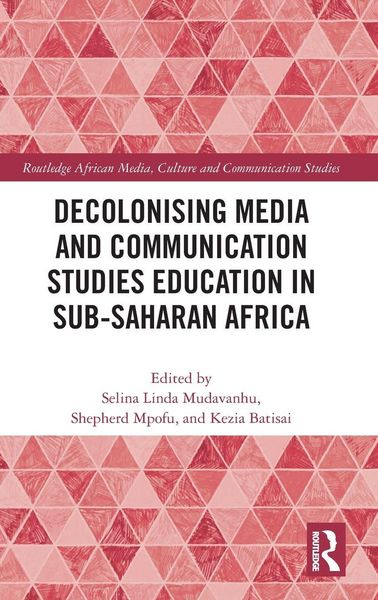

Decolonising Media and Communication Studies Education in Sub-Saharan Africa Saharan Afric
-
- Hardcover ausgewählt
- Taschenbuch
- eBook
-
Sprache:Englisch
Fr. 253.00
inkl. gesetzl. MwSt.,
Beschreibung
Produktdetails
Einband
Gebundene Ausgabe
Erscheinungsdatum
27.10.2023
Abbildungen
schwarz-weiss Illustrationen, Zeichnungen, schwarz-weiss, Tabellen, schwarz-weiss
Herausgeber
Selina Linda Mudavanhu + weitereVerlag
Taylor & FrancisSeitenzahl
298
Maße (L/B/H)
24/16.1/2.1 cm
Gewicht
559 g
Sprache
Englisch
ISBN
978-1-03-248306-1
The book provides insights on decolonising media and communication studies education from diverse African scholars at different stages of their careers. These academics, located on the continent and in the diaspora, share an interest in decolonising higher education broadly and media and communication studies teaching and learning in particular.
Although many African countries gained flag independence from different European colonial powers between the 1950s and the 1970s, this book argues that former colonies remain ensnared in a colonial power matrix. Many African universities did not jettison ways of teaching and learning established during colonialism, and even those journalism, communication, and media studies training programmes which were established after the attainment of flag independence did not place decolonial agendas at the front and centre when setting them up. Starting with big picture thematic questions around decolonisation, the book goes on to consider what the implications of change would be for students and instructors, before reflecting on how far it is possible to decolonise curricula and syllabi and what this might look like in practice across a range of subject areas and country contexts. Overall, this book presents a nuanced picture of what a decolonised media and communication studies education could look like in sub-Saharan Africa.
This book is essential for researchers in Africa in disciplines such as media and communication studies, journalism, film studies, cultural studies, and higher education studies. More broadly, the concepts and ideas on decolonising teaching and learning discussed in the book are relevant to instructors in any discipline who are interested in doing the decolonial work of contesting coloniality.
Kundinnen und Kunden meinen
Verfassen Sie die erste Bewertung zu diesem Artikel
Helfen Sie anderen Kund*innen durch Ihre Meinung