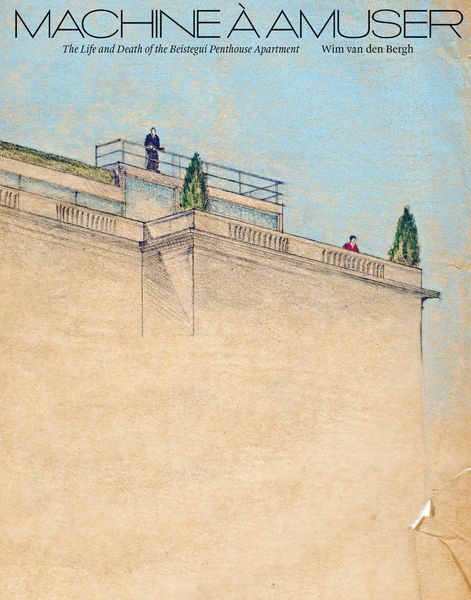
Machine à Amuser The Life and Death of the Beistegui Penthouse Apartment
-
- Englisch ausgewählt
Fr. 102.00
inkl. gesetzl. MwSt.,
Beschreibung
Produktdetails
Einband
Gebundene Ausgabe
Erscheinungsdatum
09.04.2024
Abbildungen
127 color illustrations, 151 b&w ILLU
Verlag
The MIT PressSeitenzahl
380
Maße (L/B/H)
28.4/23/4 cm
Gewicht
1677 g
Sprache
Englisch
ISBN
978-0-262-04877-4
A richly illustrated history of a single building, the celebrated and yet enigmatic penthouse of the wealthy playboy Charles de Beistegui, designed by Le Corbusier and Pierre Jeanneret in late 1920s Paris.
What does it take to build not only a house but a machine for amusement? InMachine à Amuser, Wim van den Bergh chronicles the genesis of the famous penthouse of French-born Mexican millionaire bachelor Charles de Beistegui. The penthouse was planned and constructed by Le Corbusier & Pierre Jeanneret and built on a rooftop site on the Champs-Élysées between 1929–1932. Retracing the evolution of this icon of modern architecture from the initial competition between Gabriel Guevrekian, André Lurçat, and Le Corbusier & Pierre Jeanneret up to the executed version, van den Bergh tells the story of a client’s ambition to build a house devoted to entertaining on one of the most well-heeled streets of Paris.
Machine à Amuseralso examines the cultural milieu of artists and patrons that surrounded Beistegui and which ultimately determined the apartment’s conception and use, including its rococo and surrealist-inspired interior decor. Drawing on a panoply of archival material, van den Bergh narrates the tensions that arose between client and architects as each vied for creative control of the project. As the book shows, while Le Corbusier, with his cousin Pierre Jeanneret, remained the official architects of the penthouse, its famed interior was ultimately designed by the client, Charles de Beistegui. .
An account of a single building beloved by architects and architectural historians,Machine à Amusertells a story that has never been told before. Van den Bergh redresses this lacuna in rich detail, revealing the history of the Beistegui penthouse, the evolution of the project, and its eventual erasure from the roofscapes of Paris.
Kundinnen und Kunden meinen
Verfassen Sie die erste Bewertung zu diesem Artikel
Helfen Sie anderen Kund*innen durch Ihre Meinung