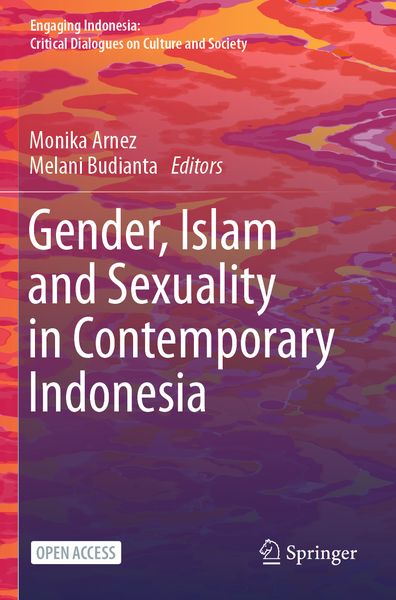
Produktbild: Gender, Islam and Sexuality in Contemporary Indonesia

Gender, Islam and Sexuality in Contemporary Indonesia

Aus der Reihe Engaging Indonesia

Fr. 58.90

inkl. gesetzl. MwSt., Versandkostenfrei


Beschreibung

Produktdetails

Einband

Taschenbuch

Erscheinungsdatum

25.02.2024

Herausgeber

Monika Arnez + weitere

Verlag

Springer Singapore

Seitenzahl

220

Maße (L/B/H)

23.5/15.5/1.4 cm

Auflage

1. Auflage

Sprache

Englisch

ISBN

978-981-9956-61-6

Beschreibung

Rezension


Gender, Islam, and Sexuality
in Contemporary Indonesia presents a valuable critical perspective on the dynamics of Indonesian society with relation to gender, sexuality, and religion. ... Those engaged in the academic study of gender, sociology, anthropology, and Southeast Asian studies would find the book essential to better understand the Indonesian community’s perspectives on gender, sexuality, and Islam.” (Mohammad Bachrul Falah, Journal of the Humanities and Social Sciences of Southeast Asia, Vol. 181 (2-3), September, 2025)


Gender, Islam and Sexuality in Contemporary Indonesia
makes significant contributions to scholarship at the intersection of gender studies, religious studies, and Southeast Asian studies. … Its multi-disciplinary approach – incorporating legal analysis, cultural studies, and ethnography – provides a comprehensive lens through which to examine the socio-political implications of increasing moral regulation… The book is highly recommended for anyone seeking a nuanced and multi-faceted understanding of gender, Islam, and sexuality in contem­porary Indonesia.” (Jing Hua, Gender, Place & Culture, February 23, 2025)

Portrait

Dr. Melani Budianta is a lecturer at the Faculty of Humanities, University of Indonesia. Her research interests tie in with gender and postcolonial studies, comparative literature, and cultural studies. She received her doctorate from Cornell University in 1992. She is an active member of the international journal Inter-Asia Cultural Studies, Routledge, the editorial board on anthology at the Project of American Literature in Asia (PALA), and she holds a position as fellow at Asian Regional Exchange for New Alternatives (ARENA). Several of her research articles have been included in international publications. Two cases in point are “Hijacking Shakespeare; The three faces of Indonesian Julius Caesars”, published in Shakespeare’s Asian Journeys - Critical Encounters, Cultural Geographies, and the Politics of Travel, edited by Bi-qi Beatrice Lei, Judy Celine Ick, amd Poonam Trivedi (2016) and The Dragon Dance: “Shifting Meaning of Chineseness in in Indonesia” in Self and Subject in Motion – Southeast Asian Pacific Cosmopolitans (2007), edited by Kathryn Robinson. Her most recently released article is “Smart Kampung: Doing Cultural Studies in the Global South” (2019), published in the journal Communication and Critical/Cultural Studies.Dr Monika Arnez is an associate professor for Social and Cultural Anthropology and head of the research cluster Anthropology Advancements in the Department of Asian Studies at Univerzita Palackého v Olomouci, Czech Republic. She participated in the Horizon 2020 projects “Competing Regional Integrations in Southeast Asia” (CRISEA; 2017-2021) and “Integration in Southeast Asia: Trajectories of Inclusion, Dynamics of Exclusion” (SEATIDE, 2012-2016). She was an Excellent Researcher in the Sinophone Borderlands project, which was funded by EU Structural Funds. Among her publications are her co-edited books Traditions Redirecting Contemporary Indonesian Cultural Productions (Cambridge Scholars Publishing, 2017; together with Jan van der Putten, Arndt Graf and Edwin Wieringa), and The Role of Religions in the European Perception of Insular and Mainland Southeast Asia: Travel Accounts of the 16th to the 21st Century (Cambridge: Cambridge Scholars Publishing, 2016; together with Jürgen Sarnowsky). On the topic of gender and Islam she published “Dimensions of Morality: The transnational Writers’ Collective” in Bijdragen tot de Taal- Land- en Volkenkunde 172(4): 449-478, together with Eva Nisa, “A Dialogue with God? Islam and lesbian relationships in two Post-Suharto narratives,” in: Susanne Schröter (ed), Gender and Islam in Southeast Asia. Women’s Rights Movements, Religious Resurgence and Local Traditions (Leiden: Brill, 2013), p. 73-94, and “Empowering women through Islam: Fatayat NU between tradition and change” in the Journal of Islamic Studies 21 (1): 59-88, as a single author.   

Produktdetails

Einband

Taschenbuch

Erscheinungsdatum

25.02.2024

Herausgeber

Verlag

Springer Singapore

Seitenzahl

220

Maße (L/B/H)

23.5/15.5/1.4 cm

Auflage

1. Auflage

Sprache

Englisch

ISBN

978-981-9956-61-6

Herstelleradresse

Springer-Verlag KG
Sachsenplatz 4-6
1201 Wien
AT

Email: ProductSafety@springernature.com

Kundinnen und Kunden meinen

0 Bewertungen

Informationen zu Bewertungen

Zur Abgabe einer Bewertung ist eine Anmeldung im Konto notwendig. Die Authentizität der Bewertungen wird von uns nicht überprüft. Wir behalten uns vor, Bewertungstexte, die unseren Richtlinien widersprechen, entsprechend zu kürzen oder zu löschen.

Die Bewertungen sind nach Format, Anzahl Sterne und Datum sortiert.

Verfassen Sie die erste Bewertung zu diesem Artikel

Helfen Sie anderen Kund*innen durch Ihre Meinung

Kundinnen und Kunden meinen

0 Bewertungen filtern

  • Produktbild: Gender, Islam and Sexuality in Contemporary Indonesia
  • Gender, Islam and Sexuality in Contemporary Indonesia: An Overview.- Advocating for Change: Cultural and Institutional Factors of Sexual Violence in Indonesia.- Criminalisation and Care: Indonesian Muslim Mass Organisations’ Perspectives on LGBT People.- On Certification and Beauty: Representations of Halal Cosmetics on YouTube in Indonesia.- Online Halal Dating: AyoPoligami and the Contestations of Polygamy as the “New Normal” in Indonesia.- Fate, Desire, and Shame: Janda in Indonesian Pop Culture.- Can Kartini Be Lesbian? Identity, Gender, and Sexual Orientation in a Post-Suharto Pop Novel.- Satukangeun Lalangsé : Sundanese Sexuality From Behind the Curtain .- Halal Lifestyle.- Shame and Self-Determination