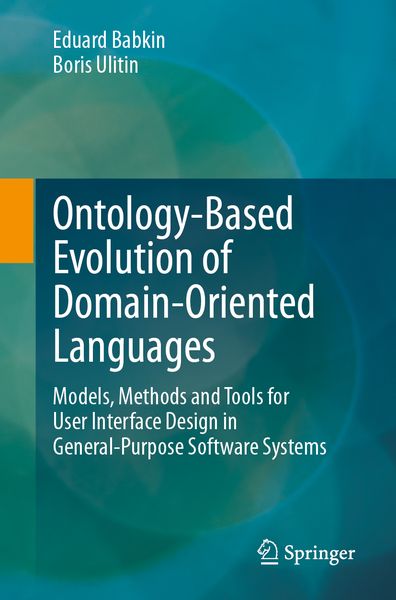
Ontology-Based Evolution of Domain-Oriented Languages Models, Methods and Tools for User Interface Design in General-Purpose Software Systems
-
- Taschenbuch ausgewählt
- eBook
-
Sprache:Englisch
Fr. 149.00
inkl. gesetzl. MwSt.,
Beschreibung
Produktdetails
Einband
Taschenbuch
Erscheinungsdatum
25.11.2023
Verlag
SpringerSeitenzahl
144
Maße (L/B/H)
23.5/15.5/0.9 cm
Gewicht
254 g
Auflage
1st edition 2024
Sprache
Englisch
ISBN
978-3-031-42201-0
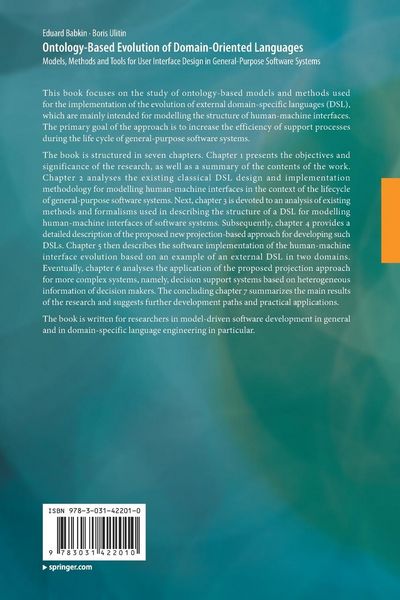
This book focuses on the study of ontology-based models and methods used for the implementation of the evolution of external domain-specific languages (DSL), which are mainly intended for modelling the structure of human-machine interfaces. The primary goal of the approach is to increase the efficiency of support processes during the life cycle of general-purpose software systems.
The book is structured in seven chapters. Chapter 1 presents the objectives and significance of the research, as well as a summary of the contents of the work. Chapter 2 analyses the existing classical DSL design and implementation methodology for modelling human-machine interfaces in the context of the lifecycle of general-purpose software systems. Next, chapter 3 is devoted to an analysis of existing methods and formalisms used in describing the structure of a DSL for modelling human-machine interfaces of software systems. Subsequently, chapter 4 provides a detailed description of the proposed new projection-based approach for developing such DSLs. Chapter 5 then describes the software implementation of the human-machine interface evolution based on an example of an external DSL in two domains. Eventually, chapter 6 analyses the application of the proposed projection approach for more complex systems, namely, decision support systems based on heterogeneous information of decision makers. The concluding chapter 7 summarizes the main results of the research and suggests further development paths and practical applications.
The book is written for researchers in model-driven software development in general and in domain-specific language engineering in particular.
Kundinnen und Kunden meinen
Verfassen Sie die erste Bewertung zu diesem Artikel
Helfen Sie anderen Kund*innen durch Ihre Meinung