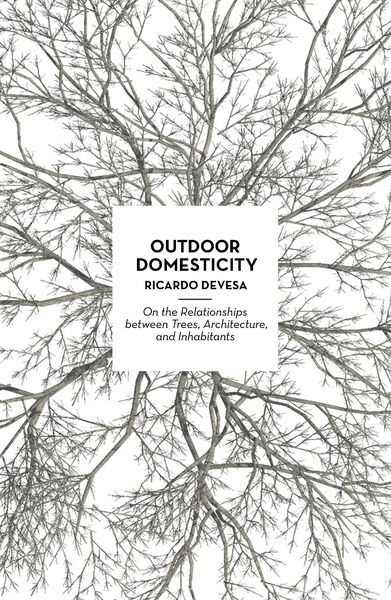
Outdoor Domesticity On the Relationships between Trees, Architecture, and Inhabitants
-
- Taschenbuch
- eBook ausgewählt
-
Form:Einzelkauf Download
-
Sprache:Englisch
Fr. 24.90
inkl. gesetzl. MwSt.Beschreibung
Produktdetails
Format
ePUB
Kopierschutz
Ja
Family Sharing
Nein
Text-to-Speech
Ja
Erscheinungsdatum
04.02.2022
Verlag
Actar DSeitenzahl
240 (Printausgabe)
Dateigröße
111626 KB
Sprache
Englisch
EAN
9781638408345
Trees have been deliberately connected with houses since they were introduced as a prominent part of architectural design. The relationships of contiguity between houses and trees have existed since ancient times. However, at the end of the 19th century those links became explicit in the design process, as the house emerged as one of the fundamental architectural programs, and as the result of an increasing sensibility towards environmental aspects and the landscape.
The first part of this publication is to present a collection of exemplary five houses that evinced explicit relationships with pre-existing trees. The five twentieth century projects are: La Casa (B. Rudofsky, 1969), Cottage Caesar (M. Breuer, 1951), Ville La Roche (Le Corbusier & P. Jeanneret, 1923), Villa Pepa (J. Navarro Baldeweg, 1994) and Hexenhaus (A. & P. Smithson, 1984-2002). The second part of the book contributes three theoretical concerns for the contemporary project, those ones which are established in the process, with respect to time, place and outdoor domesticity in modern western housing.
One of these theoretical contributions establishes that any house located on a site finds a significant place in conjunction with the preexisting trees. The second contribution describes the effects in terms of time, in addition to spatial considerations, which trees can contribute to the architectural project. Finally, the establishment of these connections between architecture and trees enlarges the idea of the house: the tree serves to draw the surrounding environment into the house and, as a result, becomes an intrinsic part of the house itself.
The first part of this publication is to present a collection of exemplary five houses that evinced explicit relationships with pre-existing trees. The five twentieth century projects are: La Casa (B. Rudofsky, 1969), Cottage Caesar (M. Breuer, 1951), Ville La Roche (Le Corbusier & P. Jeanneret, 1923), Villa Pepa (J. Navarro Baldeweg, 1994) and Hexenhaus (A. & P. Smithson, 1984-2002). The second part of the book contributes three theoretical concerns for the contemporary project, those ones which are established in the process, with respect to time, place and outdoor domesticity in modern western housing.
One of these theoretical contributions establishes that any house located on a site finds a significant place in conjunction with the preexisting trees. The second contribution describes the effects in terms of time, in addition to spatial considerations, which trees can contribute to the architectural project. Finally, the establishment of these connections between architecture and trees enlarges the idea of the house: the tree serves to draw the surrounding environment into the house and, as a result, becomes an intrinsic part of the house itself.
Kundinnen und Kunden meinen
Verfassen Sie die erste Bewertung zu diesem Artikel
Helfen Sie anderen Kund*innen durch Ihre Meinung