Gutscheinbedingungen

*Gültig bis 07.06.2026 auf (fast) alles. Ausgeschlossen sind Smartboxen, Zeitschriften, Tickets, Lebensmittel, Gaming-Elektroartikel, Tinte/Toner, Gutscheine, Geschenkkarten, Blumen und Abos | Einlösbar in allen Buchhandlungen von Orell Füssli, Barth Bücher, Buchladen Rapunzel, Schuler Orell Füssli, Stauffacher und ZAP unter Vorweisung des Gutscheins, auf www.orellfüssli.ch durch Eingabe des Gutscheincodes. Beim Service „eBooks verschenken“ und bei eBook-Käufen via eReader nicht einlösbar | Mindesteinkaufswert: Fr. 100.- | Nicht mit anderen Rabatten kumulierbar.

  • Produktbild: Science, Technology, Engineering, Arts, and Mathematics (STEAM) Education in the Early Years
  • Produktbild: Science, Technology, Engineering, Arts, and Mathematics (STEAM) Education in the Early Years

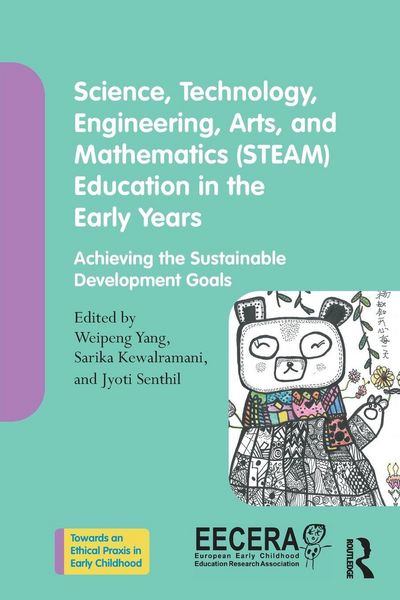
Science, Technology, Engineering, Arts, and Mathematics (STEAM) Education in the Early Years Achieving the Sustainable Development Goals

Fr. 69.90

inkl. gesetzl. MwSt., Versandkostenfrei


Beschreibung

Produktdetails

Einband

Taschenbuch

Erscheinungsdatum

05.12.2023

Abbildungen

schwarz-weiss Illustrationen, Raster, schwarz-weiss, Zeichnungen, schwarz-weiss, Tabellen, schwarz-weiss

Herausgeber

Weipeng Yang + weitere

Verlag

Taylor & Francis

Seitenzahl

294

Maße (L/B/H)

23.4/15.6/1.6 cm

Gewicht

453 g

Sprache

Englisch

ISBN

978-1-03-240568-1

Beschreibung

Rezension

Andreas Schleicher - Director for the Directorate of Education and Skills, OECD

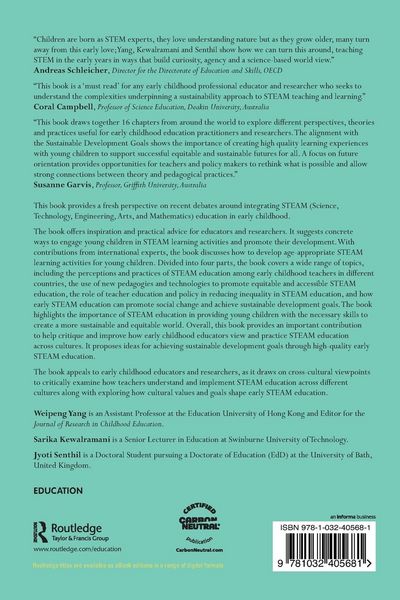
Children are born as STEM experts, they love understanding nature, to try things out and test ideas, and to figure out cause and effect. But as they grow older, many turn away from this early love, experiencing the STEM subjects in school as an abstract world of formulas and equations that is unrelated to their lives and dreams, quickly memorised and then forgotten. Yang, Kewalramani and Senthil show how we can turn this around, teaching STEM in the early years in ways that build curiosity, agency and a science-based world view. This is not just about the next generation of engineers, it is about citizens who share an evidence-based reality and who take responsible decisions for themselves, for others and for the planet.


Philip Hui Li - Chair Professor and Dean of Shanghai Institute of Early Childhood Education, Shanghai Normal University, China

This book provides a comprehensive overview of the cutting-edge state of STEAM education in early childhood settings with practical examples and effective strategies. It covers a wide range of topics, including teacher perceptions and practices, the role of new pedagogies and technologies, equity and inclusion, teacher education and policy, and achieving sustainable development goals. The diverse global perspectives and enriched international experiences make this book an essential read for anyone interested in promoting STEAM education for young children. The editors, Weipeng Yang, Sarika Kewalramani, and Jyoti Senthil, have brought together an incredible group of contributors to create a timely and valuable resource for educators, policymakers, and researchers alike.


Coral Campbell - Professor of Science Education, Deakin University, Australia

In recent years, two very strong focuses have emerged that impact the world - the need for STEM capabilities and the development of sustainable futures. If we are to have a prosperous, equitable future, we need to cultivate a futures-oriented approach to learning that involves young children. In the area of early childhood education, STEAM education has been expanding to provide young children with a means to contribute as active participants in their learning. Children also have a role in sustaining a viable environmental future. Young children will need to manage the sustainability issues of the future, with STEAM skills and knowledge. This book is a valuable contribution to the field as it successfully brings together recent relevant research from across the globe. Using a structured approach to identify the issues and successes in STEAM education for sustainability, this book is a 'must read' for any early childhood professional educator and researcher who seeks to understand the complexities underpinning a sustainability approach to STEAM teaching and learning. It is a significant contribution to the field.

Professor Susanne Garvis, Griffith University

This book draws together 16 chapters from around the world to explore different perspectives, theories and practices useful for early childhood education practitioners and researchers. The alignment with the Sustainable Development Goals shows the importance of creating high quality learning experiences with young children to support successful equitable and sustainable futures for all. A focus on future orientation provides opportunities for teachers and policy makers to rethink what is possible and allow strong connections between theory and pedagogical practices.

Produktdetails

Einband

Taschenbuch

Erscheinungsdatum

05.12.2023

Abbildungen

schwarz-weiss Illustrationen, Raster, schwarz-weiss, Zeichnungen, schwarz-weiss, Tabellen, schwarz-weiss

Herausgeber

Verlag

Taylor & Francis

Seitenzahl

294

Maße (L/B/H)

23.4/15.6/1.6 cm

Gewicht

453 g

Sprache

Englisch

ISBN

978-1-03-240568-1

Herstelleradresse

Libri GmbH
Europaallee 1
36244 Bad Hersfeld
DE

Email: gpsr@libri.de

Kundinnen und Kunden meinen

0 Bewertungen

Informationen zu Bewertungen

Zur Abgabe einer Bewertung ist eine Anmeldung im Konto notwendig. Die Authentizität der Bewertungen wird von uns nicht überprüft. Wir behalten uns vor, Bewertungstexte, die unseren Richtlinien widersprechen, entsprechend zu kürzen oder zu löschen.

Die Bewertungen sind nach Format, Anzahl Sterne und Datum sortiert.

Verfassen Sie die erste Bewertung zu diesem Artikel

Helfen Sie anderen Kund*innen durch Ihre Meinung

Kundinnen und Kunden meinen

0 Bewertungen filtern

Die Leseprobe wird geladen.
  • Produktbild: Science, Technology, Engineering, Arts, and Mathematics (STEAM) Education in the Early Years
  • Produktbild: Science, Technology, Engineering, Arts, and Mathematics (STEAM) Education in the Early Years
  • 1. From STEM to STEAM: Creating A More Sustainable and Equitable World for Young Children Part 1. The Microsystem: How Early Childhood Teachers Perceive and Practice STEAM - Inequality within and across Countries? 2. Understanding the Dynamic Process of Integrating and Navigating STEAM in Australian Early Childhood Education 3. A Chinese Style of STEM Inquiry? The Discourse of Inquiry-Based STEM Education among Chinese Early Childhood Practitioners 4. STEAM and Sustainable Development Challenges in Early Childhood Education: Estonian Preschool Teachers’ Views and Practices 5. Towards the Sustainable Development Goals: STEAM Education Beliefs and Practices in Turkish Preschools 6. STEAM Education in Preschools in Hanoi, Vietnam: Teachers’ Beliefs About the Learning Environment and Challenges in Teaching Part 2. The Mesosystem: Higher-Order Effects from New Pedagogies and Technologies for Promoting Quality and Accessible STEAM Education 7. Learning STEAM Content Via Arts-Based Hands-On Activities 8. “But Then I Am the Robot’s Brain!”: Children’s and Preschool Teachers’ Communication During STEM Teaching Scaffolded by Digital Tools 9. Equity and Inclusion Through STEAM Play in Early Childhood Education: Culturally Valued Play-Based Practices 10. “Because Every Kid Can Think Like A Scientist”: Reflecting South-African Children’s Voices on Being Scientists and Engineers Based on Their STEAM Experience Part 3. The Exosystem: The Role of Teacher Education and Policy in Early STEAM Education to Reduce Inequality 11. Early Childhood Teachers Becoming Makers Themselves Before Teaching Young Children the Value of Making 12. Saudi Early Childhood Female Teachers’ Perceptions of Children’s Gender Stereotypes When Implementing STEM 13. Early Childhood Teacher Agency and Creative Insubordination Through STEAM Learning Part 4. The Macrosystem: Achieving Sustainable Development Goals Through Early STEAM Education to Promote Social Change 14. The Design of the Curriculum for Sustainability and Climate Education in the Early Years 15. Children as Inventors of Sustainable Future: Imagination-Driven Approach to Early STEAM Education 16. STEAM Activities to Advance SDG4 in the Early Years by Making Items from Recycled Materials 17. “It’s Not a Challenge, It’s an Opportunity”: Empowering Children to Create a Sustainable Future 18. Challenges and Opportunities in STEAM Education in the Early Years Against the Global Move Towards a Sustainable Future