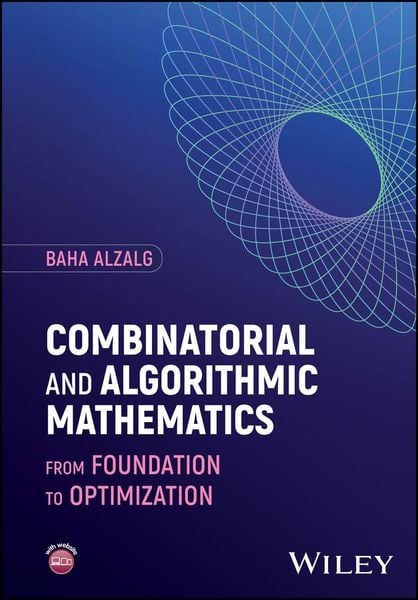
Combinatorial and Algorithmic Mathematics From Foundation to Optimization
-
- Englisch ausgewählt
Fr. 153.00
inkl. gesetzl. MwSt.,
Beschreibung
Produktdetails
Einband
Gebundene Ausgabe
Erscheinungsdatum
29.07.2024
Verlag
WileySeitenzahl
528
Maße (L/B/H)
24.9/17/3.4 cm
Gewicht
1142 g
Sprache
Englisch
ISBN
978-1-394-23594-0
Detailed review of optimization from first principles, supported by rigorous math and computer science explanations and various learning aids
Supported by rigorous math and computer science foundations, Combinatorial and Algorithmic Mathematics: From Foundation to Optimization provides a from-scratch understanding to the field of optimization, discussing 70 algorithms with roughly 220 illustrative examples, 160 nontrivial end-of-chapter exercises with complete solutions to ensure readers can apply appropriate theories, principles, and concepts when required, and Matlab codes that solve some specific problems. This book helps readers to develop mathematical maturity, including skills such as handling increasingly abstract ideas, recognizing mathematical patterns, and generalizing from specific examples to broad concepts.
Starting from first principles of mathematical logic, set-theoretic structures, and analytic and algebraic structures, this book covers both combinatorics and algorithms in separate sections, then brings the material together in a final section on optimization. This book focuses on topics essential for anyone wanting to develop and apply their understanding of optimization to areas such as data structures, algorithms, artificial intelligence, machine learning, data science, computer systems, networks, and computer security.
Combinatorial and Algorithmic Mathematics includes discussion on:
- Propositional logic and predicate logic, set-theoretic structures such as sets, relations, and functions, and basic analytic and algebraic structures such as sequences, series, subspaces, convex structures, and polyhedra
- Recurrence-solving techniques, counting methods, permutations, combinations, arrangements of objects and sets, and graph basics and properties
- Asymptotic notations, techniques for analyzing algorithms, and computational complexity of various algorithms
- Linear optimization and its geometry and duality, simplex and non-simplex algorithms for linear optimization, second-order cone programming, and semidefinite programming
Combinatorial and Algorithmic Mathematics is an ideal textbook resource on the subject for students studying discrete structures, combinatorics, algorithms, and optimization. It also caters to scientists across diverse disciplines that incorporate algorithms and academics and researchers who wish to better understand some modern optimization methodologies.
Kundinnen und Kunden meinen
Verfassen Sie die erste Bewertung zu diesem Artikel
Helfen Sie anderen Kund*innen durch Ihre Meinung