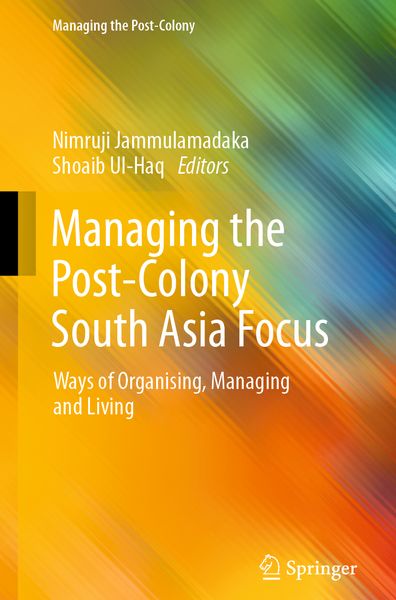
Managing the Post-Colony South Asia Focus Ways of Organising, Managing and Living
-
- Hardcover
- Taschenbuch ausgewählt
- eBook
-
Sprache:Englisch
Fr. 209.00
inkl. gesetzl. MwSt.,
Beschreibung
Produktdetails
Einband
Taschenbuch
Erscheinungsdatum
20.08.2023
Herausgeber
Nimruji Jammulamadaka + weitereVerlag
Springer SingaporeSeitenzahl
289
Maße (L/B/H)
23.5/15.5/1.8 cm
Auflage
1st ed. 2022
Sprache
Englisch
ISBN
978-981-19-2990-8
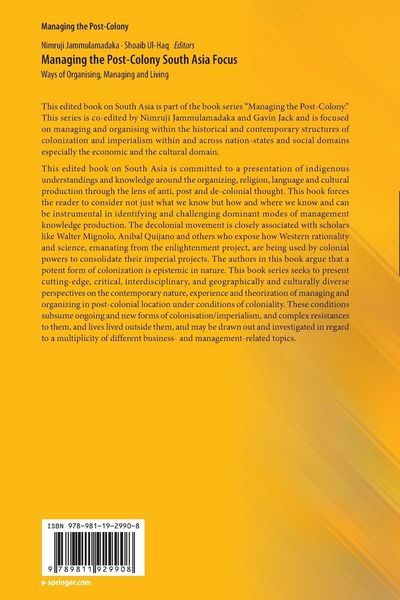
This edited book on South Asia is part of the book series “Managing the Post-colony.” This series is co-edited by Nimruji Jammulamadaka and Gavin Jack and is focused on managing and organising within the historical and contemporary structures of colonization and imperialism within and across nation-states and social domains especially the economic and the cultural domain.
This edited book on South Asia is committed to a presentation of indigenous understandings and knowledge around the organizing, religion, language and cultural production through the lens of anti, post and de-colonial thought. This book forces the reader to consider not just what we know but how and where we know and can be instrumental in identifying and challenging dominant modes of management knowledge production. The decolonial movement is closely associated with scholars like Walter Mignolo, Anibal Quijano and others who expose how Western rationality and science, emanating from the enlightenmentproject, are being used by colonial powers to consolidate their imperial projects. The authors in this book argue that a potent form of colonization is epistemic in nature. This book series seeks to present cutting-edge, critical, interdisciplinary, and geographically and culturally diverse perspectives on the contemporary nature, experience and theorization of managing and organizing in post-colonial location under conditions of coloniality. These conditions subsume ongoing and new forms of colonisation/imperialism, and complex resistances to them, and lives lived outside them, and may be drawn out and investigated in regard to a multiplicity of different business- and management-related topics.
The power of domination is its ability to silence other ways of knowing, being and doing. Focus on South Asi a: Ways of Managing, Organising and Living delivers a profound critique of Western management theory and its universalistic claims. But, it goes much furtherto advance other managements and ways of organising from the peoples and communities of South Asia.
Stella M. Nkomo, University of Pretoria, South Africa
I like very much the orientation and the composition of the volume…you have a) the meaning of management in the West changed after the Industrial revolution and by 1900 became a political issue domestically in the US and before that colonial, as you show in the colonial context of South Asia; b) so the constitution of the settler management as you show with McCaulay, destituted all existing local form of organizing their praxis of living; c) the task now is the reconstitution of the destituted, the pluriversal human (and animals too) self-organization subjected to Western regulations to their own benefit, while materializing their rhetoric of racial destitution (incapable of organizing like us, impossible for them to be like, us we have to teach them civilization, etc.).
Walter Mignolo, William H. Wannamaker Professor of Literature and Romance Studies at Duke University, USA
Very Impressive and Much Needed
Pushkala Prasad, Zankel Chair Professor, Skidmore College.
Kundinnen und Kunden meinen
Verfassen Sie die erste Bewertung zu diesem Artikel
Helfen Sie anderen Kund*innen durch Ihre Meinung