Gutscheinbedingungen

*Gültig bis 07.06.2026 auf (fast) alles. Ausgeschlossen sind Smartboxen, Zeitschriften, Tickets, Lebensmittel, Gaming-Elektroartikel, Tinte/Toner, Gutscheine, Geschenkkarten, Blumen und Abos | Einlösbar in allen Buchhandlungen von Orell Füssli, Barth Bücher, Buchladen Rapunzel, Schuler Orell Füssli, Stauffacher und ZAP unter Vorweisung des Gutscheins, auf www.orellfüssli.ch durch Eingabe des Gutscheincodes. Beim Service „eBooks verschenken“ und bei eBook-Käufen via eReader nicht einlösbar | Mindesteinkaufswert: Fr. 100.- | Nicht mit anderen Rabatten kumulierbar.

  • Produktbild: Textile Wastewater Treatment
  • Produktbild: Textile Wastewater Treatment

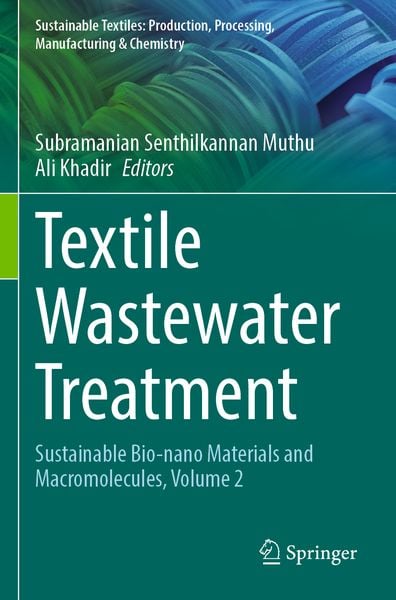
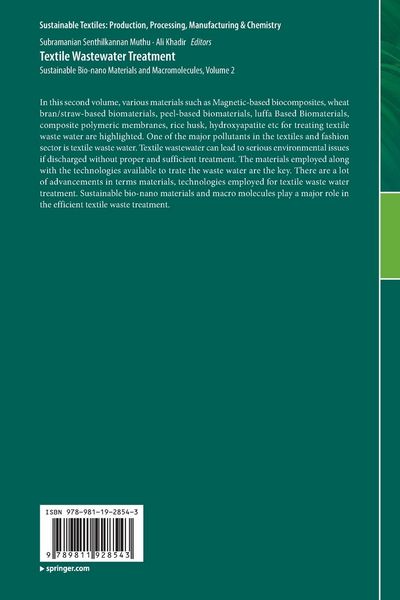
Textile Wastewater Treatment Sustainable Bio-nano Materials and Macromolecules, Volume 2

Fr. 137.00

inkl. gesetzl. MwSt., Versandkostenfrei


Beschreibung

Produktdetails

Einband

Taschenbuch

Erscheinungsdatum

20.08.2023

Herausgeber

Subramanian Senthilkannan Muthu + weitere

Verlag

Springer Singapore

Seitenzahl

272

Maße (L/B/H)

23.5/15.5/1.6 cm

Gewicht

429 g

Auflage

1st ed. 2022

Sprache

Englisch

ISBN

978-981-19-2854-3

Beschreibung

Portrait

Dr. Subramanian Senthilkannan Muthu  currently works for SgT Group as Head of Sustainability, and is based out of Hong Kong. He earned his PhD from The Hong Kong Polytechnic University, and is a renowned expert in the areas of Environmental Sustainability in Textiles & Clothing Supply Chain, Product Life Cycle Assessment (LCA) and Product Carbon Footprint Assessment (PCF) in various industrial sectors. He has five years of industrial experience in textile manufacturing, research and development and textile testing and over a decade's of experience in life cycle assessment (LCA), carbon and ecological footprints assessment of various consumer products. He has published more than 100 research publications, written numerous book chapters and authored/edited over 100 books in the areas of Carbon Footprint, Recycling, Environmental Assessment and Environmental Sustainability. 

Ali Khadir  is an environmental engineer and a member of the Young Researcher and Elite Club, Islamic Azad University of Shahre Rey Branch, Tehran, Iran. He has published several articles and book chapters in reputed international publishers. He also has been the reviewer of journals and international conferences. His research interests center on emerging pollutants, dyes, and pharmaceuticals in aquatic media, advanced water and wastewater remediation techniques and technology.

Produktdetails

Einband

Taschenbuch

Erscheinungsdatum

20.08.2023

Herausgeber

Verlag

Springer Singapore

Seitenzahl

272

Maße (L/B/H)

23.5/15.5/1.6 cm

Gewicht

429 g

Auflage

1st ed. 2022

Sprache

Englisch

ISBN

978-981-19-2854-3

Herstelleradresse

Springer-Verlag KG
Sachsenplatz 4-6
1201 Wien
AT

Email: ProductSafety@springernature.com

Kundinnen und Kunden meinen

0 Bewertungen

Informationen zu Bewertungen

Zur Abgabe einer Bewertung ist eine Anmeldung im Konto notwendig. Die Authentizität der Bewertungen wird von uns nicht überprüft. Wir behalten uns vor, Bewertungstexte, die unseren Richtlinien widersprechen, entsprechend zu kürzen oder zu löschen.

Die Bewertungen sind nach Format, Anzahl Sterne und Datum sortiert.

Verfassen Sie die erste Bewertung zu diesem Artikel

Helfen Sie anderen Kund*innen durch Ihre Meinung

Kundinnen und Kunden meinen

0 Bewertungen filtern

  • Produktbild: Textile Wastewater Treatment
  • Produktbild: Textile Wastewater Treatment
  • Treatment of textile wastewater by nanoparticles.- Magnetic-based biocomposites in dye adsorption.- Application of wheat bran/straw-based biomaterials in textile wastewater.- Application of peel-based biomaterials in textile wastewater.- Applications of Luffa Based Biomaterials in Textile Wastewater.- Recent Trends in Textile Wastewater Treatment using Agricultural Waste.- Application of Agricultural Waste in Anionic Dyes Removal from Wastewater.- Application of Composite Polymeric Membranes in Textile Wastewater.- Chitosan and Chitosan-based Nanocomposite Membranes in the Removal of Synthetic Dye from Effluent Wastewaters.- Application of Biobased and Inorganic Composite Materials to Remove Heavy Metals from Textile Effluent.- Potential of pyrolysis biochar as an eco-friendly biosorbent for dye removal from industrial wastewaters.- Application of Rice Husk-Based Biomaterial in Textile Wastewater Treatment.- Application of Hydroxyapatite in Textile Wastewater.