• Produktbild: Introduction to Enzyme Technology
  • Produktbild: Introduction to Enzyme Technology

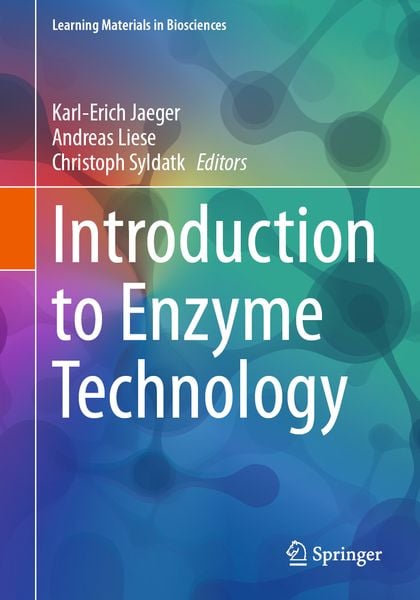
Introduction to Enzyme Technology

Fr. 120.00

inkl. gesetzl. MwSt., Versandkostenfrei


Beschreibung

Produktdetails

Einband

Taschenbuch

Erscheinungsdatum

22.03.2024

Abbildungen

VI, 114 illus., 111 illus. in color., farbige Illustrationen, schwarz-weiss Illustrationen

Herausgeber

Karl-Erich Jaeger + weitere

Verlag

Springer

Seitenzahl

472

Maße (L/B/H)

24/16.8/2.6 cm

Gewicht

798 g

Originaltitel

Einführung in die Enzymtechnologie

Sprache

Englisch

ISBN

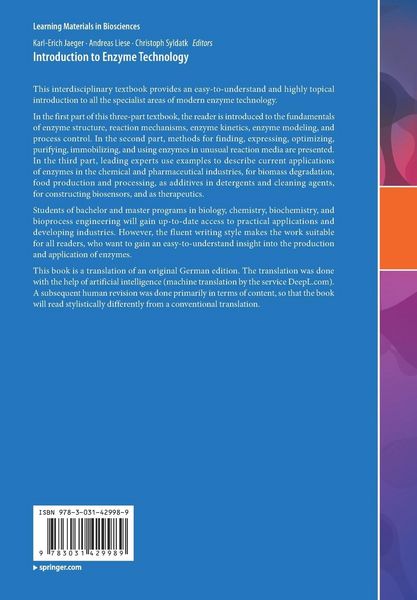
978-3-031-42998-9

Beschreibung

Portrait

Prof. Dr. Karl-Erich Jaeger  studied biology and chemistry and obtained a Ph.D. in microbiology at Ruhr-University Bochum, Germany. From 1988–1989, he worked as a postdoc with Prof. Dr. Robert E.W. Hancock at the Department of Microbiology, University of British Columbia, Vancouver, B.C., Canada. In 2002, he declined a call as Head of the Institute of Microbiology at the University of Stuttgart, Germany, and accepted the position of a full professor at Heinrich Heine University Düsseldorf and director of the Institute of Molecular Enzyme Technology at Forschungszentrum Jülich, Germany. In 2013, he was additionally appointed as director at the Institute of Bio- and Geosciences IBG-1: Biotechnology of the Forschungszentrum Jülich GmbH which belongs to the German Helmholtz Association. Karl-Erich Jaeger is co-founder of the biotech company Evocatal GmbH (now Evoxx Technologies) and served as chairman of the supervisory board from 2007 to 2017. He has published more than 250 peer-reviewed research papers and 17 patent applications; is an editorial board member of several scientific journals and serves as vice-president of the Cluster of Industrial Biotechnology – CLIB. His research interests are focused on bacterial enzymes and fluorescent proteins, their identification, biochemical and structural characterization, and biotechnological applications.

Prof. Dr. Andreas Liese  studied chemistry and carried out his doctoral research at the Research Center Jülich, Germany. He received his Ph.D. from the University of Bonn in 1998. From 1998 to 2003, Liese was an assistant professor at the University of Bonn and at the same time head of the Enzyme Group at the Institute of Biotechnology II (Prof. Dr. C. Wandrey) within the Research Center Jülich. After a sabbatical in 2000 at Pfizer Global Research & Development, San Diego, USA, he worked as an associate professor at the University of Münster from 2003 to 2004. In 2004 he was appointed as full professor for Technical Biocatalysis 2004 at the Hamburg University of Technology (TUHH), Germany, as the director of the Institute of Technical Biocatalysis. He is an elected member of the German Academy of Engineering Sciences – acatech. His research focuses on fundamental and applied aspects of technical biocatalysis, including process-analytical technologies, multiphase systems, chemo- and electroenzymatic reaction sequences, and environmental biotechnology. He and his team are unifying these concepts with the development of technologies to establish smart reactors. In addition, his team is active in STEM (Science, Technology, Engineering, and Mathematics) motivation/education of pupils with various programs.

Prof. Dr. Christoph Syldatk  studied biology at the Technical University (TU) of Braunschweig/Germany. After receiving his Ph.D. in 1984 he became an assistant professor at the Institute of Biochemistry and Biotechnology and head of the newly formed research group "Regio- and Stereoselective Bioconversions". In 1990 he received his  Venia Legendi  for Biochemistry and Biotechnology and worked as a lecturer at the Institute of Biochemistry and Biotechnology of the TU Braunschweig/Germany from 1991 - 1993 funded by a Heisenberg scholarship of the German Research Foundation (DFG). In 1993, he became a full professor at the Institute of Biochemical Engineering of the University of Stuttgart/Germany and in 2003, he accepted a call to become a full professor of Technical Biology at the Institute of Process Engineering in Life Sciences at the Karlsruhe Institute of Technology (KIT). For many years, Prof. Syldatk has been an active member of the DECHEMA (Society for Chemical Engineering and Biotechnology) and the VAAM (Association for General and Applied Microbiology). His main research interests are in industrial microbiology, enzyme technology, the production of biosurfactants, unusual enantiopure amino acids, and single-cell oils. Prof. Syldatk is the author and co-author of more than 200 peer-reviewed publications and 20 patent applications. Since April 2023, Prof. Syldatk has been an active retired Professor at KIT.


Produktdetails

Einband

Taschenbuch

Erscheinungsdatum

22.03.2024

Abbildungen

VI, 114 illus., 111 illus. in color., farbige Illustrationen, schwarz-weiss Illustrationen

Herausgeber

Verlag

Springer

Seitenzahl

472

Maße (L/B/H)

24/16.8/2.6 cm

Gewicht

798 g

Originaltitel

Einführung in die Enzymtechnologie

Sprache

Englisch

ISBN

978-3-031-42998-9

Herstelleradresse

Springer-Verlag KG
Sachsenplatz 4-6
1201 Wien
AT

Email: ProductSafety@springernature.com

Kundinnen und Kunden meinen

0 Bewertungen

Informationen zu Bewertungen

Zur Abgabe einer Bewertung ist eine Anmeldung im Konto notwendig. Die Authentizität der Bewertungen wird von uns nicht überprüft. Wir behalten uns vor, Bewertungstexte, die unseren Richtlinien widersprechen, entsprechend zu kürzen oder zu löschen.

Die Bewertungen sind nach Format, Anzahl Sterne und Datum sortiert.

Verfassen Sie die erste Bewertung zu diesem Artikel

Helfen Sie anderen Kund*innen durch Ihre Meinung

Kundinnen und Kunden meinen

0 Bewertungen filtern

  • Produktbild: Introduction to Enzyme Technology
  • Produktbild: Introduction to Enzyme Technology
  • Chapter 1. Introduction to enzyme technology.- Chapter 2. Enzyme structure and function.- Chapter 3. Enzyme modelling: from the sequence to the substrate complex.- Chapter 4. Enzyme kinetics.- Chapter 5. Enzyme reactors and process control.- Chapter 6. Enzyme identification and screening: activity-based methods.- Chapter 7. Bioinformatic methods for enzyme identification.- Chapter 8. Optimization of enzymes.- Chapter 9. Enzyme production.- Chapter 10. Enzyme purification.- Chapter 11. Enzyme immobilization.- Chapter 12. Enzymatic reactions in unusual reaction media.- Chapter 13. Principles of applied biocatalysis.- Chapter 14. Enzymes in the chemical and pharmaceutical industry.- Chapter 15. Enzymes for the degradation of biomass.- Chapter 16. Enzymes in food production.- Chapter 17. Enzymes in detergents and cleaning agents.- Chapter 18. Enzymes and biosensor technology.- Chapter 19. Therapeutic enzymes.- Chapter 20. Enzymes in molecular biotechnology.