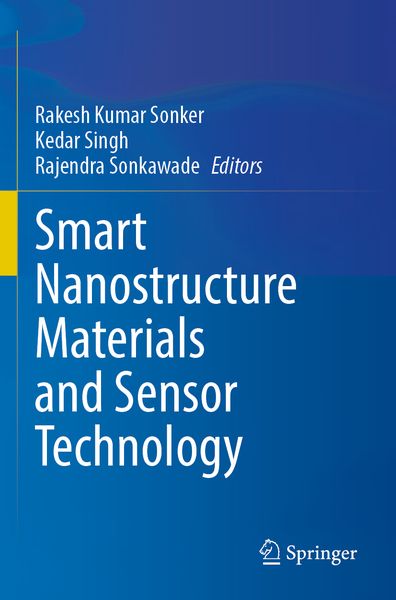
Produktbild: Smart Nanostructure Materials and Sensor Technology

Smart Nanostructure Materials and Sensor Technology

Fr. 137.00

inkl. gesetzl. MwSt., Versandkostenfrei


Beschreibung

Produktdetails

Einband

Taschenbuch

Erscheinungsdatum

27.08.2023

Herausgeber

Rakesh Kumar Sonker + weitere

Verlag

Springer Singapore

Seitenzahl

307

Maße (L/B/H)

23.5/15.5/1.7 cm

Auflage

1st ed. 2022

Sprache

Englisch

ISBN

978-981-19-2687-7

Beschreibung

Portrait

Dr. Rakesh Kumar Sonker received his Ph.D.  from the Department of Applied Physics, Babasaheb Bhimrao Ambedkar University, Lucknow, India. Currently, he is Assistant Professor in the Department of Physics, Acharya Narendra Dev College, University of Delhi, India. His research areas include the synthesis of functional 2D/3D nanomaterial, metal oxides nanoparticles, nanoporous materials, metallopolymers, etc., characterizations and their energy storage device and sensor applications.

Prof. Kedar Singh received his Ph.D. degree in Physics 2003, from the University of Rajasthan, Jaipur, India. Subsequently he joined the Department of Physics, Institute of Science, Banaras Hindu University, Varanasi, as Assistant Professor. Presently he is Professor of Physics, School of Physical Sciences, Jawaharlal Nehru University, Delhi, India. Dr. Singh was selected in 2013 for Raman fellow for Post-Doctoral Studies in Florida, USA and also, he was selected in 2008 for BOYSCAST fellow at Florida State University, USA. His current research interests are in Condensed Matter Physics: Magnetic Nano Material, Thermoelectric Materials and semiconducting thin films, gas/ bio sensors, DMS-Quantum dots, Core-Shell materials, Plasmonic Nanocrystals, Chalcogenide glasses and their nano composites applications etc. He has published 130 research papers in reputed journals and supervised 10 Ph.D. thesis.

Prof. Rajendra Sonkawade received his Ph.D. degrees in Physics 2006, from the Hemwati Nandan Bahuguna University, Srinagar (Garhwal), Uttarakhand, India. Subsequently, he worked at Inter University Accelerator Centre (formerly Nuclear Science Centre), New Delhi research centre of UGC, New Delhi, under MHRD, Government of India, for around 18 years as Senior Scientist. He has also worked as Professor at Department of Applied Physics, Babasaheb Bhimrao Ambedkar University (Central University), Lucknow, India. Presently, he is working as Professor at theDepartment of Physics, Shivaji University, Kolhapur, Maharashtra, India. He is a recipient of Visiting Scientist status from Japan Society for Promotion of Sciences (JSPS). His current research interests are in metal oxide thin films and nanostructures for gas sensing radiation physics, supercapacitor and polymer science, etc.

Produktdetails

Einband

Taschenbuch

Erscheinungsdatum

27.08.2023

Herausgeber

Verlag

Springer Singapore

Seitenzahl

307

Maße (L/B/H)

23.5/15.5/1.7 cm

Auflage

1st ed. 2022

Sprache

Englisch

ISBN

978-981-19-2687-7

Herstelleradresse

Springer-Verlag KG
Sachsenplatz 4-6
1201 Wien
AT

Email: ProductSafety@springernature.com

Kundinnen und Kunden meinen

0 Bewertungen

Informationen zu Bewertungen

Zur Abgabe einer Bewertung ist eine Anmeldung im Konto notwendig. Die Authentizität der Bewertungen wird von uns nicht überprüft. Wir behalten uns vor, Bewertungstexte, die unseren Richtlinien widersprechen, entsprechend zu kürzen oder zu löschen.

Die Bewertungen sind nach Format, Anzahl Sterne und Datum sortiert.

Verfassen Sie die erste Bewertung zu diesem Artikel

Helfen Sie anderen Kund*innen durch Ihre Meinung

Kundinnen und Kunden meinen

0 Bewertungen filtern

  • Produktbild: Smart Nanostructure Materials and Sensor Technology
  • Chapter 1 - Smart Nanomaterials and sensing devices: An Introduction.- Chapter 2 - Fundamental’s nanomaterials and design concepts for sensing devices .- Chapter 3 - General methods for fabrication of sensing devices .- Chapter 4 - Functional nanomaterials for sensing devices .- Chapter 5 - Micro-and nano-fibers -based sensing devices .- Chapter 6 - Environmental impact of sensing devices .- Chapter 7 - Advanced carbon-based gas sensors .- Chapter 8 - 2D/3D materials for gas sensors.- Chapter 9 - Gas sensors based on metal oxides.- Chapter 10 - Gas sensors based on chalcogenides.- Chapter 11 - Metal-organic frameworks for gas sensors.- Chapter 12 - Perovskite based gas sensors.- Chapter 13 - Gas sensors based on hybrid nanomaterial.- Chapter 14 - Gas sensor based on Ferrite materials.