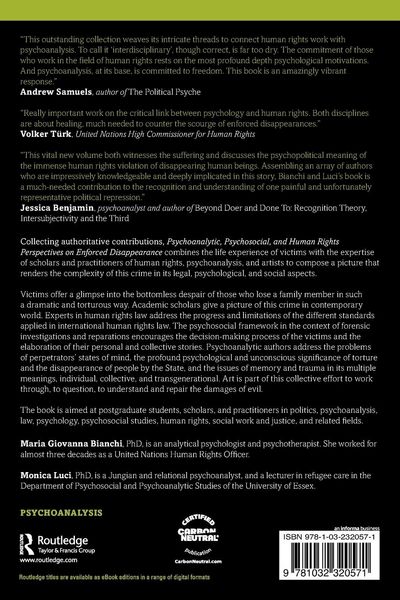
"This outstanding collection weaves its intricate threads to connect human rights work with psychoanalysis. To call it 'interdisciplinary', though correct, is far too dry. The commitment of those who work in the field of human rights rests on the most profound depth psychological motivations. And psychoanalysis, at its base, is committed to freedom. The crime of enforced disappearance presents a challenge at every level. This book is an amazingly vibrant response."
Andrew Samuels, author of The Political Psyche
"Really important work on the critical link between psychology and human rights. Both disciplines are about healing, much needed to counter the scourge of enforced disappearances."
Volker Türk, United Nations High Commissioner for Human Rights
"This vital new volume both witnesses the suffering and discusses the psychopolitical meaning of the immense human rights violation of disappearing human beings. Assembling an array of authors who are impressively knowledgeable and deeply implicated in this story, Bianchi and Luci's book is a much-needed contribution to the recognition and understanding of one painful and unfortunately representative recent and contemporary political repression."
Jessica Benjamin, psychoanalyst and author of Beyond Doer and Done To: Recognition Theory, Intersubjectivity and the Third
"In the 1970s, mothers and grandmothers in Argentina looked for the disappeared, fought for the right to the truth, and obtained the adoption of the International Convention. This book, in a profound juridical and psychological analysis of enforced disappearances, shows the sophistication needed to address, from the point of view of victims, relatives, perpetrators, lawyers, and psychotherapists, a crime that unfortunately is still being committed in many countries of the world."
Federico Villegas, former President of the Human Rights Council, Ambassador of Argentina to the United Nations
"A stunning achievement, Maria Giovanna Bianchi and Monica Luci have created a multidisciplinary depiction of the human cost of state and non-state policies of forced disappearance. This much-needed volume brings together legal theory, human rights assessments, personal testimonial accounts and psycho-social/psychoanalytic perspectives to illuminate the complex meanings for us all of living in political cultures in which forced disappearance is practiced as a strategy to control and intimidate specific groups or entire populations. The book's authors explore the frozen mourning process among those whose loved ones are disappeared as well as the psychological cost to people when existential anxieties of the unknown and unpredictable are transformed into real politically-organized policies of threat. This single volume is a precious gift to those interested in understanding the complex convergences between the social and the psyche in the context of the traumatogenic human rights violation of forced disappearance."
Nancy Caro Hollander, author, Uprooted Minds: A Social Psychoanalysis for Precarious Times (Routledge, 2023)
"This pioneering volume is most welcome not only for highlighting a relatively neglected topic and for attempting to view it from a variety of different perspectives, but also for grappling with a unique form of 'involuntary dislocation', where the tyrannical presence of the absence of loved ones creates complexities of human experiences and judicial investigations that are extremely difficult to grasp and to pursue."
Renos K Papadopoulos, professor and director, Centre for Trauma, Asylum and Refugees, University of Essex, UK, author, Involuntary Dislocation: Home, Trauma, Resilience and Adversity-Activated Development