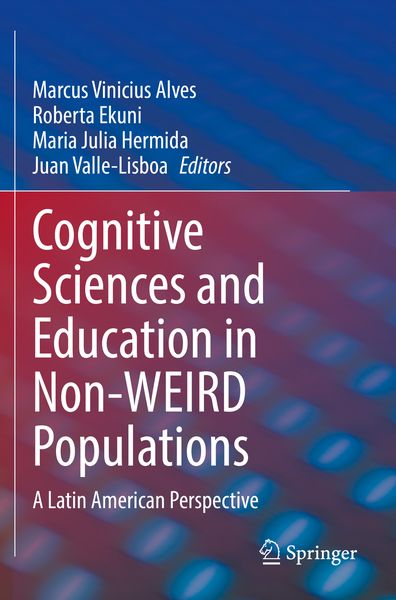
Cognitive Sciences and Education in Non-WEIRD Populations A Latin American Perspective
-
- Hardcover
- Taschenbuch ausgewählt
- eBook
-
Sprache:Englisch
Fr. 137.00
inkl. gesetzl. MwSt.,
Beschreibung
Produktdetails
Einband
Taschenbuch
Erscheinungsdatum
29.08.2023
Herausgeber
Marcus Vinicius Alves + weitereVerlag
SpringerSeitenzahl
367
Maße (L/B/H)
23.5/15.5/2.2 cm
Gewicht
598 g
Auflage
1st ed. 2022
Sprache
Englisch
ISBN
978-3-031-06910-9
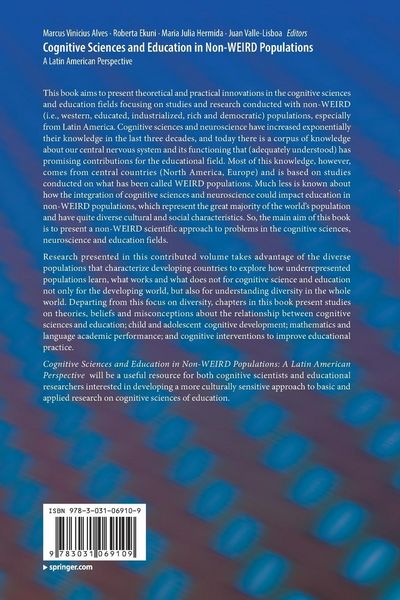
This book aims to present theoretical and practical innovations in the cognitive sciences and education fields focusing on studies and research conducted with non-WEIRD (i.e., western, educated, industrialized, rich and democratic) populations, especially from Latin America. Cognitive sciences and neuroscience have increased exponentially their knowledge in the last three decades, and today there is a corpus of knowledge about our central nervous system and its functioning that (adequately understood) has promising contributions for the educational field. Most of this knowledge, however, comes from central countries (North America, Europe) and is based on studies conducted on what has been called WEIRD populations. Much less is known about how the integration of cognitive sciences and neuroscience could impact education in non-WEIRD populations, which represent the great majority of the world’s population and have quite diverse cultural and social characteristics. So, the main aim of this book is to present a non-WEIRD scientific approach to problems in the cognitive sciences, neuroscience and education fields.
Research presented in this contributed volume takes advantage of the diverse populations that characterize developing countries to explore how underrepresented populations learn, what works and what does not for cognitive science and education not only for the developing world, but also for understanding diversity in the whole world. Departing from this focus on diversity, chapters in this book present studies on theories, beliefs and misconceptions about the relationship between cognitive sciences and education; child and adolescent cognitive development; mathematics and language academic performance; and cognitive interventions to improve educational practice.
Cognitive Sciences and Education in Non-WEIRD Populations: A Latin American Perspective will be a useful resource for both cognitive scientists and educational researchers interested in developing a more culturally sensitive approach to basic and applied research on cognitive sciences of education.
Kundinnen und Kunden meinen
Verfassen Sie die erste Bewertung zu diesem Artikel
Helfen Sie anderen Kund*innen durch Ihre Meinung