Gutscheinbedingungen

*Gültig bis 07.06.2026 auf (fast) alles. Ausgeschlossen sind Smartboxen, Zeitschriften, Tickets, Lebensmittel, Gaming-Elektroartikel, Tinte/Toner, Gutscheine, Geschenkkarten, Blumen und Abos | Einlösbar in allen Buchhandlungen von Orell Füssli, Barth Bücher, Buchladen Rapunzel, Schuler Orell Füssli, Stauffacher und ZAP unter Vorweisung des Gutscheins, auf www.orellfüssli.ch durch Eingabe des Gutscheincodes. Beim Service „eBooks verschenken“ und bei eBook-Käufen via eReader nicht einlösbar | Mindesteinkaufswert: Fr. 100.- | Nicht mit anderen Rabatten kumulierbar.

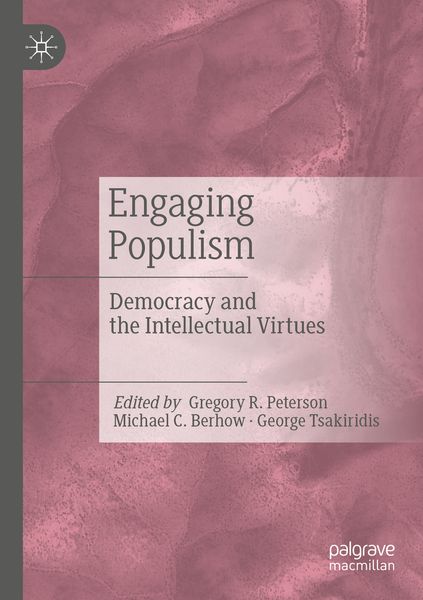
  • Produktbild: Engaging Populism
  • Produktbild: Engaging Populism

Engaging Populism Democracy and the Intellectual Virtues

Fr. 137.00

inkl. gesetzl. MwSt., Versandkostenfrei


Beschreibung

Produktdetails

Einband

Taschenbuch

Erscheinungsdatum

31.08.2023

Herausgeber

Gregory R. Peterson + weitere

Verlag

Springer

Seitenzahl

371

Maße (L/B/H)

21/14.8/2.1 cm

Gewicht

501 g

Auflage

1st ed. 2022

Sprache

Englisch

ISBN

978-3-031-05787-8

Beschreibung

Portrait

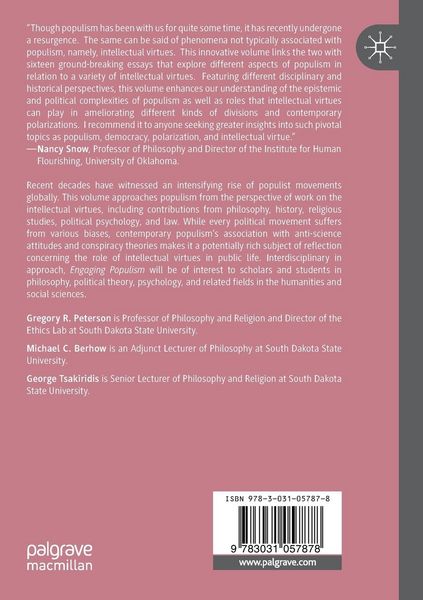
Gregory R. Peterson is Professor of Philosophy and Religion and Director of the Ethics Lab at South Dakota State University. While Dr. Peterson’s early work focused on issues of religion and science in the philosophy of religion, his more recent work focuses on moral and political philosophy and experimental ethics. Dr. Peterson is author or coauthor of over 50 journal articles and book chapters. In addition to the monograph, Minding God , he is co-editor of Property Rights in Contemporary Governance, Habits in Mind , and the Routledge Companion to Religion and Science. Dr. Peterson has also received numerous grant and fellowship awards from the National Endowment for the Humanities, the National Science Foundation, and the Templeton Foundation.


Michael C. Berhow is an Adjunct Lecturer of Philosophy at South Dakota State University. He is the author of Dysteleology: A Philosophical Assessment of Suboptimal Design in Biology (2019), and his research focuses on various topics related to religion and science, intellectual virtues, and political/social tribalism. In addition to his scholarly activity, Dr. Berhow has organized and participated in numerous lectures, forums, and panels—all of which are designed to address current events and controversies related to the intersection of science, ethics, religion, and politics.

George Tsakiridis is Senior Lecturer of Philosophy & Religion at South Dakota State University, where he is involved with the Ethics Lab. He is the author of  Evagrius Ponticus and Cognitive Science: A Look at Moral Evil and the Thoughts  (2010), and  Seven Virtues for Success  (2021). His published research also focuses on the topic of guilt and forgiveness. Dr. Tsakiridis recently edited the volume  Theology and Spider-Man  (2021), and he is currently working on several projects related to popular culture. He holds a PhD in Religion and Science/Theology from the Lutheran School of Theology at Chicago.


Produktdetails

Einband

Taschenbuch

Erscheinungsdatum

31.08.2023

Herausgeber

Verlag

Springer

Seitenzahl

371

Maße (L/B/H)

21/14.8/2.1 cm

Gewicht

501 g

Auflage

1st ed. 2022

Sprache

Englisch

ISBN

978-3-031-05787-8

Herstelleradresse

Springer-Verlag GmbH
Tiergartenstr. 17
69121 Heidelberg
DE

Email: ProductSafety@springernature.com

Kundinnen und Kunden meinen

0 Bewertungen

Informationen zu Bewertungen

Zur Abgabe einer Bewertung ist eine Anmeldung im Konto notwendig. Die Authentizität der Bewertungen wird von uns nicht überprüft. Wir behalten uns vor, Bewertungstexte, die unseren Richtlinien widersprechen, entsprechend zu kürzen oder zu löschen.

Die Bewertungen sind nach Format, Anzahl Sterne und Datum sortiert.

Verfassen Sie die erste Bewertung zu diesem Artikel

Helfen Sie anderen Kund*innen durch Ihre Meinung

Kundinnen und Kunden meinen

0 Bewertungen filtern

  • Produktbild: Engaging Populism
  • Produktbild: Engaging Populism
  • Chapter 1: Introduction.- Part I: Putting Populism in Context.- Chapter 2: Using Political Psychology to Understand Populism, Intellectual Virtues, and Declining Support for Democratic Norms.- Chapter 3: Midcentury Populists & the Intellectual Virtues.- Chapter 4: Populism, Evangelicalism, and Technology: A Familiar Trinitarian Formula.- Part II: Populism and Intellectual Virtues: Philosophical Approaches.- Chapter 5: Populism, Expertise, and Intellectual Autonomy.- Chapter 6: Truthfulness as a Democratic Virtue.- Chapter 7: E Pluribus Unum? Empathy as an Antidote to Populism's Antipluralism.- Chapter 8: Populism and the Virtues of Argument.- Chapter 9: Epistemic Charity in Times of Populist Polarization.- Part III: Populism and Intellectual Virtues Across Disciplines.- Chapter 10: An Epistemology for Listening across Cultural and Political Divides.- Chapter 11: Certain Simple Stories.- Chapter 12: Virtuous Autonomy and its Explanatory Role in Turkish Activism.- Chapter 13: The People, the Experts, and the Citizens: Cognitive and Recognitive Attitudes in Democratic Practice.- Part IV: The Big Picture: Virtues, Populism, and Epistemic Environments.- Chapter 14: Justifying Humanitarian Interference for Epistemic Threats.- Chapter 15: Intellectual Virtues, Epistemic Democracy, and the Wisdom of the Crowd.- Chapter 16: Pandemic Postscript: Populism and Intellectual Virtues After COVID-19.