
Imitation from Infancy Through Early Childhood Typical and Atypical Development
-
- Hardcover
- Taschenbuch ausgewählt
- eBook
-
Sprache:Englisch
Fr. 137.00
inkl. gesetzl. MwSt.,
Beschreibung
Produktdetails
Einband
Taschenbuch
Erscheinungsdatum
01.09.2023
Verlag
SpringerSeitenzahl
201
Maße (L/B/H)
23.5/15.5/1.3 cm
Gewicht
341 g
Auflage
1st ed. 2022
Sprache
Englisch
ISBN
978-3-031-08901-5
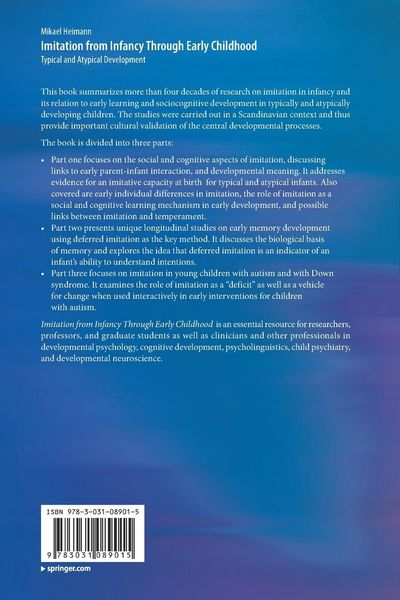
This book summarizes more than four decades of research on imitation in infancy and its relation to early learning and sociocognitive development in typically and atypically developing children. The studies were carried out in a Scandinavian context and thus provide important cultural validation of the central developmental processes.
The book is divided into three parts:
Part one focuses on the social and cognitive aspects of imitation, discussing links to early parent-infant interaction, and developmental meaning. It addresses evidence for an imitative capacity at birth for typical and atypical infants. Also covered are early individual differences in imitation, the role of imitation as a social and cognitive learning mechanism in early development, and possible links between imitation and temperament. Part two presents unique longitudinal studies on early memory development using deferred imitation as the key method. It discusses the biological basis of memory and explores the idea that deferred imitation is an indicator of an infant’s ability to understand intentions. Part three focuses on imitation in young children with autism and with Down syndrome. It examines the role of imitation as a “deficit” as well as a vehicle for change when used interactively in early interventions for children with autism. Imitation from Infancy Through Early Childhood is an essential resource for researchers, professors, and graduate students as well as clinicians and other professionals in developmental psychology, cognitive development, psycholinguistics, child psychiatry, and developmental neuroscience.
The book is divided into three parts:
Part one focuses on the social and cognitive aspects of imitation, discussing links to early parent-infant interaction, and developmental meaning. It addresses evidence for an imitative capacity at birth for typical and atypical infants. Also covered are early individual differences in imitation, the role of imitation as a social and cognitive learning mechanism in early development, and possible links between imitation and temperament. Part two presents unique longitudinal studies on early memory development using deferred imitation as the key method. It discusses the biological basis of memory and explores the idea that deferred imitation is an indicator of an infant’s ability to understand intentions. Part three focuses on imitation in young children with autism and with Down syndrome. It examines the role of imitation as a “deficit” as well as a vehicle for change when used interactively in early interventions for children with autism. Imitation from Infancy Through Early Childhood is an essential resource for researchers, professors, and graduate students as well as clinicians and other professionals in developmental psychology, cognitive development, psycholinguistics, child psychiatry, and developmental neuroscience.
Kundinnen und Kunden meinen
Verfassen Sie die erste Bewertung zu diesem Artikel
Helfen Sie anderen Kund*innen durch Ihre Meinung