• Produktbild: Handbook of Waste Biorefinery
  • Produktbild: Handbook of Waste Biorefinery

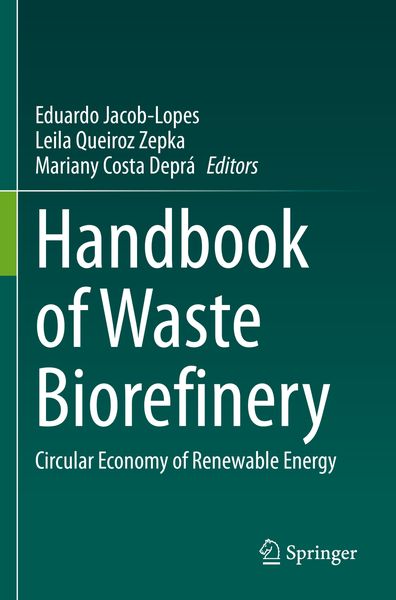
Handbook of Waste Biorefinery Circular Economy of Renewable Energy

Fr. 264.00

inkl. gesetzl. MwSt., Versandkostenfrei


Beschreibung

Produktdetails

Einband

Taschenbuch

Erscheinungsdatum

03.09.2023

Herausgeber

Eduardo Jacob-Lopes + weitere

Verlag

Springer

Seitenzahl

1014

Maße (L/B/H)

23.5/15.5/5.5 cm

Gewicht

1521 g

Auflage

1st ed. 2022

Sprache

Englisch

ISBN

978-3-031-06564-4

Beschreibung

Portrait

Prof. Eduardo Jacob-Lopes  is currently associate professor at the Department of Food Technology and Science, Federal University of Santa Maria, Brazil. He has more than 18 years of teaching and research experience. He is a technical and scientific consultant of several companies, agencies, and scientific journals. He has more than 600 publications/communications and has registered 15 patents. His research interest includes biotechnology and bioengineering with emphasis on environmental biotechnology. 


Prof. Leila Queiroz Zepka  is currently an associate professor at the Department of Food Technology and Science, Federal University of Santa Maria, Brazil. She has more than 18 years of teaching and research experience. She is a technical and scientific consultant of several companies, agencies and scientific journals. She has 500 publications/communications and has registered 11 patents. Her research interest includes microalgal biotechnology with emphasis on biomolecules and novel products.

Dr. Mariany Costa Deprá  is currently a researcher at the Department of Food Science and Technology, Federal University of Santa Maria, Brazil. She is a technical and scientific consultant of companies and scientific journals.With more than 100 publications/communications, her research interest includes process engineering with emphasis on sustainability metrics and indicators.


Produktdetails

Einband

Taschenbuch

Erscheinungsdatum

03.09.2023

Herausgeber

Verlag

Springer

Seitenzahl

1014

Maße (L/B/H)

23.5/15.5/5.5 cm

Gewicht

1521 g

Auflage

1st ed. 2022

Sprache

Englisch

ISBN

978-3-031-06564-4

Herstelleradresse

Springer-Verlag KG
Sachsenplatz 4-6
1201 Wien
AT

Email: ProductSafety@springernature.com

Kundinnen und Kunden meinen

0 Bewertungen

Informationen zu Bewertungen

Zur Abgabe einer Bewertung ist eine Anmeldung im Konto notwendig. Die Authentizität der Bewertungen wird von uns nicht überprüft. Wir behalten uns vor, Bewertungstexte, die unseren Richtlinien widersprechen, entsprechend zu kürzen oder zu löschen.

Die Bewertungen sind nach Format, Anzahl Sterne und Datum sortiert.

Verfassen Sie die erste Bewertung zu diesem Artikel

Helfen Sie anderen Kund*innen durch Ihre Meinung

Kundinnen und Kunden meinen

0 Bewertungen filtern

  • Produktbild: Handbook of Waste Biorefinery
  • Produktbild: Handbook of Waste Biorefinery
  • Part I. Fundamentals.- Chapter 1. Principles, Concepts, and Recent Trends Applied to the Waste Biorefineries.- Chapter 2. Zero Waste Biorefinery.- Chapter 3. Waste Biorefineries Facilities: The Feedstock Choice.- Chapter 4. Emerging Pretreatment Technologies Applied to Waste Biorefinery.- Chapter 5. Waste Biomaterials Innovation Markets.- Chapter 6. Step Forward on Waste Biorefineries: Technology Bottlenecks and Perspective on Commercialization.- Part II. Feedstocks.- Chapter 7. Strategies for Municipal Solid Waste: Functional Elements, Integrated Management, and Legislative Aspects.- Chapter 8. Sewage Sludge Biochar.- Chapter 9. Recovery of Value Added Products from Industrial Wastewaters: A Review to Potential Feedstocks.- Chapter 10. Fats, Oils, and Grease (FOG): Opportunities, Challenges, and Economic Approaches.- Chapter 11. Food Waste Biorefineries: Developments, Current Advances and Future Outlook.- Chapter 12. The Role of Livestock Wastes in Clean Energy: A Mapping in Germany's Potential Installations.- Chapter 13. Agricultural Waste-Derived Management for Bioenergy: A Paradigm Shift in the Waste Perceptions.- Chapter 14. Forestry Wastes: Technical Concepts, Economic Circularity, and Sustainability Approaches.- Chapter 15. Panoramic View about Microalgae Biomass as Waste-To-Energy: A Biorefinery Concept.- Chapter 16. Yeast Biomass: A By-Product for Application in the Food, Energy, Plastics and Pharmaceutical Industries.- Chapter 17. Enzymes Applied to Lignocellulosic Biorefinery.- Part III. Waste to Energy-Food-Feed-Chemical-Material Technologies (WtEFFCM-Tech).- Chapter 18. Waste-to-Chemicals.- Chapter 19. Fundamentals for Waste-to-Energy from Anaerobic Digestion Technologies: An Overview. Chapter 20. Composting Technologies for Biowastes: Environmental and Techno-Economic Feasibilities under Biorefinery Concepts.- Chapter 21. Vermicomposting Technology: A Sustainable Option for Waste Beneficiation.- Chapter 22. Land Application of Organic Waste Compost.- Chapter 23. Thermal Cracking Processes Up-to-Dateness for Oil Vacuum Residual and Bio-Raw Materials: A Perspective for Municipal Solid Waste.- Chapter 24. Chemistry to Technology of Gasification Process: A Close Look into Reactions and Kinetic Models.- Chapter 25. Open Burning Application to Municipal Solid Waste: Quantification Methods, Emission Inventories, and Uncertainty Delineations.- Chapter 26. Overview of Torrefaction Technologies: A Path Getaway for Waste-to-Energy.- Chapter 27. Hydrothermal Carbonisation of Waste Biomass: Current Limitations, Strategic Success and Market Position Analysis.- Chapter 28. A Comprehensive Outlook to Hydrothermal Liquefaction Technology: Economic and Environmental Benefits.- Chapter 29. Landfill Gas Utilization.- Chapter 30. Plasma Technology in Waste-to-Energy Valorization: Fundamentals, Current Status, and Future Directions.- Part IV. Criteria for Policy, Environmental, Intellectual Property, Economic Aspects, Social, and Scalability.- Chapter 31. Strategy and Design of Innovation Policy Road Mapping for Waste Biorefineries.- Chapter 32. Sustainability Metrics on Waste Biorefineries.- Chapter 33. Exergy Analysis of Waste Biorefineries.- Chapter 34. Social Circular Economy Indicators Applied to Waste Biorefineries.- Chapter 35. How to Realize an Urban Circular Bioeconomy.- Chapter 36. Innovation Management on Waste Biorefineries.- Chapter 37. Incentivising Circular and Sustainable Innovations Through Patent Law.- Chapter 38. Industrial Economy and Technological Management in The Context of Waste Biorefineries.- Chapter 39. Techno-economic Aspects and Circular Economy of Waste Biorefineries.- Chapter 40. Unlocking the Global Potential of Waste Biorefining: Scaling Up or Scaling Down?.- Chapter 41. Development and Scale-Up of Waste Biorefineries Systems: Lactic Acid as a Case Study.