Gutscheinbedingungen

*Gültig bis 07.06.2026 auf (fast) alles. Ausgeschlossen sind Smartboxen, Zeitschriften, Tickets, Lebensmittel, Gaming-Elektroartikel, Tinte/Toner, Gutscheine, Geschenkkarten, Blumen und Abos | Einlösbar in allen Buchhandlungen von Orell Füssli, Barth Bücher, Buchladen Rapunzel, Schuler Orell Füssli, Stauffacher und ZAP unter Vorweisung des Gutscheins, auf www.orellfüssli.ch durch Eingabe des Gutscheincodes. Beim Service „eBooks verschenken“ und bei eBook-Käufen via eReader nicht einlösbar | Mindesteinkaufswert: Fr. 100.- | Nicht mit anderen Rabatten kumulierbar.

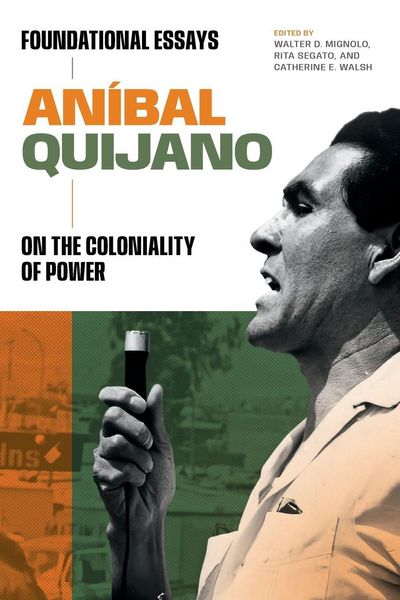
  • Produktbild: Aníbal Quijano
  • Produktbild: Aníbal Quijano

Aníbal Quijano Foundational Essays on the Coloniality of Power

Fr. 54.90

inkl. gesetzl. MwSt., Versandkostenfrei


Beschreibung

Produktdetails

Verkaufsrang

21565

Einband

Taschenbuch

Erscheinungsdatum

05.04.2024

Herausgeber

Walter D. Mignolo + weitere

Verlag

Duke University Press

Seitenzahl

496

Maße (L/B/H)

22.9/15.2/2.9 cm

Gewicht

792 g

Übersetzt von

David Frye

Sprache

Englisch

ISBN

978-1-4780-3032-4

Beschreibung

Rezension

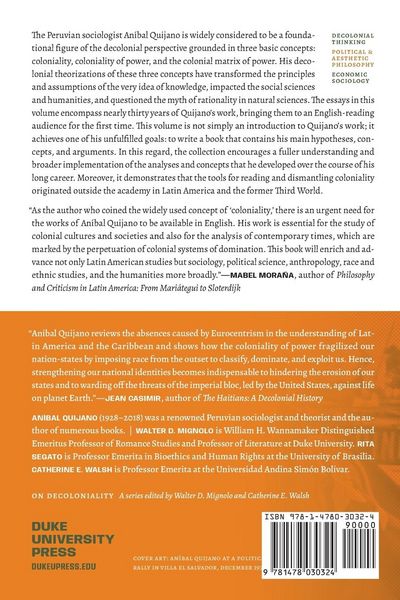
"As the author who coined the widely used concept of 'coloniality,' there is an urgent need for the works of AnÍbal Quijano to be available in English. His work is essential for the study of colonial cultures and societies and also for the analysis of contemporary times, which are marked by the perpetuation of colonial systems of domination. This book will enrich and advance not only Latin American studies but sociology, political science, anthropology, race and ethnic studies, and the humanities more broadly." - Mabel Moraña, author of (Philosophy and Criticism in Latin America: From Mariátegui to Sloterdijk) "AnÍbal Quijano reviews the absences caused by Eurocentrism in the understanding of Latin America and the Caribbean and shows how the coloniality of power fragilized our nation-states by imposing race from the outset to classify, dominate, and exploit us. Hence, strengthening our national identities becomes indispensable to hindering the erosion of our states and to warding off the threats of the imperial bloc, led by the United States, against life on planet Earth." - Jean Casimir, author of (The Haitians: A Decolonial History) "Quijano's oeuvre is both relentlessly historical-often tracing important developments over centuries-and insistently relational, positing that modern Latin America is not intelligible independent of its relationship to Europe (and the U.S.). Many of his essays are stunningly penetrating and dazzlingly synthetic. . . . If Foundational Essays on the Coloniality of Power is consumed in conjunction with his earlier work already available in English, it is sure to satisfy intellectually hungry Anglophones." - Simeon J. Newman (Sociology of Race and Ethnicity) "I hope that the translation of so much of Quijano's work and the incisive introduction provided by the editors will induce his inclusion in graduate sociology curricula. But more importantly, I hope that this volume will remind graduate students that decoloniality, in the ways elaborated and exemplified by Quijano, is a project worth dreaming about and defending. - Nabila N. Islam (Sociology of Race and Ethnicity) "AnÍbal Quijano is one of the classics. . . . The introduction ... introduces four main ideas by Quijano that the volume makes accessible to a wider, non-Spanish speaking readership. It does this well, in a condensed, but readable manner. . . . A worthwhile read." - Alke Jenss (Sociology of Race and Ethnicity) "Quijano gave us much, and I would argue that many of the ideas that he develops or takes from different places and connects with each other in Foundational Essays are indispensable for decolonial thought in this century. . . ." - Nelson Maldonado-Torres (Theory, Culture & Society) "There are many gems in this collection for those who are familiar with Quijano's political thinking as much as for those who are new to it. . . . [Quijano is] a neglected thinker whose essays still exude a dynamism and originality, not often seen in academia." - Ronaldo Munck (Bulletin of Latin American Research)

Produktdetails

Verkaufsrang

21565

Einband

Taschenbuch

Erscheinungsdatum

05.04.2024

Herausgeber

Verlag

Duke University Press

Seitenzahl

496

Maße (L/B/H)

22.9/15.2/2.9 cm

Gewicht

792 g

Übersetzt von

David Frye

Sprache

Englisch

ISBN

978-1-4780-3032-4

Herstelleradresse

Libri GmbH
Europaallee 1
36244 Bad Hersfeld
DE

Email: gpsr@libri.de

Kundinnen und Kunden meinen

0 Bewertungen

Informationen zu Bewertungen

Zur Abgabe einer Bewertung ist eine Anmeldung im Konto notwendig. Die Authentizität der Bewertungen wird von uns nicht überprüft. Wir behalten uns vor, Bewertungstexte, die unseren Richtlinien widersprechen, entsprechend zu kürzen oder zu löschen.

Die Bewertungen sind nach Format, Anzahl Sterne und Datum sortiert.

Verfassen Sie die erste Bewertung zu diesem Artikel

Helfen Sie anderen Kund*innen durch Ihre Meinung

Kundinnen und Kunden meinen

0 Bewertungen filtern

  • Produktbild: Aníbal Quijano
  • Produktbild: Aníbal Quijano
  • Introduction / Catherine E. Walsh, Walter D. Mignolo, and Rita Segato 1
    1. Paradoxes of Modernity in Latin America  32
    2. The Aesthetic of Utopia  64
    3. Coloniality and Modernity/Rationality  73
    4. Questioning “Race”  85
    5. Coloniality of Power and Social Classification  95
    6. The Return of the Future and Questions about Knowledge  132
    7. Coloniality of Power, Globalization, and Democracy  146
    8. The New Anticapitalist Imaginary  188
    9. Don Quixote and the Windmills in Latin America  204
    10. The “Indigenous Movement” and Unresolved Questions in Latin America  229
    11. Coloniality of Power, Eurocentrism, and Latin America  256
    12. Coloniality of Power and De/Coloniality of Power  303
    13. Thirty Years Later: Another Reunion: Notes for Another Debate  317
    14. The Crisis of the Colonial/Modern/Eurocentred Horizon of Meaning  331
    15. Latin America: Toward a New Historical Meaning  347
    16. Coloniality of Power and Subjectivity in Latin America  361
    17. “Bien Vivir”: Between “Development” and the De/Coloniality of Power  379
    18. Labor  392
    19. Notes on the Decoloniality of Power  411
    20. Modernity, Capital, and Latin America Were Born the Same Day: Interview by Nora Velarde  418
    Bibliography  443
    Index  457