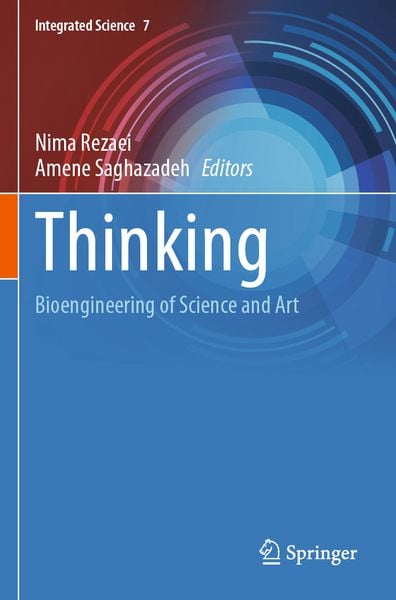

• Produktbild: Thinking
  • Produktbild: Thinking

Thinking Bioengineering of Science and Art

Aus der Reihe Integrated Science

Fr. 191.00

inkl. gesetzl. MwSt., Versandkostenfrei


Beschreibung

Produktdetails

Einband

Taschenbuch

Erscheinungsdatum

07.09.2023

Herausgeber

Nima Rezaei + weitere

Verlag

Springer

Seitenzahl

803

Maße (L/B/H)

23.5/15.5/4.4 cm

Gewicht

1218 g

Auflage

1st ed. 2022

Sprache

Englisch

ISBN

978-3-031-04077-1

Beschreibung

Produktdetails

Einband

Taschenbuch

Erscheinungsdatum

07.09.2023

Herausgeber

Verlag

Springer

Seitenzahl

803

Maße (L/B/H)

23.5/15.5/4.4 cm

Gewicht

1218 g

Auflage

1st ed. 2022

Sprache

Englisch

ISBN

978-3-031-04077-1

Herstelleradresse

Springer-Verlag GmbH
Tiergartenstr. 17
69121 Heidelberg
DE

Email: ProductSafety@springernature.com

Kundinnen und Kunden meinen

0 Bewertungen

Informationen zu Bewertungen

Zur Abgabe einer Bewertung ist eine Anmeldung im Konto notwendig. Die Authentizität der Bewertungen wird von uns nicht überprüft. Wir behalten uns vor, Bewertungstexte, die unseren Richtlinien widersprechen, entsprechend zu kürzen oder zu löschen.

Die Bewertungen sind nach Format, Anzahl Sterne und Datum sortiert.

Verfassen Sie die erste Bewertung zu diesem Artikel

Helfen Sie anderen Kund*innen durch Ihre Meinung

Kundinnen und Kunden meinen

0 Bewertungen filtern

  • Produktbild: Thinking
  • Produktbild: Thinking
  • Introduction on THINKING: Bioengineering of Science and Art.- Thinking as A Philosophical, Theological and Psychological Phenomenon.- How to Think about Human-Animal Differences in Thinking: Two Cases of Marginal Analogy in the Philosophical Explication of Animal Cognition.- Homo Pictor’: A Philosophical Enquiry into the Origins of Human Thinking.- Idealism and Science of Life: An Intersection between Philosophy and Biology.- Embodied Creativity and Symbolic Variation in The Evolution of Life.- Within the Box: Captives of our Own Mind.- The Dialectic of Mind and Matter in The Trialectic Approach: A New Path of The Cognition Process.- Efforts Deployed in the Penetration of “Thought”.- Pseudo-Thinking and Real Thinking.- Three Paradoxes of Thought: Thought Power Measured.- A New Philosophical Paradigm of Thinking for Particular Sciences: Physics, Cognitive Science, and Biology.- Indicators of Variation in Thinking Actions and Reactions.- Multidimensional Thinking: Economizing Thinking and Maximizing Outcomes.- How You Know What I Know That She Said About You: Theory of Mind, Intentionality and the Evolutionary Roots of Artistic Practice.- A Philosophical Perspective on the Bioengineering of Art: Ethical Shifts in Mimesis.- Thinking Through the Body: Art and Philosophy in Dialogue.- Mechanism vs. Organism: A Loosely Kantian Perspective and its Implications for Bioengineering.- New Media Art: The Liminal Space Between Thinking and Perceiving.- Towards a New Science of Interfaces: Bridging Art and Engineering.- Art as Metacognitive Tool for Critical Thinking in Engineering.- Dimensions of Thinking, Reflecting, and Knowing through Design.- Thinking Through Sound: Music Listening as A Model for Enhanced Cognition.- Poetic Thinking and the Constitution of Our World: On Language and Reality.- Thinking as the Invention of New Aspects within Language-Games.- Literature as a Genealogy of the Social Sciences Thought.- How Rational Thought Is Conceived in Christian Doctrine: The Case of Saint Thomas Aquinas.- The Interest of Religion on Ethical Thought in Science.- Thinking, Politics, and the Evolutionary Process of Societies.- Information Processing in Reasoning in the Environment of Forbidden Sentences.- The impact of economic science on human thinking.- Generations of Systems Thinking: Models for Future Learning.- Systems Thinking and Action for An Entrepreneurial Journey Towards the House of Lab Science.-Systems Approach for Modeling Multifactorial Human Interactions that Affect Ecological and Environmental Systems.- Cradle to Cradle and Cradle to Grave: Discussing the Case of Eco-Coffins.- THINKING 2050: Bioengineering of Science and Art.