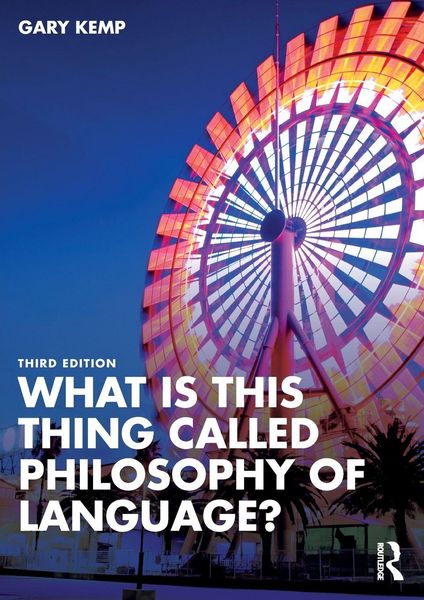
What is this thing called Philosophy of Language?
-
- Hardcover
- Taschenbuch ausgewählt
- eBook
-
Sprache:Englisch
-
Auflage:3. Auflage
- 2. Auflage Fr. 62.90
- 3. Auflage Fr. 73.90 ausgewählt
Fr. 73.90
inkl. gesetzl. MwSt.,
Beschreibung
Produktdetails
Einband
Taschenbuch
Erscheinungsdatum
04.03.2024
Abbildungen
schwarz-weiss Illustrationen, Zeichnungen, schwarz-weiss, Tabellen, schwarz-weiss
Verlag
Taylor & FrancisSeitenzahl
334
Maße (L/B/H)
24.6/17.4/1.8 cm
Gewicht
600 g
Auflage
3. Auflage
Sprache
Englisch
ISBN
978-1-03-242654-9
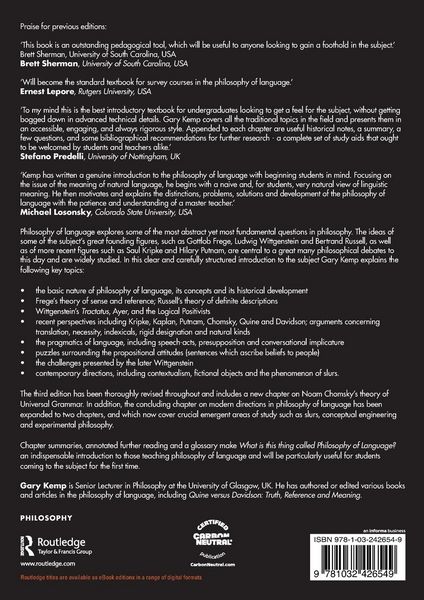
Philosophy of language explores some of the most abstract yet most fundamental questions in philosophy. The ideas of some of the subject's great founding figures, such as Gottlob Frege, Ludwig Wittgenstein and Bertrand Russell, as well as of more recent figures such as Saul Kripke and Hilary Putnam, are central to a great many philosophical debates to this day and are widely studied. In this clear and carefully structured introduction to the subject Gary Kemp explains the following key topics:
- the basic nature of philosophy of language, its concepts and its historical development
- Frege's theory of sense and reference; Russell's theory of definite descriptions
- Wittgenstein's Tractatus, Ayer, and the Logical Positivists
- recent perspectives including Kripke, Kaplan, Putnam, Chomsky, Quine and Davidson; arguments concerning translation, necessity, indexicals, rigid designation and natural kinds
- the pragmatics of language, including speech-acts, presupposition and conversational implicature
- puzzles surrounding the propositional attitudes (sentences which ascribe beliefs to people)
- the challenges presented by the later Wittgenstein
- contemporary directions, including contextualism, fictional objects and the phenomenon of slurs
The third edition has been thoroughly revised throughout and includes a new chapter on Noam Chomsky's theory of Universal Grammar. In addition, the concluding chapter on modern directions in philosophy of language has been expanded to two chapters, and which now cover crucial emergent areas of study such as slurs, conceptual engineering and experimental philosophy.
Chapter summaries, annotated further reading and a glossary make What is this thing called Philosophy of Language? an indispensable introduction to those teaching philosophy of language and will be particularly useful for students coming to the subject for the first time.
Kundinnen und Kunden meinen
Verfassen Sie die erste Bewertung zu diesem Artikel
Helfen Sie anderen Kund*innen durch Ihre Meinung