Gutscheinbedingungen

*Gültig bis 07.06.2026 auf (fast) alles. Ausgeschlossen sind Smartboxen, Zeitschriften, Tickets, Lebensmittel, Gaming-Elektroartikel, Tinte/Toner, Gutscheine, Geschenkkarten, Blumen und Abos | Einlösbar in allen Buchhandlungen von Orell Füssli, Barth Bücher, Buchladen Rapunzel, Schuler Orell Füssli, Stauffacher und ZAP unter Vorweisung des Gutscheins, auf www.orellfüssli.ch durch Eingabe des Gutscheincodes. Beim Service „eBooks verschenken“ und bei eBook-Käufen via eReader nicht einlösbar | Mindesteinkaufswert: Fr. 100.- | Nicht mit anderen Rabatten kumulierbar.

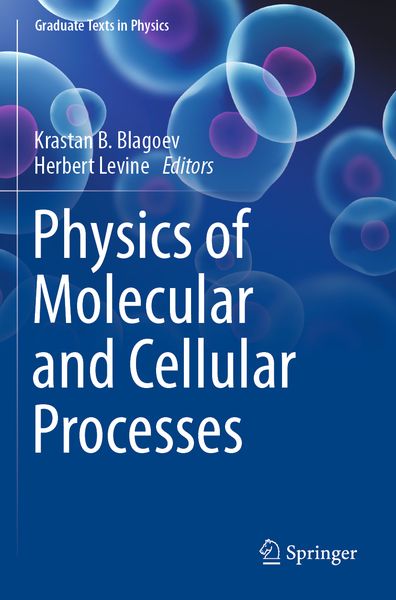
  • Produktbild: Physics of Molecular and Cellular Processes
  • Produktbild: Physics of Molecular and Cellular Processes

Physics of Molecular and Cellular Processes

Fr. 72.90

inkl. gesetzl. MwSt., Versandkostenfrei


Beschreibung

Produktdetails

Einband

Taschenbuch

Erscheinungsdatum

10.09.2023

Herausgeber

Krastan B. Blagoev + weitere

Verlag

Springer

Seitenzahl

253

Maße (L/B/H)

23.5/15.5/1.5 cm

Gewicht

417 g

Auflage

1st ed. 2022

Sprache

Englisch

ISBN

978-3-030-98608-7

Beschreibung

Portrait

Krastan B. Blagoev is a Program Director at the US National Science Foundation and is a Research Scientist at the Johns Hopkins University, Department of Biophysics. His research is focused on applying methods of non-equilibrium physics and control theory to gain insight in the function and architecture of living systems. His research has been featured in Physics Today, Physics World, Science Daily, Aznei-News. Blagoev is a Fellow of the American Physical Society. Heworked on the creation and establishment of the International Graduate Student Research Network, The International Physics of Living Systems Teachers Network, and the Cancer Convergence Education Network.

Herbert Levine is a Distinguished Professor of Physics and Bioengineering at Northeastern Univ.. He is a pioneer in using theory to expand experimental findings and in the development of well-parameterized computational models that can be used to garner new insights into biological and biomedical systems. Levineis an elected member of the American Academy of Arts and Sciences, an elected member of the National Academy of Science, a fellow of the American Physical Society, and past chair of the American Physical Society’s Division of Biological Physics. He is the author of more than 300 peer-reviewed publications. His research has been featured in the New York Times, Scientific American, the Today Show and many other popular science forums. Levine is a co-director of Center for Theoretical Biological Physics, an NSF-sponsored effort to apply physical science to the living world. Also, Dr. Levine is the coordinator of an international network of graduate students conducting research into the Physics of Living Systems. 

Produktdetails

Einband

Taschenbuch

Erscheinungsdatum

10.09.2023

Herausgeber

Verlag

Springer

Seitenzahl

253

Maße (L/B/H)

23.5/15.5/1.5 cm

Gewicht

417 g

Auflage

1st ed. 2022

Sprache

Englisch

ISBN

978-3-030-98608-7

Herstelleradresse

Springer-Verlag KG
Sachsenplatz 4-6
1201 Wien
AT

Email: ProductSafety@springernature.com

Kundinnen und Kunden meinen

0 Bewertungen

Informationen zu Bewertungen

Zur Abgabe einer Bewertung ist eine Anmeldung im Konto notwendig. Die Authentizität der Bewertungen wird von uns nicht überprüft. Wir behalten uns vor, Bewertungstexte, die unseren Richtlinien widersprechen, entsprechend zu kürzen oder zu löschen.

Die Bewertungen sind nach Format, Anzahl Sterne und Datum sortiert.

Verfassen Sie die erste Bewertung zu diesem Artikel

Helfen Sie anderen Kund*innen durch Ihre Meinung

Kundinnen und Kunden meinen

0 Bewertungen filtern

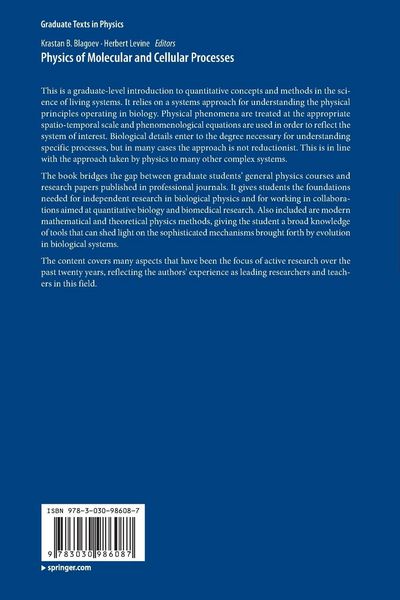
  • Produktbild: Physics of Molecular and Cellular Processes
  • Produktbild: Physics of Molecular and Cellular Processes
  • Part I. The non-equilibrium nature of living systems.- 1.1 Introduction.- 1.2 Equilibrium and non-equilibrium thermodynamics and statistical physics.- 1.3 Organization and evolution of life.- 1.4 The physics of biomolecules.- 1.5 The physics of proteins: The special role of water. Folding, unfolding and misfolding. Active sites, allostery. Molecular motors (e.g. flagellar motor) and the use of free energy. Protein-protein interactions and their role in cell signaling.- 1.6 Physics of DNA and RNA: Electrostatistics, folding, unfolding, topology, geometry, accessibility. Protein-DNA interactions and chromatin structure.- 1.7 Physics of metabolism: Energy production and charge transport. Network analysis. Bacterial growth laws. Mitochondrial structure and function.- 1.8 Physics of Cytoskeletal proteins. Polymerization kinetics and applications to actin and microtubules. Nucleation dynamics. Kinesin, Dynein and Myosin as non-equilibrium walkers.- 1.9 Physics of Viruses.- Part II. The Physics of the Cell.- 2.1 Physics of the cell membrane: real and model membranes, Helfrich free energy. Embedded protein, including surface receptors. Membrane fusion and fission, application to viral entry, endo- and exo-cytosis.- 2.2 Dynamics in the cell. Transport via passive diffusion versus active transport. Targeting to organelles via molecular signals. Scaffolds and compartments for chemical reaction control. The cytoskeletal network and its role in cell mechanics.- 2.3 Genetic networks. Transcriptional dynamics, examples from phage and bacteria. Control of translation, for example via small RNAs. Role of chromatin structure for eukaryotic systems.- 2.4 Signal transduction: Receptor subtypes (GPCR, Tyrosine kinase, ion channels) and kinetics. Phosphorelay in the Map Kinase pathway. Second messenger dynamics, including amplification in e.g. calcium signaling. Adaptation and chemotacis in bacteria.- Part III. The Physics of the Organism.- 3.1 Cell division – DNA replication. Bacteria cell size determination, contractile ring placement and dynamics; Eukaryotic cell division mitotic spindle, cell cycle checkpoints.- 3.2 DNA damage and repair, chromosome instability, damage checkpoints, telomere dynamics and chromosome instability.- 3.3 Cell motion types of bacterial motion: swimming versus gliding. Crawling of eukaryotic cells; adhesion complexes, active forces due to contraction and polymerization. Chemotaxis and durotaxis.- 3.4 Cellular decisions sporulation in Bacillus,Dictyostelium. Stem cells versus differentiated cells. Landscapes in non-equilibrium systems. The origins of multicellularity.