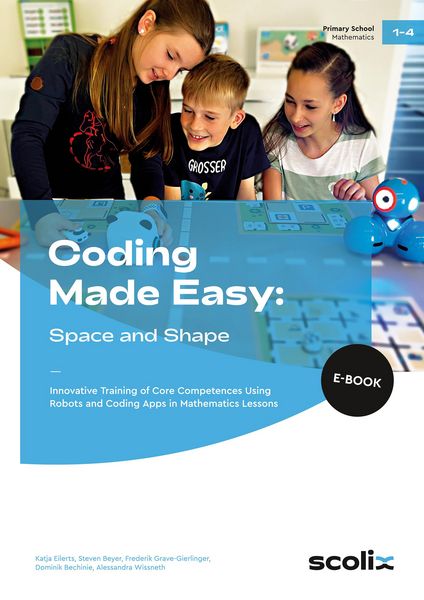
Coding Made Easy: Space and Shape Innovative Training of Core Competences Using Robots and Coding Apps in Mathematics Lessons (1. bis 4. Klasse)
-
- Einzelkauf Download ausgewählt
-
Sprache:Deutsch
Fr. 26.90
inkl. gesetzl. MwSt.Beschreibung
Produktdetails
Format
Kopierschutz
Nein
Family Sharing
Nein
Text-to-Speech
Nein
Erscheinungsdatum
01.08.2023
Verlag
ScolixSeitenzahl
95 (Printausgabe)
Dateigröße
14762 KB
Auflage
1. Auflage
Sprache
Deutsch
EAN
9783403407690
Proven digital learning environments for modern mathematics teaching!
Digital learning environments for modern math class!
How does the robot in Cornerstown reach its destination? How must Linda the ladybug crawl to create a frieze pattern along her path? Within these four learning environments, your students engage deeply with plane shapes, frieze patterns, coordinate systems, networks, and paths. Initially, they explore these concepts using physical materials, and then switch to digital tools. The approach is simple and effective: the children create basic programs, experiment with them, and observe the results of their individual solutions. Through this process, mathematical skills, spatial imagination, computational thinking, and logical reasoning are fostered. But which programmable materials are suitable for primary school?
The research team of the math.media.lab at Humboldt-Universität (Berlin) has tested various digital materials specifically for use in primary school mathematics lessons. The four learning environments presented here are carefully designed to work well with selected robots and coding apps. However, they can also be adapted to accommodate other programmable materials. By embracing a technology-open approach, you provide optimal support to your students, empowering them to progress steadily in their mathematical journey!
Digital learning environments for modern math class!
How does the robot in Cornerstown reach its destination? How must Linda the ladybug crawl to create a frieze pattern along her path? Within these four learning environments, your students engage deeply with plane shapes, frieze patterns, coordinate systems, networks, and paths. Initially, they explore these concepts using physical materials, and then switch to digital tools. The approach is simple and effective: the children create basic programs, experiment with them, and observe the results of their individual solutions. Through this process, mathematical skills, spatial imagination, computational thinking, and logical reasoning are fostered. But which programmable materials are suitable for primary school?
The research team of the math.media.lab at Humboldt-Universität (Berlin) has tested various digital materials specifically for use in primary school mathematics lessons. The four learning environments presented here are carefully designed to work well with selected robots and coding apps. However, they can also be adapted to accommodate other programmable materials. By embracing a technology-open approach, you provide optimal support to your students, empowering them to progress steadily in their mathematical journey!
Kundinnen und Kunden meinen
Verfassen Sie die erste Bewertung zu diesem Artikel
Helfen Sie anderen Kund*innen durch Ihre Meinung