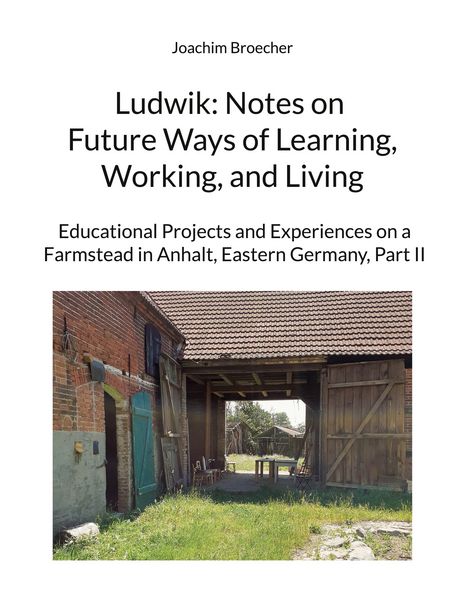
Ludwik: Notes on Future Ways of Learning, Working, and Living Educational Projects and Experiences on a Farmstead in Anhalt, Eastern Germany, Part II
-
- Taschenbuch ausgewählt
- eBook
-
Sprache:Englisch
Fr. 28.90
inkl. gesetzl. MwSt.,
-
Kostenlose Lieferung ab Fr. 30 Einkaufswert
Schweiz & Liechtenstein:
Versandkostenfrei ab Fr. 30.00
Versandkosten bis Fr. 30.00: Fr. 3.50Andere Lieferländer
Fr. 18.00 unabhängig vom Warenwert
Beschreibung
Produktdetails
Einband
Taschenbuch
Erscheinungsdatum
14.08.2023
Verlag
BoD – Books on DemandSeitenzahl
228
Maße (L/B/H)
22/17/1.6 cm
Gewicht
405 g
Auflage
1. Auflage
Sprache
Englisch
ISBN
978-3-7578-0812-9
If we had an unconditional basic income for everyone, including the middle class that generates the tax revenue, in the sense of an incentive to act entrepreneurially and to assume social responsibility, if we converted compulsory schooling into compulsory self-designed education, and if Germany were to come to terms with a sensible migration policy, then people could get together and buy the vacant real estate in eastern Germany and turn it into vibrant craft, technical or agricultural projects, including in other parts of the country and in the cities. Young people would be able to move from project to project, wandering around, learning on their own. Children would grow up with several caregivers, a broader range of male and female role models, and professional profiles, which would benefit their development.
People would then do a lot of things themselves again and help each other in the communities, from caring for small children, to pedagogical work with older children, parallel to the schools and day care centers that continue to exist but have become fewer in number, to the integration and care of the elderly. Vocational schools and universities could make entrance exams for those who learn in their own projects. A lot of driving would be eliminated, which would also be good for the climate. Deceleration would occur, people would have more time for each other and would be healthier. What we need is a different social structure and a philosophy from which identity-promoting and socially cohesive narratives can emerge anew. This second documentary volume shows what the status is, in the further development of a three-sided farm from 1884, located in Anhalt, into a think tank and in the creation of the first cultural and educational references.
Kundinnen und Kunden meinen
Verfassen Sie die erste Bewertung zu diesem Artikel
Helfen Sie anderen Kund*innen durch Ihre Meinung