• Produktbild: Atmospheric Chemistry in the Mediterranean Region
  • Produktbild: Atmospheric Chemistry in the Mediterranean Region

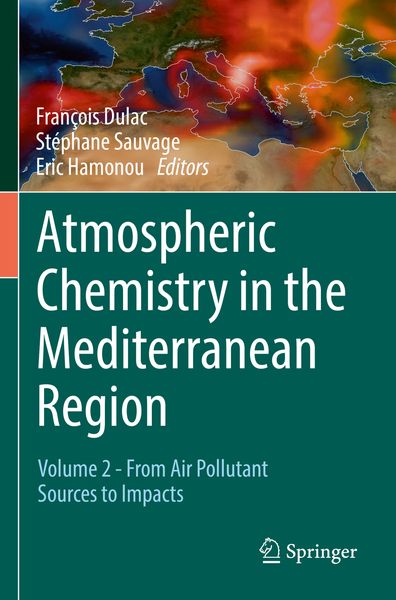
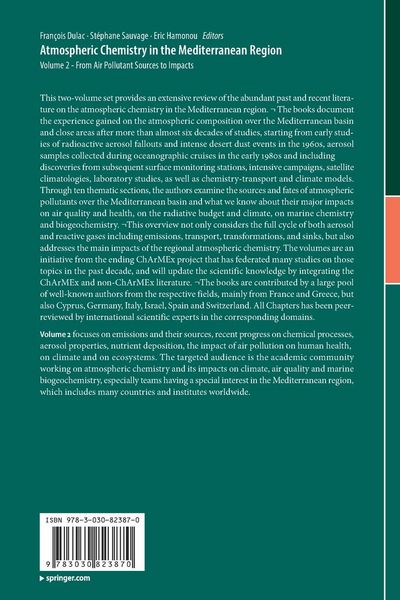
Atmospheric Chemistry in the Mediterranean Region Volume 2 - From Air Pollutant Sources to Impacts

Fr. 137.00

inkl. gesetzl. MwSt., Versandkostenfrei


Beschreibung

Produktdetails

Einband

Taschenbuch

Erscheinungsdatum

11.09.2023

Herausgeber

François Dulac + weitere

Verlag

Springer

Seitenzahl

601

Maße (L/B/H)

23.5/15.5/3.5 cm

Gewicht

972 g

Auflage

1st ed. 2022

Sprache

Englisch

ISBN

978-3-030-82387-0

Beschreibung

Portrait

Dr. François DULAC is a senior research scientist in atmospheric chemistry from the French Commissariat à l’Energie Atomique et aux Energies Alternatives (CEA). He is working at the Laboratoire des Sciences du Climat et de l’Environnement (LSCE) that is also part of CNRS, Univ. of Versailles-St-Quentin and Univ. of Paris-Saclay, and member of the Institut Pierre Simon Laplace des Sciences de l’Environnement d’Ile de France (IPSL). He co-signs 80 papers published in high-level peer reviewed international journals including 2 in Nature (Isi Web of Knowledge H-Index of 35). His main field of research is tropospheric aerosols, especially mineral dust, and their impacts on the surface ocean biogeochemistry, radiative budget, and air quality. Since his PhD in atmospheric chemistry and environmental physics (Univ. Paris-7, 1986) focused on Mediterranean aerosols, he has developed synergetic approaches based on multi parameter data, combining in situ observations, remote sensing (including one of the earliest near-real time aerosol monitoring system based on Meteosat), and model approaches. He is part of the MedCLIVAR international steering committee since 2007 and has served as program officer for atmospheric chemistry and middle atmosphere at the French Space Agency (CNES). He has initiated and coordinated the Chemistry-Aerosol Mediterranean Experiment (ChArMEx, 2010-2020), a large federative international research effort dedicated to the study of atmospheric chemistry and its impacts in the Mediterranean region.

Pr. Stéphane SAUVAGE is Full Professor in Atmospheric Sciences and Environmental Data analysis from IMT Lille Douai. IMT Lille Douai is part of the Institute Mines-Telecom (IMT), the largest national higher education engineering consortium in France : IMT sign up nearly 14,000 engineering students annually (5-year program), MSc-level, engineering degree programmes in addition to 1,650 PhD students (3-year doctoral programmes). Stéphane Sauvage is (co)author of +60 scientific articles in peer-reviewed journals. His work encompasses a long experience in receptor-oriented methods from field observations to advanced data handling. His researches mainly focus on air quality and atmospheric short life gaseous compounds for the understanding of the impacts of human activities on the atmospheric composition in a context of climate change. He has coordinated the Work package “Pollutants Sources” of ChArMEx. Since 2021, he is the head of the French consortium contributing to ACTRIS which is a Pan-European research infrastructure producing high-quality data and information on short-lived atmospheric constituents to support research on air quality and climate.

Dr. Eric HAMONOU is a senior program manager with a strong background in aerosol optical properties. He has contributed to several past international field campaigns in the Mediterranean (MEDUSE, STAAARTE) and in the world (INDOEX), and has been in chargeof the co-animation of ChArMEx. He is the cofounder and CEO of SCIENCE PARTNERS, a social economy company built by and for researchers themselves. SCIENCE PARTNERS is a new research player that brings sustainability in the career and life of freelance researchers by offering them the possibility to tailor their own permanent position. It also brings sustainability to research itself by safeguarding knowledge and know-hows inside the research ecosystem. Eric HAMONOU has also a strong background in scientific journalism. He has worked several years as a journalist for Science et Vie, the number one French popular science magazine, and he has been in charge of the creation of a Master-2 of the University of Paris-Saclay for professional journalists willing to get further insights in climate change and its impacts.


Produktdetails

Einband

Taschenbuch

Erscheinungsdatum

11.09.2023

Herausgeber

Verlag

Springer

Seitenzahl

601

Maße (L/B/H)

23.5/15.5/3.5 cm

Gewicht

972 g

Auflage

1st ed. 2022

Sprache

Englisch

ISBN

978-3-030-82387-0

Herstelleradresse

Springer-Verlag GmbH
Tiergartenstr. 17
69121 Heidelberg
DE

Email: ProductSafety@springernature.com

Kundinnen und Kunden meinen

0 Bewertungen

Informationen zu Bewertungen

Zur Abgabe einer Bewertung ist eine Anmeldung im Konto notwendig. Die Authentizität der Bewertungen wird von uns nicht überprüft. Wir behalten uns vor, Bewertungstexte, die unseren Richtlinien widersprechen, entsprechend zu kürzen oder zu löschen.

Die Bewertungen sind nach Format, Anzahl Sterne und Datum sortiert.

Verfassen Sie die erste Bewertung zu diesem Artikel

Helfen Sie anderen Kund*innen durch Ihre Meinung

Kundinnen und Kunden meinen

0 Bewertungen filtern

  • Produktbild: Atmospheric Chemistry in the Mediterranean Region
  • Produktbild: Atmospheric Chemistry in the Mediterranean Region
  • Chapter 1-Introduction.- Chapter 2-Sea spray emissions.- Chapter 3-Emissions from the Mediterranean vegetation.- Chapter 4-Aeolian erosion.- Chapter 5-Anthropogenic emissions in the Mediterranean region.- Chapter 6-Total OH reactivity.- Chapter 7-Ozone photochemical production rates [in the western Mediterranean].- Chapter 8-Nucleation in the Mediterranean atmosphere.- Chapter 9-Secondary aerosol formation and their modeling.- Chapter 10-Particle-gas multiphasic interactions.- Chapter 11-Aerosol size distribution.- Chapter 12-Aerosol composition.- Chapter 13-Mediterranean aerosol optical properties.- Chapter 14-Aerosol hygroscopicity.- Chapter 15-Mass deposition in the Mediterranean region.- Chapter 16-Nutrient deposition and variability.- Chapter 17-Trace metals and contaminants deposition.- Chapter 18-Aerosol and ozone direct radiative impact.- Chapter 19-Aerosol impact on cloud properties and regional climate.- Chapter 20-Aerosol impact on atmospheric and precipitation chemistry.- Chapter 21-Air quality and health impacts.- Chapter 22-Impact of atmospheric deposition on marine chemistry and biogeochemistry.- Chapter 23-Impact of atmospheric pollution on terrestrial ecosystems.- Chapter 24-Summary of recent progress and recommendations for future research.