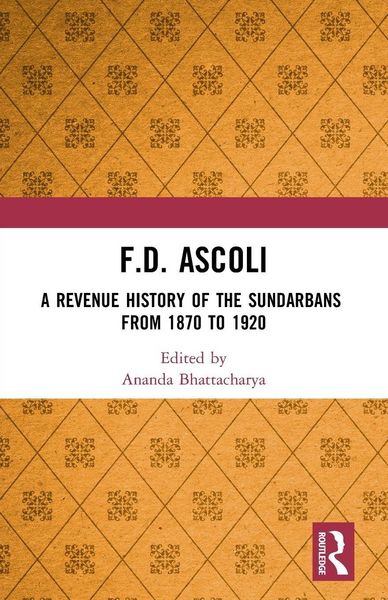
F.D. Ascoli From 1870 to 1920
-
- Hardcover
- Taschenbuch ausgewählt
- eBook
-
Sprache:Englisch
Fr. 79.90
inkl. gesetzl. MwSt.,
Beschreibung
Produktdetails
Einband
Taschenbuch
Erscheinungsdatum
25.06.2024
Herausgeber
Ananda BhattacharyaVerlag
Taylor & FrancisSeitenzahl
312
Maße (L/B/H)
21.6/14/1.7 cm
Gewicht
200 g
Sprache
Englisch
ISBN
978-1-03-265448-5
Frank David Ascoli's Revenue History of Sundarbans during the Period 1870- 1920 looks at the area bounded on the north by the limits of Permanent Settlement in 24-Parganas, Khulna and Bakarganj districts and on the south by the sea face stretching from the Hughli estuary to the mouth of the Meghna River. A quarter of this large area consisted of water out of 19,501 sq. km. For administrative purposes the Division was grouped in three circles known as the Bagerhat, Khulna and Satkhira. Revenue stations were established at all the principal points of egress from the Sundarbans, and purchasers proceed to the forests and take their requirements from any locality they choose. The process of land formation appears to have been followed by the growth of different vegetation and plants which turned into forest it left uncleared. The entire Sundarban tract is managed by the Forest Department, which has operated a yearly auction for cutting rights for many decades. In this way the Sundarbans emerged between the Bay of Bengal and the fringes of the Bengal delta. The revenue history of the Sundarbans is distinct from that of the rest of the district that presents several peculiar features, so that a separate account of it is necessary. It is apparent that some of the most forbidding remnants of Sundarbans jungle were transformed into fertile rice fields, schools, dispensaries, post offices, markets and cooperative societies.
Please note: Taylor & Francis does not sell or distribute the Hardback in India, Pakistan, Nepal, Bhutan, Bangladesh and Sri Lanka
Kundinnen und Kunden meinen
Verfassen Sie die erste Bewertung zu diesem Artikel
Helfen Sie anderen Kund*innen durch Ihre Meinung