• Produktbild: Shaping the Future of Biological Education Research
  • Produktbild: Shaping the Future of Biological Education Research

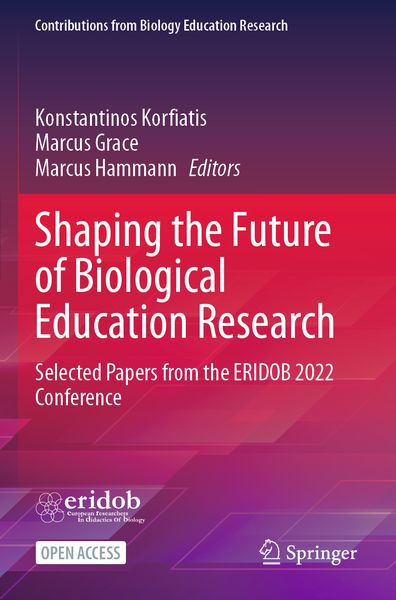
Shaping the Future of Biological Education Research Selected Papers from the ERIDOB 2022 Conference

Fr. 58.90

inkl. gesetzl. MwSt., Versandkostenfrei


Beschreibung

Produktdetails

Einband

Taschenbuch

Erscheinungsdatum

02.12.2023

Herausgeber

Konstantinos Korfiatis + weitere

Verlag

Springer

Seitenzahl

353

Maße (L/B/H)

23.5/15.5/2.1 cm

Gewicht

563 g

Auflage

1st ed. 2024

Sprache

Englisch

ISBN

978-3-031-44794-5

Beschreibung

Portrait

Konstantinos Korfiatis  is Professor of Environmental Education at the Department of Education, University of Cyprus. His research interests expand to the areas of environmental education, ecology and sustainability education. In particular, he explores the concepts of children participation, motivation and agency through climate change and school-garden programmes. He currently is a member of the Academic Committee of ERIDOB.  

Marcus Grace  is Professor of Science Education and Head of the Education School at the University of Southampton, UK. His main interests include learning and teaching about socio-scientific issues, particularly biodiversity conservation and outdoor science education. He has served as a Chair of the Academic Committee of ERIDOB, and has researched and published widely on education for socio-scientific issues with colleagues around the world. 

Marcus Hammann  is Professor of Biology Education atMünster University, Germany. His research interests include cognitive and affective aspects of evolution and genetics education. He is co-editor of Contributions from Biology Education Research (CBER), the Springer international book series of the European Researchers in Didactics of Biology (ERIDOB) and Chair of the Academic Committee of ERIDOB. 

Produktdetails

Einband

Taschenbuch

Erscheinungsdatum

02.12.2023

Herausgeber

Verlag

Springer

Seitenzahl

353

Maße (L/B/H)

23.5/15.5/2.1 cm

Gewicht

563 g

Auflage

1st ed. 2024

Sprache

Englisch

ISBN

978-3-031-44794-5

Herstelleradresse

Springer-Verlag GmbH
Tiergartenstr. 17
69121 Heidelberg
DE

Email: ProductSafety@springernature.com

Kundinnen und Kunden meinen

0 Bewertungen

Informationen zu Bewertungen

Zur Abgabe einer Bewertung ist eine Anmeldung im Konto notwendig. Die Authentizität der Bewertungen wird von uns nicht überprüft. Wir behalten uns vor, Bewertungstexte, die unseren Richtlinien widersprechen, entsprechend zu kürzen oder zu löschen.

Die Bewertungen sind nach Format, Anzahl Sterne und Datum sortiert.

Verfassen Sie die erste Bewertung zu diesem Artikel

Helfen Sie anderen Kund*innen durch Ihre Meinung

Kundinnen und Kunden meinen

0 Bewertungen filtern

  • Produktbild: Shaping the Future of Biological Education Research
  • Produktbild: Shaping the Future of Biological Education Research
  • Part I: Teaching Strategies and Learning Environments : Chapter 1.  Using Physical and Virtual Labs for Experimentation in STEM+ Education: From Theory and Research to Practice(Yvoni Pavlou and Zacharias C. Zacharia).- Chapter2.  Problematisation, Narrative and Fiction in The Science Classroom(Catherine Bruguière and Denise Orange Ravachol).- Chapter 3.  Using External Representations to Support Mathematical Modelling Competence in Biology Education(Benjamin Stöger and Claudia Nerdel).- Chapter 4. The Effect of Adult Intervention in The Development of Science Process Skills)(María Napal Fraile, Lara Vázquez Bienzobas, Isabel Zudaire and Irantzu Uriz Doray).- Chapter 5.     Facilitating the Practice of 4 C Skills in Biology Education through Educational Escape Rooms (Georgios Villias and Mark Winterbottom).- Chapter 6.  Museum Guides’ Views on the Integration of Nature of Science While Addressing Visitors’ Experiences:The Context of Ecological and Evolutionary Issues(Anna Pshenichny-Mamo and Dina Tsybulsky).- Chapter 7.  Friends or Foes? Microorganisms in Greek School Textbooks(Georgios Ampatzidis and Anastasia Armeni).-  Part II: Students’ Knowledge, Conceptions, Values, Attitudes and Motivation. Chapter 8.   Investigative School Research Projects in Biology: Effects on Students(Wilton G. Lodge, Michael J Reiss and Richard Sheldrake).- Chapter9.   Investigating Relationships Between Epistemological Beliefs and Personal Beliefs in Biological Evolution(Andreani Baytelman, Theonitsa Loizou and Salomi Hadjiconstantinou).- Chapter 10.  Plant Blindness Intensity Throughout the School and University Years: A Cross-Age Study(Alexandros Amprazis and Penelope Papadopoulou).- Chapter 11. Where Do Plants Get Their Mass From? Using Drawings to Assess Adolescent Students’ Modelling Skills and Their Ideas About Plant Growth.(Eliza Rybska, Joanna Wojtkowiak, Zofia Chyleńska, Costas Constantinou and Pantelitsa Karnaou).- Chapter 12. Diagnosing of Valuing and Decision-Making Competencies in Biology Lessons (Malte Ternieten and Doris Elster).- Chapter 13.  Factors Influencing the Intention of Students in Regard to Stem Cell Donation for Leukemia Patients - A Comparison of Non-Intenders and Intenders (Julia Holzer & Doris Elster).- Chapter 14.   Mapping Adolescents' Nutritional Knowledge(Martha Georgiou and Matina Moshogianni).-  Part III: Outdoor and Environmental Education. Chapter 15.  1Implementing Climate Change Education: The Role of Inter-Sectorial Collaborations(Nofar Naugauker, Orit Ben Zvi Assaraf, Daphne Goldman and Efrat Eilam).- Chapter 16.  From Curriculum to Enacted Teaching of Photosynthesis: The Carbon Cycle and Sustainability in an Upper Primary School Class( Lina Varg).- Chapter 17.  Primary Students' Visions Regarding Environmental Factors Influencing Biodiversity in Specific Environments(Chadia Rammou, Arnau Amat, Isabel Jiménez Bargalló and Jordi Martí).- Chapter 18.  Learning Biology in the Early Years through Nature Play in The Forest: An Exploratory Study from Slovenia(Marjanca Kos, Sue Dale Tunnicliffe, Luka Praprotnik and Gregor Torkar).- Chapter 19.  Personal Relevance in Secondary School Students’ Nature Experiences (Marcus Hammann).- Chapter 20.  Challenges Emerged During an Action Research Approach Applied in a Schoolgarden Project: Reflections and Revisions(Anthi Christodoulou and Konstantinos Korfiatis).- Pa rt IV: Biology teachers’ professional development. Chapter 21.    Assessing the quality of mentoring: Evidence-Based Development of a training programme for biology teachers for scientific issues (Emanuel Nestler, Carolin Retzlaff-Fürst and Jorge Gross).- Chapter 22.  Exploring a Theory-Practice-Gap: An Investigation of Pre-Service Biology Teachers’ Enacted TPACK(Alexander Aumann and Holger Weitzel).- Chapter 23.  Promoting Digitally Supported Inquiry Learning in Diverse Classrooms through Teacher Training(Patrizia Weidenhiller, Susanne Miesera and Claudia Nerdel).- Chapter 24.  Implementation Processes: Sustainable Integration of Biotechnology Experiments into Schools(Sara Grossbruchhaus, Patricia Schöppner and Claudia Nerdel).