Gutscheinbedingungen

*Gültig bis 07.06.2026 auf (fast) alles. Ausgeschlossen sind Smartboxen, Zeitschriften, Tickets, Lebensmittel, Gaming-Elektroartikel, Tinte/Toner, Gutscheine, Geschenkkarten, Blumen und Abos | Einlösbar in allen Buchhandlungen von Orell Füssli, Barth Bücher, Buchladen Rapunzel, Schuler Orell Füssli, Stauffacher und ZAP unter Vorweisung des Gutscheins, auf www.orellfüssli.ch durch Eingabe des Gutscheincodes. Beim Service „eBooks verschenken“ und bei eBook-Käufen via eReader nicht einlösbar | Mindesteinkaufswert: Fr. 100.- | Nicht mit anderen Rabatten kumulierbar.

  • Produktbild: Phytonanotechnology
  • Produktbild: Phytonanotechnology

Phytonanotechnology

Fr. 191.00

inkl. gesetzl. MwSt., Versandkostenfrei


Beschreibung

Produktdetails

Einband

Taschenbuch

Erscheinungsdatum

22.09.2023

Herausgeber

Maulin P. Shah + weitere

Verlag

Springer Singapore

Seitenzahl

336

Maße (L/B/H)

23.5/15.5/1.9 cm

Auflage

1st ed. 2022

Sprache

Englisch

ISBN

978-981-19-4813-8

Beschreibung

Portrait

Dr. Maulin P. Shah is interested in genetic adaptation processes in bacteria. He has more than 120 research publications in highly reputable national and international journals. He directs the research program at Enviro Technology Ltd., Ankleshwar, India. He has guided more than 100 post-graduate students in various disciplines of life science. He is an active editorial board member in more than 150 renowned journals in the field of environmental and biological sciences. He was the founder and editor-in-chief of the International Journal of Environmental Bioremediation and Biodegradation (2012–2014) and the Journal of Applied & Environmental Microbiology (2012–2014) [Science and Education publishing (SciEP), USA]. He is also serving as a reviewer for various journals of national and international repute. Recently, he has been awarded a Young Biotechnologist Medal by the Biotechnological Society of Nepal. He has edited 115 books in the area of wastewater microbiology and industrialwastewater Treatment. He is the Editor In Chief of Biotechnology & Genetic Engineering Reviews- Taylor & Francis.

Arpita Roy is currently working as an assistant professor in the Department of Biotechnology, Sharda University, India, with a specialisation in plant biotechnology, nanobiotechnology, environmental biotechnology and microbiology. She has been teaching graduate- and postgraduate-level biotechnology. She has taught topics related to plant biotechnology, microbiology, bioprocess engineering and solid waste management. She has authored more than 25 scientific articles and 14 book chapters. She has participated and presented at numerous state, national and international conferences, seminars, workshops and symposiums. She has received the Commendable Research Award for excellence in research during the years 2019, 2020 and 2021 from Delhi Technological University, and she has served as an editorial board member and reviewer of international journals.

Produktdetails

Einband

Taschenbuch

Erscheinungsdatum

22.09.2023

Herausgeber

Verlag

Springer Singapore

Seitenzahl

336

Maße (L/B/H)

23.5/15.5/1.9 cm

Auflage

1st ed. 2022

Sprache

Englisch

ISBN

978-981-19-4813-8

Herstelleradresse

Springer-Verlag GmbH
Tiergartenstr. 17
69121 Heidelberg
DE

Email: ProductSafety@springernature.com

Kundinnen und Kunden meinen

0 Bewertungen

Informationen zu Bewertungen

Zur Abgabe einer Bewertung ist eine Anmeldung im Konto notwendig. Die Authentizität der Bewertungen wird von uns nicht überprüft. Wir behalten uns vor, Bewertungstexte, die unseren Richtlinien widersprechen, entsprechend zu kürzen oder zu löschen.

Die Bewertungen sind nach Format, Anzahl Sterne und Datum sortiert.

Verfassen Sie die erste Bewertung zu diesem Artikel

Helfen Sie anderen Kund*innen durch Ihre Meinung

Kundinnen und Kunden meinen

0 Bewertungen filtern

  • Produktbild: Phytonanotechnology
  • Produktbild: Phytonanotechnology
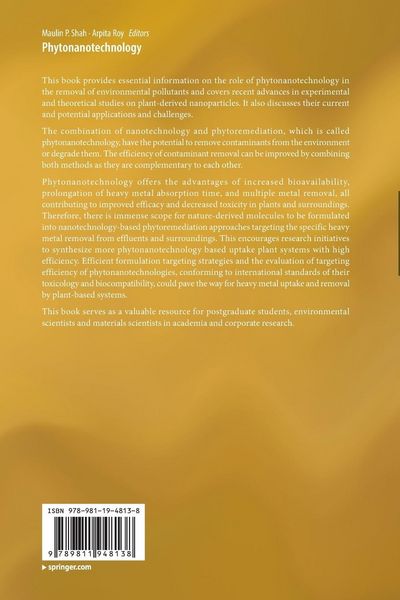
  • - Plant synthesized nanoparticles for dye degradation.- Plant-Mediated Green Synthesis of Nanoparticles for Photocatalytic Dye Degradation.- Plant-derived nanoparticles for heavy metal remediation.- Biomedical applications of phytonanotechnology.- Application of nanotechnology in plant secondary metabolites production.- Applications of Nanotechnology in Preservation and Development of the Plants: A Look Back.- Environmental applications of Phytonanotechnology: a promise to sustainable future.- Phytonanotechnological Approach for Silver Nanoparticles: Mechanistic Aspect, Properties and Reliable Heavy Metal Ion Sensing.- Plant Material Assisted Magnetic Nanoparticles (MNPs) for the Separation of Inorganic Pollutants.- Environmental Applications of Green Engineered Silver Nanoparticles.- Bioremediation of heavy metal contaminated sites using phytogenic nanoparticles.- Environmental applications of green engineered copper nanoparticles.- Plant mediated nanocomposites for water remediation.- Photocatalytic degradation of dye from various metal/metal oxides derived from diverse plants.- Phytonanotechnology for the removal of pollutants from the contaminated soil environment.