Gutscheinbedingungen

*Gültig bis 07.06.2026 auf (fast) alles. Ausgeschlossen sind Smartboxen, Zeitschriften, Tickets, Lebensmittel, Gaming-Elektroartikel, Tinte/Toner, Gutscheine, Geschenkkarten, Blumen und Abos | Einlösbar in allen Buchhandlungen von Orell Füssli, Barth Bücher, Buchladen Rapunzel, Schuler Orell Füssli, Stauffacher und ZAP unter Vorweisung des Gutscheins, auf www.orellfüssli.ch durch Eingabe des Gutscheincodes. Beim Service „eBooks verschenken“ und bei eBook-Käufen via eReader nicht einlösbar | Mindesteinkaufswert: Fr. 100.- | Nicht mit anderen Rabatten kumulierbar.

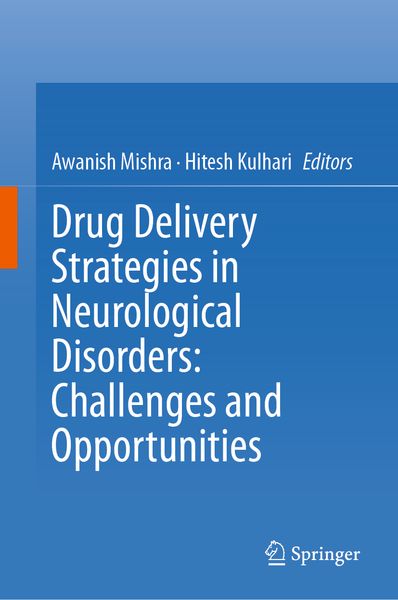
  • Produktbild: Drug Delivery Strategies in Neurological Disorders: Challenges and Opportunities
  • Produktbild: Drug Delivery Strategies in Neurological Disorders: Challenges and Opportunities

Drug Delivery Strategies in Neurological Disorders: Challenges and Opportunities

Fr. 201.00

inkl. gesetzl. MwSt., Versandkostenfrei


Beschreibung

Produktdetails

Einband

Gebundene Ausgabe

Erscheinungsdatum

29.02.2024

Herausgeber

Awanish Mishra + weitere

Verlag

Springer Singapore

Seitenzahl

453

Maße (L/B/H)

24.1/16/3.1 cm

Auflage

1. Auflage

Sprache

Englisch

ISBN

978-981-9968-06-0

Beschreibung

Portrait

Dr. Awanish Mishra is an assistant professor in the Department of Pharmacology and Toxicology at the National Institute of Pharmaceutical Sciences and Drug Research, Guwahati. He has earlier served as assistant professor in the Department of Pharmacology and Toxicology at the National Institute of Pharmaceutical Sciences and Drug Research, Raebareli (2013-2020). He is focused on understanding the molecular mechanisms for the development of neurological diseases (like epilepsy, Alzheimer’s disease, and Parkinson's disease) and associated psychiatric comorbidities. He has added interest in how groundwater pollutants (arsenic, iron, copper, fluoride) and insecticides (especially organophosphates) are causing neurotoxicity and how natural bioactive molecules are useful in mitigating the same. In addition, he is also working on utilizing nanomedicine in neurological disorders and the evaluation of toxicological aspects of nanomedicine. He has more than 11 years of teaching experience in Pharmacology, Toxicology, Drug Metabolism, Pharmacological screening models of various diseases. He has contributed more than 55 peer-reviewed articles in international journals, authored 14 book chapters, and filed 3 patents. He is a member of many international scientific societies and organizations importantly, Indian Pharmacological Society, Indian Academy of Neuroscience, and Laboratory Animal Science Association of India and Editorial member to various prestigious journals like Metabolic Brain Disease (Springer Nature), etc.


Dr. Hitesh Kulhari is an assistant professor at the School of Nano Sciences, Central University of Gujarat, Gandhinagar. Previously, he worked as associate professor at the Department of Pharmaceutical Technology (Formulations) at the National Institute of Pharmaceutical Sciences and Drug Research, Guwahati. Dr. Kulhari received his PhD degree from RMIT University, Melbourne, Australia in the area of Nanomedicines. His research focuses on designing targeted drug delivery systems and pharmaceutical nanotechnology. He has published 71 research articles in peer-reviewed international journals, 14 book chapters and edited 01 book on pharmaceutical applications of dendrimers. Dr. Kulhari is a recipient of several awards and research grants including Prof CNR Rao Research Excellence Award in material science in 2015, INSPIRE faculty award from DST, New Delhi in 2015, and appreciation award from Cancer Research Foundation, India in 2020. He has more than 13 years of teaching and research experience in pharmaceutical technology, biopharmaceutics, and nanotechnology.

Produktdetails

Einband

Gebundene Ausgabe

Erscheinungsdatum

29.02.2024

Herausgeber

Verlag

Springer Singapore

Seitenzahl

453

Maße (L/B/H)

24.1/16/3.1 cm

Auflage

1. Auflage

Sprache

Englisch

ISBN

978-981-9968-06-0

Herstelleradresse

Springer-Verlag KG
Sachsenplatz 4-6
1201 Wien
AT

Email: ProductSafety@springernature.com

Kundinnen und Kunden meinen

0 Bewertungen

Informationen zu Bewertungen

Zur Abgabe einer Bewertung ist eine Anmeldung im Konto notwendig. Die Authentizität der Bewertungen wird von uns nicht überprüft. Wir behalten uns vor, Bewertungstexte, die unseren Richtlinien widersprechen, entsprechend zu kürzen oder zu löschen.

Die Bewertungen sind nach Format, Anzahl Sterne und Datum sortiert.

Verfassen Sie die erste Bewertung zu diesem Artikel

Helfen Sie anderen Kund*innen durch Ihre Meinung

Kundinnen und Kunden meinen

0 Bewertungen filtern

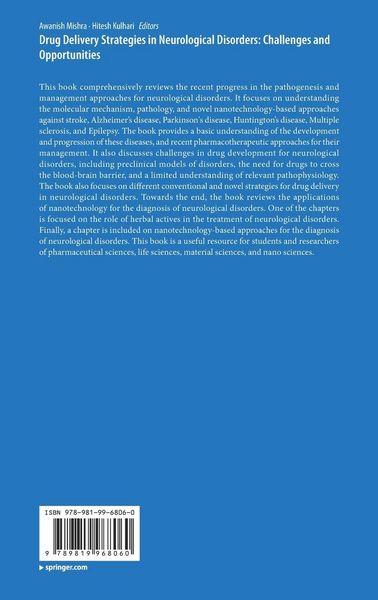
  • Produktbild: Drug Delivery Strategies in Neurological Disorders: Challenges and Opportunities
  • Produktbild: Drug Delivery Strategies in Neurological Disorders: Challenges and Opportunities
  • Section A: Anatomy and Physiology of Human Nervous System.- Chapter 1. Nanocarriers as an emerging tool for drug delivery to combat neurodegenerative diseases.- Chapter 2. Challenges in drug development for neurological disorders.- Chapter 3. Transporter systems and metabolism at the blood-brain barrier and blood-CSF barrier.- Section B: Pathophysiology and management of Neurological disorders.- Chapter 4. Pathophysiology and management approaches for Alzheimer’s Disease.- Chapter 5. Pathophysiology and management approaches for Parkinson's Disease.- Chapter 6 Pathophysiology and management approaches for Epilepsy.- Chapter 7. Pathophysiology and management approaches for Epilepsy.- Chapter 8. Pathophysiology and management approaches for Multiple Sclerosis, Huntington’s disease, and other neurodegenerative diseases.- Chapter 9. Genes Encoding Ion Channels in Neurotherapeutics: Opportunities and Challenges.- Chapter 10. Herbal approaches for the management of neurological disorders.- Section C: Drug Delivery Strategies in Neurological disorders.- Chapter 11. Essential Considerations for brain delivery of nanoformulations.- Chapter 12. Drug delivery strategies in Alzheimer’s disease.- Chapter 13. Drug delivery strategies in Parkinson's disease.- Chapter 14. Drug delivery strategies in Epilepsy.- Chapter 15. Drug delivery strategies in Traumatic Brain Injury.- Chapter 16. Drug delivery strategies in Multiple Sclerosis, Huntington’s disease, and other neurodegenerative diseases.- Chapter 17. Nose-to-brain strategies for neurological disorders.- Chapter 18. Drug delivery strategies for the delivery of natural compounds to the brain.