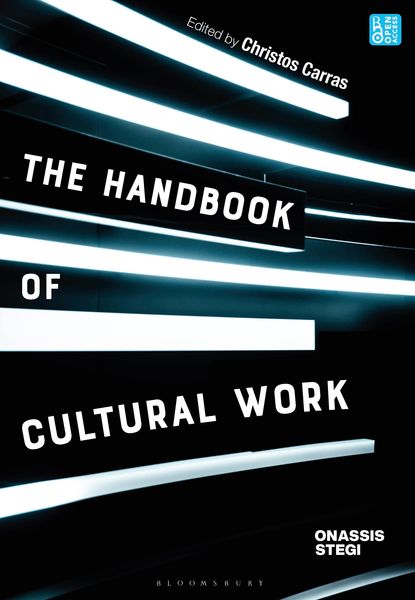
Table of Contents
List of Illustrations
Notes on Contributors
Acknowledgements
Foreword: Cultural Work in a Complex World
Introduction to the Handbook of Cultural Work, Christos Carras (Onassis Cultural Centre, Greece)
Part One: Spaces of cultural action
1.1. Cultural and creative districts in a changing Europe, Adrian Ellis (Global Cultural District Network, UK / Turkey)
1.2. Transformative arts. Community theatre as democratic infrastructure, Jasmina Ibrahimovic (Rotterdam Wijktheater, Bosnia and Herzegovina / Netherlands) & Catherine Koekoek (Erasmus Universiteit Rotterdam, The Netherlands)
1.3. The power of neglected spaces, Mieke Renders (BE, Manager for urban and rural regeneration, Belgium)
1.4. Spaces of cultural action: focusing on working in and with communities, in public spaces, in urban districts or rural areas, or across borders, Piotr Michalowski (European Network of Cultural Centres, Poland)
1.5. Places for life, Gundega Laivina (Pratt Institute, NY, Latvia)
1.6. The street, the field, the workshop and the stage: staging grounds for transdisciplinary urban enquiry, Dr. John Bingham-Hall (Theatrum Mundi, UK)
1.7. Artists Without Borders - Building a case for cultural policies that transcend nations, Milica Ilic (Office National de Diffusion Artistique, Serbia)
Part Two: Cross-sectoral cultural action
2.1. New Cultural Policies for Enabling Cross-Sectoral Positive Transformation, Sylvia Amann (IDEA Consult / Creative FLIP, Denmark)
2.2. Culture and well-being - a promising area of cross-sectoral action, Rarita Zbranca (Cluj Cultural Centre, Romania)
2.3. Navigating the digital future, Kristina Maurer (S+T+ARTS, EU) & Veronika Liebl (Ars Electronica Centre, Austria)
2.4. The Lion and the Mouse - The move from informal to formal education in Brussels, Christophe De Jaeger (Gluon - Platform for Art, Science, and Technology, Belgium)
2.5. Artistic Thinking and Societal Change, Dr. Jaana Erkkilä-Hill (University of the Arts, Finland)
Part Three: Politics, Power & Access
3.1. The meaning of participation, François Matarasso (A Restless Art / Independent researcher / blogger, France)
3.2. How can culture and the arts recover and reaffirm values of solidarity? Strategy and action from a network of municipalities, Marta Martins (Artemrede, Portugal)
3.3. Et maintenant, on va où? Diversity in arts and culture: between formal correctness and genuine needs, Yamam Al-Zubaidi (National Touring Theatre of Sweden, Iraq / Sweden)
3.4. Road of Oblivion and Love: Orchestrated Ebbs and Flows in Romany Cultural Development, Vasil Chaprazov (Roma public intellectual, Bulgaria)
3.5. Art, Aesthetics, and Access: disability and contemporary cultural practice, Ben Evans (British Council, UK)
3.6. A call to bear witness, Christina Varvia (GR, Forensic Architecture)
Part Four: The cultural economy, funding, and policies in Europe
4.1. The busy intersection of cultural and social policy, Tere Badia (Culture Action Europe, Belgium / Estonia) & Gabriele Rosana
4.2. For Culture to address global challenges - the 2022 Recommendation of the Council of Europe, Philippe Kern (KEA, France)
4.3. Imagine! Philanthropy for Europe, André Wilkens (NEMO, Amsterdam), Isabelle Schwarz& Tsveta Andreeva (European Cultural Foundation, Amsterdam)
4.4. The potential of crowdfunding in culture, Isabelle De Voldere (IDEA Consult, Belgium) & Martina Fraioli (European Network of Cultural Centres, Belgium)
4.5. Cultural entrepreneurship and funding policies in Europe, Annick Schramme (University of Antwerp, Belgium)
Part Five: Culture, the climate emergency and the Sustainable Development Goals
5.1. Senses of Purpose, Lucia Pietroiusti (Serpentine Galleries, UK / Italy)
5.2. Culture and the Sustainable Development Goals, Christos Carras (Onassis Cultural Centre, Greece)
5.3. Environmental Policy Frameworks and Cultural Work, Iphigenia Taxopoulou (Julie's Bicycle, UK / Greece)
5.4. Theatre into the Doughnut, Caroline Barneaud, Darious Ghavami & Tristan Pannatier (Théâtre Vidy-Lausanne, Switzerland)
5.5. What Would It Mean to Restitute to Earth All We Have Taken from the Earth? Decolonial Aesthesis and Transition in Art, Design, and Fashion, a Discussion between Hicham Khalidi and Rolando Vázquez (Van Eyck Academy, Netherlands / Mexico)
5.6. Ecological sensing of "aquaforming" in the age of Aquatocene, Robertina Sebjanic (HR/SI, Artist, Croatia / Slovenia)
Part Six: The digital transformation of cultural practice
6.1. The Digital Transformation of Cultural Practice, Oonagh Murphy (Goldsmiths, University of London, UK / Ireland)
6.2. The interdependence of networked archives, Alessandro Ludovico (Neural / Winchester School of Art, University of Southampton, UK / Italy)
6.3. How to communicate, collaborate and distribute - Canal180's decade-long learnings, case studies and contributions from our network, João Vasconcelos (Canal 180, Portugal)
6.4. Platform fever, Prodromos Tsiavos (Onassis Cultural Centre, Greece)
Index