• Produktbild: Inclusive Pedagogical Practices Amidst a Global Pandemic
  • Produktbild: Inclusive Pedagogical Practices Amidst a Global Pandemic
Band 7

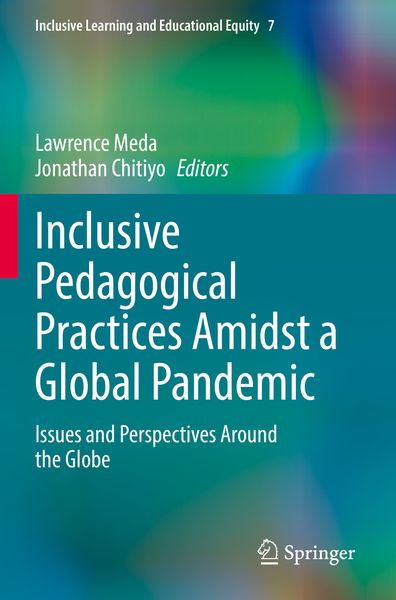
Inclusive Pedagogical Practices Amidst a Global Pandemic Issues and Perspectives Around the Globe

Fr. 137.00

inkl. gesetzl. MwSt., Versandkostenfrei


Beschreibung

Produktdetails

Einband

Taschenbuch

Erscheinungsdatum

25.09.2023

Herausgeber

Lawrence Meda + weitere

Verlag

Springer

Seitenzahl

311

Maße (L/B/H)

23.5/15.5/1.8 cm

Gewicht

493 g

Auflage

1st ed. 2022

Sprache

Englisch

ISBN

978-3-031-10644-6

Beschreibung

Portrait

Dr. Lawrence Meda holds a PhD in Curriculum Studies. He is currently working as an Associate Professor and Director of Research at Sharjah Education Academy in the United Arab Emirates. He is a certified online instructor and very passionate about research. His main research interests are in Inclusive Education, Curriculum Studies, Educational Technology and Teacher Education. He has supervised Masters and Doctoral students and published in high impact accredited journals.

Jonathan Chitiyo holds a PhD in special education from Southern Illinois University Carbondale, USA. He is currently working as Associate Professor of Special Education and Director of Teacher Education at the University of Pittsburgh at Bradford, USA. His research interests include the implementation of different school-based practices, factors affecting the education of vulnerable children, and the development of special education systems in developing countries, especially in Africa.

Produktdetails

Einband

Taschenbuch

Erscheinungsdatum

25.09.2023

Herausgeber

Verlag

Springer

Seitenzahl

311

Maße (L/B/H)

23.5/15.5/1.8 cm

Gewicht

493 g

Auflage

1st ed. 2022

Sprache

Englisch

ISBN

978-3-031-10644-6

Herstelleradresse

Springer-Verlag KG
Sachsenplatz 4-6
1201 Wien
AT

Email: ProductSafety@springernature.com

Kundinnen und Kunden meinen

0 Bewertungen

Informationen zu Bewertungen

Zur Abgabe einer Bewertung ist eine Anmeldung im Konto notwendig. Die Authentizität der Bewertungen wird von uns nicht überprüft. Wir behalten uns vor, Bewertungstexte, die unseren Richtlinien widersprechen, entsprechend zu kürzen oder zu löschen.

Die Bewertungen sind nach Format, Anzahl Sterne und Datum sortiert.

Verfassen Sie die erste Bewertung zu diesem Artikel

Helfen Sie anderen Kund*innen durch Ihre Meinung

Kundinnen und Kunden meinen

0 Bewertungen filtern

  • Produktbild: Inclusive Pedagogical Practices Amidst a Global Pandemic
  • Produktbild: Inclusive Pedagogical Practices Amidst a Global Pandemic
  • Acknowledgements.- Chapter 1. Introducing the road to inclusion during the COVID-19 global pandemic (Lawrence Meda and Jonathan Chitiyo).- Chapter 2. Students with disabilities in inclusive educational settings in Poland (Joanna Głodkowska, Barbara Marcinkowska and Emilia Wojdyła).- Chapter 3. Inclusion of economically deprived secondary school children in virtual-based learning during COVID-19 in Malawi (Louis Akpan and Omolara Oluwatuyi-Akpan).- Chapter 4. Inclusion and the right to education in Latin America and the Caribbean: policies, resources, and good practice in the COVID-19 social and educational emergency (Andres Paya Rico).- Chapter 5. On the cultivation of autonomous learning during times of a pandemic: pedagogical implications of inclusive online education (Naima Al-husban and Yusef Waghid).- Chapter 6. It takes a village: preparing Chinese immigrant families for remote learning of their children with disabilities (Lusa Lo and Kathy Tsang).- Chapter 7. Factors influencingfive Foundation Phase teachers’ teaching experiences during COVID-19 in an inclusive suburban school (Carin Stollz, Heather Phillips, and Janet Condy).- Chapter 8. The potential of online education: beyond the status quo of equity and inclusion (Meaghan Krazinski and Megan Cartier).- Chapter 9. Perspectives on reconceptualizing and recontextualizing schools' inclusive culture for students with disabilities during the COVID-19 pandemic (Efthymia Efthymiou).- Chapter 10. Inclusive art pedagogies for refugee children and youth with mental health disabilities during COVID-19: a Canadian perspective (Susan Barber).- Chapter 11. Supporting students with disabilities in transition: collaboration between school counselors and special educators (Sara McDaniel, Zachary Pietrantoni, and Szu-Yu Chen).- Chapter 12. The spirit of volunteerism: supporting young children of medical workers during the COVID-19 pandemic in the United Arab Emirates (Lawrence Meda).- Chapter 13 Collaborative roles of rural school managers to benefit learners within inclusive education (Patrick Mweli and Ntombizandile Gcelu).- Chapter 14. Teaching in a global pandemic: experiences of five educators supporting students with disabilities in inclusive classrooms in the United States (Adam Moore, Abigail Higgins, Carly Doulette, Kayla Hoff, & Simoneil Sarbh).- Chapter 15. Educators coming together to empower learners, families, and teachers in developing culturally responsive/sustaining postsecondary transition plans during COVID-19 (Rebekka Jez, Keitha Osborne, and Clara Hauth).- Chapter 16. Understanding life in lockdown for autistic young people in Northern Ireland (Gillian O’Hagan and Bronagh Byrne).- Chapter 17. Inclusive educational practices in Turkey during the period of COVID-19 (Ismail Mirici).- Chapter 18. Inclusive pedagogical practices amidst a global pandemic: Lessons learnt from across the globe (Jonathan Chitiyo and Lawrence Meda).- Index.