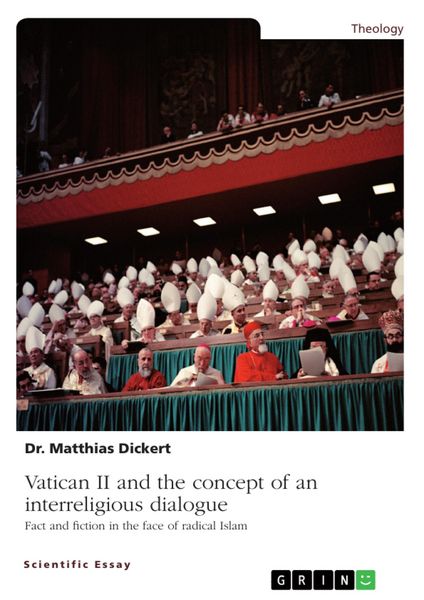
Vatican II and the concept of an interreligious dialogue. Fact and fiction in the face of radical Islam
-
- Taschenbuch
- eBook ausgewählt
-
Form:Einzelkauf Download
-
Sprache:Englisch
Fr. 17.90
inkl. gesetzl. MwSt.Beschreibung
Produktdetails
Format
Kopierschutz
Nein
Family Sharing
Nein
Text-to-Speech
Nein
Erscheinungsdatum
31.08.2023
Verlag
GRINSeitenzahl
35 (Printausgabe)
Dateigröße
1651 KB
Sprache
Englisch
EAN
9783346931986
Scientific Essay from the year 2023 in the subject Theology - Islamic theology, Leuven Catholic University, course: LEST XIV: 60 Years Vatican II: The End of the Western Church?, language: English, abstract: Vatican II and its progressive declaration of the Roman Catholic Church in dealing with other religions, "Nostra Aetate", meant a turning point for the traditional Christian - non Christian relationship. This traditionally mostly negative relationship between the Catholic Church and other religions was now radically discussed anew and put on another scale with the aim of an improvement between all religions. A special focus hereby was put on a new approach with Judaism and above all Islam.
The history between Islam and Christianity for centuries was accompanied by political and religious conflicts and wars, which were marked by the notions of jihad and crusade.
It was in this antagonistic atmosphere where the famous four "Cs" of the West (Conquest, Commerce, Civilization and Christianity) were followed by terrorism and fundamentalism on the Muslim side.
Fundamental thinking, in fact, has not left the relationship between Islam and Christianity and the attitude to the West and Christianity in the Muslim world have turned to a more radical attitude since the Shah was overthrown in 1979 in Iran. One can take this date as the beginning of events such as 9/11, the Gulf Wars or the wars in Afghanistan and Syria where the Islamic State proclaimed a new and even more radical era between Islam and Christianity with the establishment of the caliphate, the geographical, political and religious expression of fundamental Islamic thinking.
Things have not yet improved to the better since developments like globalization processes are presently challenging traditional religions with a tendency to fundamental thinking as the (seemingly) best adapted form of the religious in times of globalization and massive migration waves due to war, poverty, hunger or environment pollution.
All these developments are constantly challenging the positive basis of an interreligious dialogue between Muslims and Christians, which during the last sixty years was marked by progress and regression on both sides alike.
The history between Islam and Christianity for centuries was accompanied by political and religious conflicts and wars, which were marked by the notions of jihad and crusade.
It was in this antagonistic atmosphere where the famous four "Cs" of the West (Conquest, Commerce, Civilization and Christianity) were followed by terrorism and fundamentalism on the Muslim side.
Fundamental thinking, in fact, has not left the relationship between Islam and Christianity and the attitude to the West and Christianity in the Muslim world have turned to a more radical attitude since the Shah was overthrown in 1979 in Iran. One can take this date as the beginning of events such as 9/11, the Gulf Wars or the wars in Afghanistan and Syria where the Islamic State proclaimed a new and even more radical era between Islam and Christianity with the establishment of the caliphate, the geographical, political and religious expression of fundamental Islamic thinking.
Things have not yet improved to the better since developments like globalization processes are presently challenging traditional religions with a tendency to fundamental thinking as the (seemingly) best adapted form of the religious in times of globalization and massive migration waves due to war, poverty, hunger or environment pollution.
All these developments are constantly challenging the positive basis of an interreligious dialogue between Muslims and Christians, which during the last sixty years was marked by progress and regression on both sides alike.
Kundinnen und Kunden meinen
Verfassen Sie die erste Bewertung zu diesem Artikel
Helfen Sie anderen Kund*innen durch Ihre Meinung