Gutscheinbedingungen

*Gültig bis 07.06.2026 auf (fast) alles. Ausgeschlossen sind Smartboxen, Zeitschriften, Tickets, Lebensmittel, Gaming-Elektroartikel, Tinte/Toner, Gutscheine, Geschenkkarten, Blumen und Abos | Einlösbar in allen Buchhandlungen von Orell Füssli, Barth Bücher, Buchladen Rapunzel, Schuler Orell Füssli, Stauffacher und ZAP unter Vorweisung des Gutscheins, auf www.orellfüssli.ch durch Eingabe des Gutscheincodes. Beim Service „eBooks verschenken“ und bei eBook-Käufen via eReader nicht einlösbar | Mindesteinkaufswert: Fr. 100.- | Nicht mit anderen Rabatten kumulierbar.

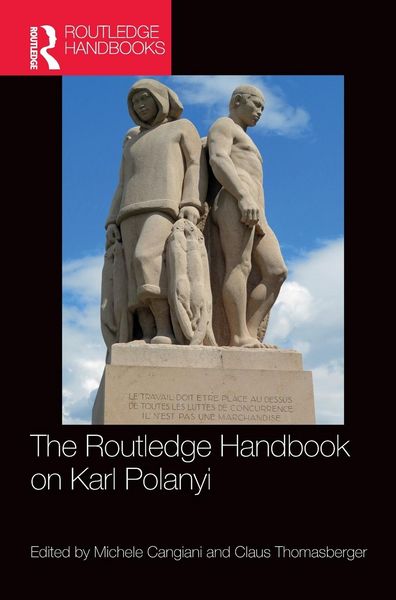
  • Produktbild: The Routledge Handbook on Karl Polanyi
  • Produktbild: The Routledge Handbook on Karl Polanyi

The Routledge Handbook on Karl Polanyi

Fr. 389.00

inkl. gesetzl. MwSt., Versandkostenfrei


Beschreibung

Produktdetails

Einband

Gebundene Ausgabe

Erscheinungsdatum

05.02.2024

Herausgeber

Michele Cangiani + weitere

Verlag

Taylor & Francis

Seitenzahl

418

Maße (L/B/H)

25/17.5/2.7 cm

Gewicht

860 g

Sprache

Englisch

ISBN

978-1-03-237383-6

Beschreibung

Rezension

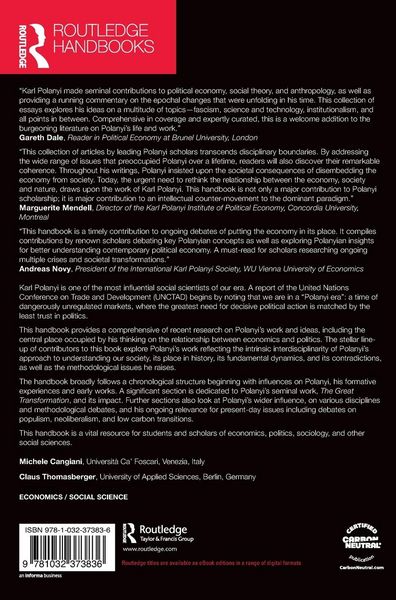
"Karl Polanyi made seminal contributions to political economy, social theory, and anthropology, as well as providing a running commentary on the epochal changes that were unfolding in his time. This collection of essays explores his ideas on a multitude of topics-fascism, science and technology, institutionalism, and all points in between. Comprehensive in coverage and expertly curated, this is a welcome addition to the burgeoning literature on Polanyi's life and work."

Gareth Dale, Reader in Political Economy at Brunel University, London

"This collection of articles by leading Polanyi scholars transcends disciplinary boundaries. By addressing the wide range of issues that preoccupied Polanyi over a lifetime, readers will also discover their remarkable coherence. Throughout his writings, Polanyi insisted upon the societal consequences of disembedding the economy from society. Today, the urgent need to rethink the relationship between the economy, society and nature, draws upon the work of Karl Polanyi. This handbook is not only a major contribution to Polanyi scholarship; it is major contribution to an intellectual counter-movement to the dominant paradigm."

Marguerite Mendell, Director of the Karl Polanyi Institute of Political Economy, Concordia University, Montreal

"This handbook is a timely contribution to ongoing debates of putting the economy in its place. It compiles contributions by renown scholars debating key Polanyian concepts as well as exploring Polanyian insights for better understanding contemporary political economy. A must-read for scholars researching ongoing multiple crises and societal transformations."

Andreas Novy, President of the International Karl Polanyi Society, WU Vienna University of Economics

Produktdetails

Einband

Gebundene Ausgabe

Erscheinungsdatum

05.02.2024

Herausgeber

Verlag

Taylor & Francis

Seitenzahl

418

Maße (L/B/H)

25/17.5/2.7 cm

Gewicht

860 g

Sprache

Englisch

ISBN

978-1-03-237383-6

EU-Ansprechpartner

Taylor & Francis Verlag GmbH
Kaufingerstraße 24
80331 München
DE
GPSR@taylorandfrancis.com

Herstelleradresse

Taylor & Francis Group
5 Howick Place
SW1P 1WG London
UK
GPSR@taylorandfrancis.com

Kundinnen und Kunden meinen

0 Bewertungen

Informationen zu Bewertungen

Zur Abgabe einer Bewertung ist eine Anmeldung im Konto notwendig. Die Authentizität der Bewertungen wird von uns nicht überprüft. Wir behalten uns vor, Bewertungstexte, die unseren Richtlinien widersprechen, entsprechend zu kürzen oder zu löschen.

Die Bewertungen sind nach Format, Anzahl Sterne und Datum sortiert.

Verfassen Sie die erste Bewertung zu diesem Artikel

Helfen Sie anderen Kund*innen durch Ihre Meinung

Kundinnen und Kunden meinen

0 Bewertungen filtern

Die Leseprobe wird geladen.
  • Produktbild: The Routledge Handbook on Karl Polanyi
  • Produktbild: The Routledge Handbook on Karl Polanyi
  • Part 1: Polanyi’s early training 1. Károly Polányi’s Hungary János Gyurgyák 2. On the edge of Austro-Marxism Diego De Bernardin Stadoan 3. The socialist calculation debate and the problem of modern civilization Claus Thomasberger Part 2: The ‘Great Transformation’ I . In theory 4. Polanyi and neoliberalism Bob Jessop 5. Twenty-first-century capitalism between embeddedness and disembeddedness: Karl Polanyi and beyond Cristiano Fonseca Monteiro and Raphael Jonathas da Costa Lima 6. Antimonies of the ‘double movement’: From Polanyi to the Polanyi debate Eren Duzgun 7. Markets, Protectionism and Self-Regulation: A key to the ‘Great Transformation’ Hannes Lacher II . Its history 8. The League of Nations’ program ‘Financial Reconstruction of Austria’ and Polanyi’s economic and political theory Maria Markantonatou 9. The World Economic Crisis of the 1930s. Polanyi’s analysis of the Great Depression, and the current global crisis Kari Polanyi Levitt 10. Observing the transformation. Polanyi’s writings in the interwar period Michele Cangiani 11. Polanyi’s unorthodox contribution to the study of fascism Kris Millett and Sang Hun Lim 12. Karl Polanyi and the ‘international civil war’: The analysis of a lucid witness and interpreter of his time Francesco Soverina 13. Karl Polanyi’s idea of co-existence: War and peace in the international frames of politics and economy in the interwar period Chikako Nakayama 14. After World War II: Universal capitalism or regional planning? Claus Thomasberger Part 3: Historical and anthropological studies 15. Polanyi’s anthropological insights: a comparative-holistic approach Justin A. Elardo 16. Karl Polanyi and the study of the Ancient Mediterranean and Western Asia David Tandy 17. Karl Polanyi on money Jérôme Maucourant Part 4: Methodology and political philosophy 18. Freedom and socialism Michael Brie 19. Polanyi versus Hayek. The problem of freedom and democracy in the market society Paula Valderrama 20. Marx and Polanyi: A philosophical encounter Hüseyin Özel 21. Polanyi reads Marx Michele Cangiani 22. Polanyi’s institutionalism between the lines Sabine Frerichs 23. Karl Polanyi’s institutionalist approach and its contemporary value for the social sciences Giorgio Resta 24. How theories shape, and are shaped by history Chaitawat Boonjubun and Asad Zaman 25. Making interdependence Übersichtlich: Reading Polanyi through a (neo)republican Lens Louis Mosar Part 5: Current problems and debates 26. Where Polanyi is more relevant than ever: Social justice and technical productivity in scientific knowledge production Emrah Irzik and Gürol Irzik 27. Chronicler of the interregnum. Karl Polanyi and the War in Ukraine Florin Poenaru 28. The double movement in the Global South: Critiques, extensions, and new horizons Geoff Goodwin 29. The ecological thought of Karl Polanyi and his contribution to ecological economics Federico Zuberman 30. Karl Polanyi in the transition to a low-carbon and biodiverse society Peadar Kirby 31. Ecosocialist freedom through participatory democratic planning Pat Devine