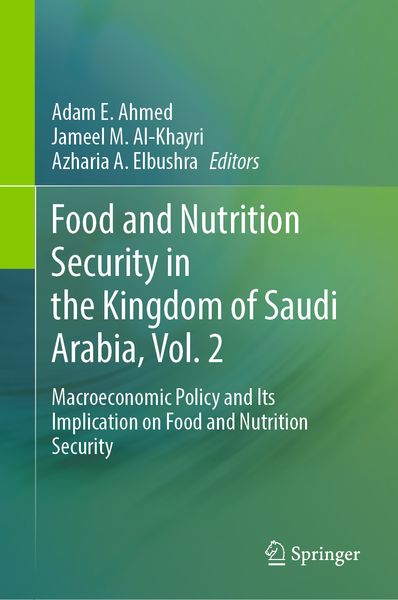
Food and Nutrition Security in the Kingdom of Saudi Arabia, Vol. 2 Macroeconomic Policy and Its Implication on Food and Nutrition Security
-
- Hardcover ausgewählt
- Taschenbuch
- eBook
-
Sprache:Englisch
Fr. 264.00
inkl. gesetzl. MwSt.,
Beschreibung
Produktdetails
Einband
Gebundene Ausgabe
Erscheinungsdatum
02.01.2024
Herausgeber
Adam E. Ahmed + weitereVerlag
SpringerSeitenzahl
492
Maße (L/B/H)
24.1/16/3.3 cm
Gewicht
922 g
Sprache
Englisch
ISBN
978-3-031-46703-5
Food and nutrition security is a major concern for Saudi Arabia and the surrounding regions due to the range of challenges they face. These challenges include limited agricultural resources, low self-sufficiency in key food staples, climate change, and high levels of food loss and waste. This book aims to evaluate and analyze the current situation and future prospects of food and nutrition security in Saudi Arabia. Additionally, it seeks to analyze and assess the roles and functions of various institutions related to food security, providing a deeper understanding of the complex problems associated with it. Furthermore, this book aligns with Kingdom Vision 2030, which includes a set of strategies and programs focused on agriculture, food, and water security. It also aligns with the institutional identity of King Faisal University's "Food Security and Environmental Sustainability".
The book consists of four volumes. Volume 2 is entitled "Macroeconomic Policy Implications on Food and Nutrition Security". It covers various areas, including food price, loss and waste, processing, finance, trade, investment, quality and safety, consumption patterns, climate change, early warning systems, nutrition institutions, oil revenue, and the significance of date palm and Hassawi rice, genetically modified food, and edible insects in ensuring food and nutritional security.
This book is highly significant for professionals, researchers, policymakers, and entrepreneurs involved in food and nutrition security in Saudi Arabia, the Gulf Cooperation Council, and various national and international organizations. It offers a comprehensive analysis of the obstacles and possibilities in ensuring food and nutrition security, as well as presenting practical approaches to address these issues. Additionally, graduate students studying in fields related to food and nutrition security will benefit from this book.
The book consists of four volumes. Volume 2 is entitled "Macroeconomic Policy Implications on Food and Nutrition Security". It covers various areas, including food price, loss and waste, processing, finance, trade, investment, quality and safety, consumption patterns, climate change, early warning systems, nutrition institutions, oil revenue, and the significance of date palm and Hassawi rice, genetically modified food, and edible insects in ensuring food and nutritional security.
This book is highly significant for professionals, researchers, policymakers, and entrepreneurs involved in food and nutrition security in Saudi Arabia, the Gulf Cooperation Council, and various national and international organizations. It offers a comprehensive analysis of the obstacles and possibilities in ensuring food and nutrition security, as well as presenting practical approaches to address these issues. Additionally, graduate students studying in fields related to food and nutrition security will benefit from this book.
Kundinnen und Kunden meinen
Verfassen Sie die erste Bewertung zu diesem Artikel
Helfen Sie anderen Kund*innen durch Ihre Meinung