
What's Left of Human Nature? A Post-Essentialist, Pluralist, and Interactive Account of a Contested Concept
-
- Taschenbuch ausgewählt
- eBook
-
Sprache:Englisch
Fr. 63.90
inkl. gesetzl. MwSt.,
Beschreibung
Produktdetails
Einband
Taschenbuch
Altersempfehlung
ab 18 Jahr(e)
Erscheinungsdatum
31.10.2023
Verlag
University PressesSeitenzahl
334
Maße (L/B/H)
22.9/15.2/2 cm
Gewicht
544 g
Sprache
Englisch
ISBN
978-0-262-54968-4
A philosophical account of human nature that defends the concept against dehumanization, Darwinian, and developmentalist challenges.
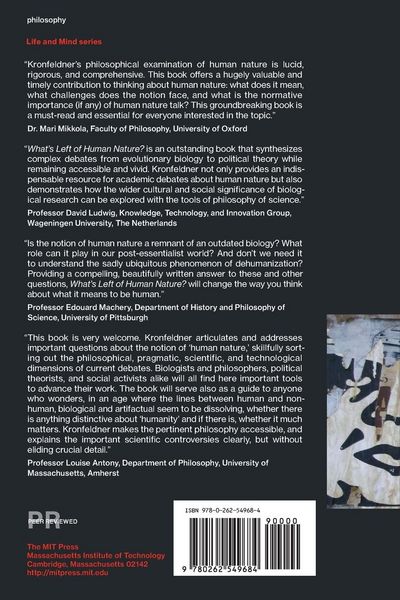
Human nature has always been a foundational issue for philosophy. What does it mean to have a human nature? Is the concept the relic of a bygone age? What is the use of such a concept? What are the epistemic and ontological commitments people make when they use the concept? In What's Left of Human Nature? Maria Kronfeldner offers a philosophical account of human nature that defends the concept against contemporary criticism. In particular, she takes on challenges related to social misuse of the concept that dehumanizes those regarded as lacking human nature (the dehumanization challenge); the conflict between Darwinian thinking and essentialist concepts of human nature (the Darwinian challenge); and the consensus that evolution, heredity, and ontogenetic development result from nurture and nature.
After answering each of these challenges, Kronfeldner presents a revisionist account of human nature that minimizes dehumanization and does not fall back on outdated biological ideas. Her account is post-essentialist because it eliminates the concept of an essence of being human; pluralist in that it argues that there are different things in the world that correspond to three different post-essentialist concepts of human nature; and interactive because it understands nature and nurture as interacting at the developmental, epigenetic, and evolutionary levels. On the basis of this, she introduces a dialectical concept of an ever-changing and “looping” human nature. Finally, noting the essentially contested character of the concept and the ambiguity and redundancy of the terminology, she wonders if we should simply eliminate the term “human nature” altogether.
Human nature has always been a foundational issue for philosophy. What does it mean to have a human nature? Is the concept the relic of a bygone age? What is the use of such a concept? What are the epistemic and ontological commitments people make when they use the concept? In What's Left of Human Nature? Maria Kronfeldner offers a philosophical account of human nature that defends the concept against contemporary criticism. In particular, she takes on challenges related to social misuse of the concept that dehumanizes those regarded as lacking human nature (the dehumanization challenge); the conflict between Darwinian thinking and essentialist concepts of human nature (the Darwinian challenge); and the consensus that evolution, heredity, and ontogenetic development result from nurture and nature.
After answering each of these challenges, Kronfeldner presents a revisionist account of human nature that minimizes dehumanization and does not fall back on outdated biological ideas. Her account is post-essentialist because it eliminates the concept of an essence of being human; pluralist in that it argues that there are different things in the world that correspond to three different post-essentialist concepts of human nature; and interactive because it understands nature and nurture as interacting at the developmental, epigenetic, and evolutionary levels. On the basis of this, she introduces a dialectical concept of an ever-changing and “looping” human nature. Finally, noting the essentially contested character of the concept and the ambiguity and redundancy of the terminology, she wonders if we should simply eliminate the term “human nature” altogether.
Kundinnen und Kunden meinen
Verfassen Sie die erste Bewertung zu diesem Artikel
Helfen Sie anderen Kund*innen durch Ihre Meinung