Gutscheinbedingungen

*Gültig bis 07.06.2026 auf (fast) alles. Ausgeschlossen sind Smartboxen, Zeitschriften, Tickets, Lebensmittel, Gaming-Elektroartikel, Tinte/Toner, Gutscheine, Geschenkkarten, Blumen und Abos | Einlösbar in allen Buchhandlungen von Orell Füssli, Barth Bücher, Buchladen Rapunzel, Schuler Orell Füssli, Stauffacher und ZAP unter Vorweisung des Gutscheins, auf www.orellfüssli.ch durch Eingabe des Gutscheincodes. Beim Service „eBooks verschenken“ und bei eBook-Käufen via eReader nicht einlösbar | Mindesteinkaufswert: Fr. 100.- | Nicht mit anderen Rabatten kumulierbar.

Produktbild: Progress in Nanoscale and Low-Dimensional Materials and Devices

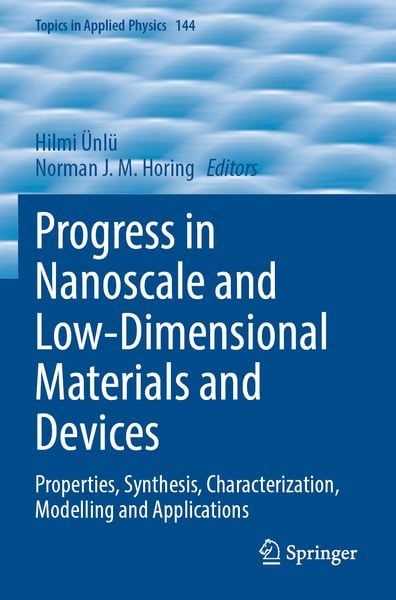
Progress in Nanoscale and Low-Dimensional Materials and Devices Properties, Synthesis, Characterization, Modelling and Applications

Fr. 191.00

inkl. gesetzl. MwSt., Versandkostenfrei


Beschreibung

Produktdetails

Einband

Taschenbuch

Erscheinungsdatum

21.10.2023

Herausgeber

Hilmi Ünlü + weitere

Verlag

Springer

Seitenzahl

938

Maße (L/B/H)

23.5/15.5/5.1 cm

Gewicht

1416 g

Auflage

1st ed. 2022

Sprache

Englisch

ISBN

978-3-030-93462-0

Beschreibung

Portrait

Prof. Dr. Hilmi Ünlü received his PhD in Electrical Engineering from University of Minnesota at Twin Cities, USA in 1986. After working at the Coordinated Science Laboratory of  the  University of Illinois at Urbana-Champaign as a post-doctoral research associate (1986-1989), he  joined  the  University  of  Miami,  Florida, as Assistant Professor of Electrical and Computer Engineering (1990-1993). He  then began working at Istanbul Technical University as Assistant Professor of Physics Engineering, where he has been Full Professor since 2005. Ünlü is an expert on nanoscience and nanotechnology of semiconductor materials and devices. He has co-authored five international scientific and technical books, authored/co-authored three book chapters and  edited/translated four internationally well-recognized physics books from English to Turkish, which was awarded by the Turkish  Academy  of  Science  (TÜBA) as the best translated book in the natural sciences. He has published over 40 scientific papers in refereed international journals indexed by Science Citation Index (SCI), 20 scientific works in Conference Proceedings and contributed 30 abstracts to international scientific conferences.

Prof. Dr. Norman J. Morgenstern Horing studied undergraduate physics at the City Collage of New York, CUNY, under Prof. Dr. Mark Zemansky, and completed his doctoral thesis research at Harvard University with Prof. Dr. Julian Schwinger in 1964.  He worked for five years as a staff physicist at the MIT Lincoln and National Magnet Laboratories, following which he was invited to the Cavendish Laboratory at Cambridge University, England, as a Visiting Lecturer for the year 1965 in the group of Prof. Dr. Sir Nevill Mott.  After another year at the U.S. Naval Research Laboratory, Semiconductors Branch, Washington, D.C., he joined the Dept. of Physics at Stevens Institute of Technology as Assistant Professor in 1966, rising to Associate Professor (1969) and Professor (1975).  He retired as Professor Emeritus in 2016 after fifty years of faculty service, but continues in semiconductor physics research.  Dr. Horing’s work has been focused on the use of quantum field theoretic Green’s function methods in statistical physics and many-body problems, correlation phenomena, collective modes in low dimensional systems, superlattices, nanostructures, Dirac-like materials. His research activities also include quantum transport/magnetotransport, van der Waals interactions, Landau quantization phenomenology and, most recently quantum statistical thermodynamics of low dimensional/nanostructure/Dirac systems.  Dr. Horing has published over 350 articles in refereed physics research journals or invited book chapters; and he authored/co-authored five advanced physics books.

Produktdetails

Einband

Taschenbuch

Erscheinungsdatum

21.10.2023

Herausgeber

Verlag

Springer

Seitenzahl

938

Maße (L/B/H)

23.5/15.5/5.1 cm

Gewicht

1416 g

Auflage

1st ed. 2022

Sprache

Englisch

ISBN

978-3-030-93462-0

Herstelleradresse

Springer-Verlag GmbH
Tiergartenstr. 17
69121 Heidelberg
DE

Email: ProductSafety@springernature.com

Kundinnen und Kunden meinen

0 Bewertungen

Informationen zu Bewertungen

Zur Abgabe einer Bewertung ist eine Anmeldung im Konto notwendig. Die Authentizität der Bewertungen wird von uns nicht überprüft. Wir behalten uns vor, Bewertungstexte, die unseren Richtlinien widersprechen, entsprechend zu kürzen oder zu löschen.

Die Bewertungen sind nach Format, Anzahl Sterne und Datum sortiert.

Verfassen Sie die erste Bewertung zu diesem Artikel

Helfen Sie anderen Kund*innen durch Ihre Meinung

Kundinnen und Kunden meinen

0 Bewertungen filtern

  • Produktbild: Progress in Nanoscale and Low-Dimensional Materials and Devices
  • Electronic Structure and Charge Transport Properties of Low Dimensional Semiconductor Heterostructure Materials and Devices.- Electronic and Optical Properties of Nanoscale Semiconductor Materials: Heterostructure Quantum Dots and Nanowires.- Synthesis, Characterization and Modelling of Colloidal Quantum Dots.- Spin Dependent Thermoelectric Currents of Tunnel Junctions and other Nanostructures like Small Rings and Quantum Dots: Onsager Theory.- Quantum Dynamics and Statistical Thermodynamics of Nanostructured Dirac-Like “Diced” Lattice Green’s Function, Spectrum and Statistical Thermodynamics.- Exact Temperature and Density Dependencies of the Statistical Thermodynamic Functions of Pseudospin 1 Diced Lattice Carriers.- Quantum Dynamics and Landau Minibands in a 1D Quantum Dot Lattice.- Grassmann Stochastic Schrödinger Equations for Low Dimensional Open Fermionic Systems.- Topological Quantum States in Electronic Materials and Ultracold Atomic Gases.- Collective Spin Systems of RydbergAtoms: Quantum Control of Entanglement.- Localized Exciton Emission in Low Dimensional Materials: Towards a Quantum Light Source.- Probing Dyakonov-like Surface Waves in Graphene Nanoribbon Twisted Arrays with Electron Energy Loss Spectroscopy.- Atomistic Tight-Binding Study of Core/Shell Nanocrystals.- Nonlinear Optical Properties of Low-Dimensional Quantum Systems.- Superconducting Proximity in Dirac/Weyl Materials.- Landau Quantized Dynamics and Energy Spectra of Asymmetric Double-Quantum-Dot Systems.- Two-Dimensional Magnetoconductivity Tensor Subject to Landau Quantization and its Associated Magnetopolaritons.- Synthesis of Transition Metal Dichalcogenides.- Numerical Analysis of the Helmholtz Green’s Function for Scalar Wave.- Propagation Through a Nanohole on a Plasmonic Layer.-Near Zone Electromagnetic Wave Transmission Through a Nanohole in a Plasmonic Layer.- Reversible DC Electric Field Modification of Optical Properties of CdTe Nanocrystals.- Density Functional Theory Analysis of Optical and Elastic Properties of Al 1 − x In x N/GaN Ternary/Binary Heterostructures.- Magnetic Nanostructure Studied by Synchrotron Radiation.- Two-Dimensional Nanomaterial-Based Biosensors.- Recent Applications of Microfluidics in Bionanotechnology.- Applications of Bioscience and Bionanotechnology.- Near Infrared Fluorescent Nanoparticles and Their Medical Applications.