• Produktbild: Unlocking the Emotional Brain
  • Produktbild: Unlocking the Emotional Brain

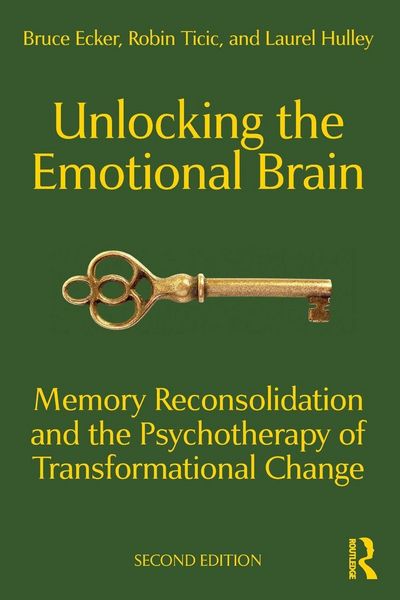
Unlocking the Emotional Brain Memory Reconsolidation and the Psychotherapy of Transformational Change

Fr. 61.90

inkl. gesetzl. MwSt., Versandkostenfrei


Beschreibung

Produktdetails

Einband

Taschenbuch

Erscheinungsdatum

22.04.2024

Verlag

Taylor & Francis

Seitenzahl

430

Maße (L/B/H)

22.9/15.2/2.4 cm

Gewicht

620 g

Auflage

2. Auflage

Sprache

Englisch

ISBN

978-1-03-213912-8

Beschreibung

Rezension

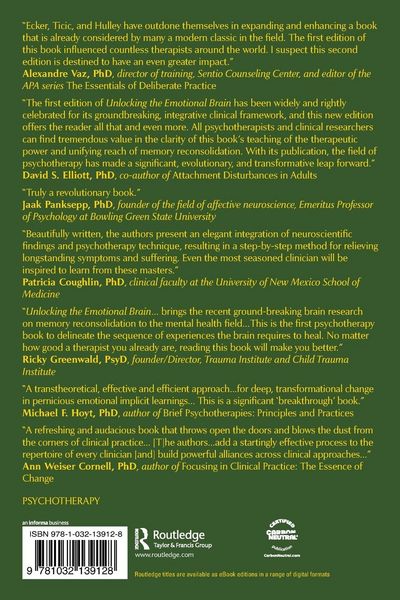
"Ecker, Ticic, and Hulley have outdone themselves in expanding and enhancing a book that is already considered by many a modern classic in the field. The first edition of this book influenced countless therapists around the world. I suspect this second edition is destined to have an even greater impact."

Alexandre Vaz, PhD, director of training, Sentio Counseling Center, and editor of the APA series The Essentials of Deliberate Practice

"The first edition of Unlocking the Emotional Brain has been widely and rightly celebrated for its groundbreaking, integrative clinical framework, and this new edition offers the reader all that and even more. All psychotherapists and clinical researchers can find tremendous value in the clarity of this book's teaching of the therapeutic power and unifying reach of memory reconsolidation. With its publication, the field of psychotherapy has made a significant, evolutionary, and transformative leap forward." 

David S. Elliott, PhD, co-author of Attachment Disturbances in Adults

FROM THE FIRST EDITON:

"Truly a revolutionary book."

Jaak Panksepp, PhD, founder of the field of affective neuroscience, Emeritus Professor of Psychology at Bowling Green State University 

"Beautifully written, the authors present an elegant integration of neuroscientific findings and psychotherapy technique, resulting in a step-by-step method for relieving long-standing symptoms and suffering. Even the most seasoned clinician will be inspired to learn from these masters."

Patricia Coughlin, PhD, clinical faculty at the University of New Mexico School of Medicine, author of Maximizing Therapeutic Effectiveness in Dynamic Psychotherapy

"Unlocking the Emotional Brain... brings the recent ground-breaking brain research on memory reconsolidation to the mental health field...This is the first psychotherapy book to delineate the sequence of experiences the brain requires to heal. No matter how good a therapist you already are, reading this book will make you better." 

Ricky Greenwald, PsyD, founder/Director, Trauma Institute and Child Trauma Institute, author of EMDR Within a Phase Model of Trauma-Informed Treatment 

"A transtheoretical, effective and efficient approach...for deep, transformational change in pernicious emotional implicit learnings... This is a significant 'breakthrough' book."

Michael F. Hoyt, PhD, author of Brief Psychotherapies: Principles and Practices

"A refreshing and audacious book that throws open the doors and blows the dust from the corners of clinical practice... [T]he authors...add a startingly effective process to the repertoire of every clinician [and] build powerful alliances across clinical approaches..."

Ann Weiser Cornell, PhD, author of Focusing in Clinical Practice: The Essence of Change

"Unlocking the Emotional Brain is destined to be a landmark publication... I'm sensing an emerging consensus in the field of psychotherapy... I think memory reconsolidation and this book could be the hub around which the various approaches unite... It is essential reading for therapists of all stripes..."

David Van Nuys, PhD, Emeritus Professor of Psychology, Sonoma State University 

Produktdetails

Einband

Taschenbuch

Erscheinungsdatum

22.04.2024

Verlag

Taylor & Francis

Seitenzahl

430

Maße (L/B/H)

22.9/15.2/2.4 cm

Gewicht

620 g

Auflage

2. Auflage

Sprache

Englisch

ISBN

978-1-03-213912-8

EU-Ansprechpartner

Taylor & Francis Verlag GmbH
Kaufingerstraße 24
80331 München
DE
GPSR@taylorandfrancis.com

Herstelleradresse

Taylor & Francis Group
5 Howick Place
SW1P 1WG London
UK
GPSR@taylorandfrancis.com

Kundinnen und Kunden meinen

0 Bewertungen

Informationen zu Bewertungen

Zur Abgabe einer Bewertung ist eine Anmeldung im Konto notwendig. Die Authentizität der Bewertungen wird von uns nicht überprüft. Wir behalten uns vor, Bewertungstexte, die unseren Richtlinien widersprechen, entsprechend zu kürzen oder zu löschen.

Die Bewertungen sind nach Format, Anzahl Sterne und Datum sortiert.

Verfassen Sie die erste Bewertung zu diesem Artikel

Helfen Sie anderen Kund*innen durch Ihre Meinung

Kundinnen und Kunden meinen

0 Bewertungen filtern

Die Leseprobe wird geladen.
  • Produktbild: Unlocking the Emotional Brain
  • Produktbild: Unlocking the Emotional Brain
  • Foreword by Alexandre Vaz Part One: The Emotional Coherence Framework: Equipping Psychotherapists for Unprecedented Effectiveness 1. Maximum Psychotherapeutic Effectiveness: The Reality of Transformational Change 2. How the Brain Unlearns: Memory Reconsolidation Explained 3. The Transformational Psychotherapy of Emotional Unlearning 4. The Moments of Fundamental Change in Slow Motion: Three Case Examples of Coherence Therapy 5. Is It Always About Attachment? Emotional Coherence and The Great Attachment Debate 6. A Framework for the Unification of Psychotherapy: Introduction to Part 2 Part Two: Hidden in Plain Sight: One Core Process in Therapies of Transformational Change 7. Accelerated Experiential Dynamic Psychotherapy (AEDP) 8. Emotion-Focused Therapy (EFT) 9. Eye-Movement Desensitization and Reprocessing (EMDR) 10. Internal Family Systems Therapy (IFS) 11. Interpersonal Neurobiology (IPNB) 12. Intensive Short-Term Dynamic Psychotherapy (ISTDP) 13. Psychedelic-Assisted Therapy: Ayahuasca 14. Somatic Experiencing (SE) Part Three: The Versatility of Coherence-Focused Psychotherapy 15. A Father's Tormenting Guilt: Deep Resolution in Seven Coherence-Focused Sessions 16. Up On Top From Down Below: Ending Compulsive Drinking Using Coherence Therapy 17. Bypassing Bypass Surgery: Using Emotional Coherence to End Compulsive Eating 18. Hearing Hostile Voices: Ending Psychotic Symptoms at Their Coherent Roots 19. Releasing Blocked Self-Expression from the Wounds of Systemic Racism: Coherence Therapy for a Deep Recalibration of Vulnerability 20. Don't Be That Way: Liberation from Lifelong Homophobic Oppression via Coherence-Guided Narratology 21. Life in the Stranglehold of Rules: Using Meditative Experience for Ending Insecure Attachment within Coherence Therapy 22. Young Teen Medicated and Misdiagnosed ADHD: Ending Hyperactive Behavior by Finding its Underlying Coherence 23. Plunging Moods and Erratic Behaviors "For No Reason": A Six-Year-Old Boy's Secret Fear Dissolves in Coherence Therapy 24. It's My Fault: Group Coherence Therapy fo Nine-Year-Old Children with Divorcing Parents