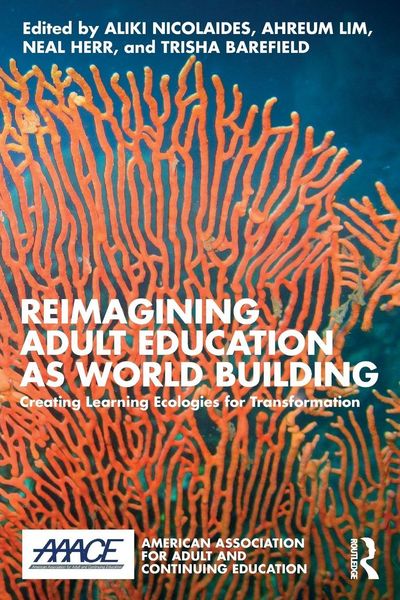
• Produktbild: Reimagining Adult Education as World Building
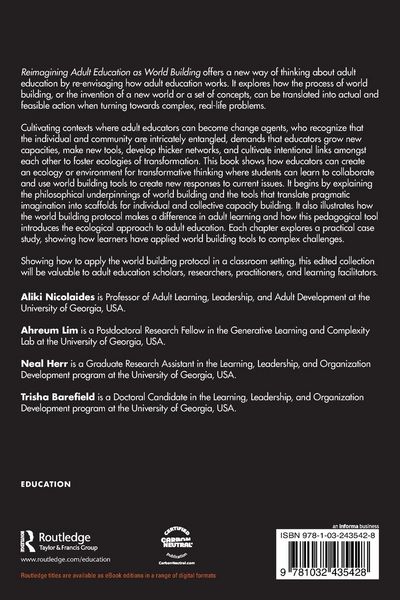
  • Produktbild: Reimagining Adult Education as World Building

Reimagining Adult Education as World Building Creating Learning Ecologies for Transformation

Fr. 79.90

inkl. gesetzl. MwSt., Versandkostenfrei


Beschreibung

Produktdetails

Einband

Taschenbuch

Erscheinungsdatum

18.03.2024

Abbildungen

schwarz-weiss Illustrationen, Zeichnungen, schwarz-weiss, Tabellen, schwarz-weiss

Herausgeber

Aliki Nicolaides + weitere

Verlag

Taylor & Francis

Seitenzahl

184

Maße (L/B/H)

22.9/15.2/1.1 cm

Gewicht

453 g

Sprache

Englisch

ISBN

978-1-03-243542-8

Beschreibung

Rezension

"Reimagining Adult Education is about putting an innovative program for graduate education into action. Much of the work it documents was conceived and deployed during the global pandemic (2020), a moment in time that provided an amazing opportunity to reimagine the aims, methods, and approaches of Ph.D. level education in our world of accelerating change. I find the book profound. It not only presents their explorations into using worldbuilding to break problem-solving and accredited learning canons, but also their journey of wrestling with this new approach pragmatically and ethically. They present both the student's viewpoints/experiences and the faculty's perspectives not merely as after-reviews but the process of theorizing, doing, reflecting, theorizing some more, recalibrating, and scaffolding student expectations, discomfort, and achievement. It presents a remarkable window into what it actually takes to innovate and land a new process that expands our imaginations of what could be possible."

John Seely Brown

, Co-author (with Ann Pendleton-Jullian) of Design Unbound: Designing for emergence in a White Water World (2018) and also co-author (with Doug Thomas) of A New Culture of Learning (2011)
Former Chief Scientist, Xerox Corporation.

"A cathartic and invigorating read. During the global Covid-19 pandemic Nicolaides and her co-editors (doctoral students within her department) fearlessly embraced the ambiguity and uncertainty of the time as a catalyst to disrupt the established norms of adult learning. Drawing upon the invaluable tools outlined by Ann Pendleton-Jullian and John Seely Brown's Design Unbound, Nicolaides et al. embarked on an illuminating journey of world building, exploring the vast possibilities of a desired future, and daringly reimagining the landscape of adult education. The result of their labors is artfully summarized in the text, making it an invaluable resource for adult

educators, scholars, practitioners, and learners alike who seek to embrace the concept of world building in the classroom."

Erin Benson

, Director, Disability Resource Center, Division of Student Affairs, University of Georgia

"The authors introduce world building-a device originating in narrative and adapted for innovation learning-to adults in higher education to build individual and systemic capacities for learning and work in a VUCA world. Doctoral students in collaboratives 'troubled' their individual and collective views of "wicked" problems and literally "made" new-world alternatives that challenged their own and the groups' thinking. Their experiences shed light on the promise and perils of radical change in teaching and learning to prepare adult learners for exponential complexity!"

Victoria J Marsick

, Adult Learning & Leadership, Teachers College, Columbia University

"At a time when adult education programs struggle to survive in the neo-liberal academy, Nicolaides and her student collaborators sketch an early path to reclaiming our power to change the world! In these pages, we see the making of a new form of doctoral education as it unfolds in the life and work of a brilliant educator and her brave students. A provocative and hopeful perspective, and a must read for all preparing the future generation of adult educators."

Ellen Scully-Russ

, Associate Professor, Human and Organizational Learning, The George Washington University

"By emphasising self-refection, collaboration and innovation, this book reminds readers that adult education can not only address global challenges but also contribute to the development of a more inclusive and transformative future."

Muhammad Taufiq Akbar, International Review of Education

Produktdetails

Einband

Taschenbuch

Erscheinungsdatum

18.03.2024

Abbildungen

schwarz-weiss Illustrationen, Zeichnungen, schwarz-weiss, Tabellen, schwarz-weiss

Herausgeber

Verlag

Taylor & Francis

Seitenzahl

184

Maße (L/B/H)

22.9/15.2/1.1 cm

Gewicht

453 g

Sprache

Englisch

ISBN

978-1-03-243542-8

EU-Ansprechpartner

Taylor & Francis Verlag GmbH
Kaufingerstraße 24
80331 München
DE
GPSR@taylorandfrancis.com

Herstelleradresse

Taylor & Francis Group
5 Howick Place
SW1P 1WG London
UK
GPSR@taylorandfrancis.com

Kundinnen und Kunden meinen

0 Bewertungen

Informationen zu Bewertungen

Zur Abgabe einer Bewertung ist eine Anmeldung im Konto notwendig. Die Authentizität der Bewertungen wird von uns nicht überprüft. Wir behalten uns vor, Bewertungstexte, die unseren Richtlinien widersprechen, entsprechend zu kürzen oder zu löschen.

Die Bewertungen sind nach Format, Anzahl Sterne und Datum sortiert.

Verfassen Sie die erste Bewertung zu diesem Artikel

Helfen Sie anderen Kund*innen durch Ihre Meinung

Kundinnen und Kunden meinen

0 Bewertungen filtern

Die Leseprobe wird geladen.
  • Produktbild: Reimagining Adult Education as World Building
  • Produktbild: Reimagining Adult Education as World Building
  • 1. Ruptures in Adult Education 2. Rethinking Pragmatism Through World Building as a Research Method 3. Reducing Polarization Through Informal Facilitators of Learning 4. Beyond the Learning Curve: The Roughness of Learning 5. Utilizing World Building to Explore Vaccine Hesitancy 6. Decolonizing Adult Education: An Imagined Potential 7. Iteration, Creation, and Frustration: Student Perspectives on World Building in the Classroom 8. Half-baked and Muddling Through: A Critical Collaborative Autoethnography of a Minor Pedagogy 9. (Re)Imagining Adult Education as Ecologies of Transformation