
Gutscheinbedingungen

*Gültig bis 07.06.2026 auf (fast) alles. Ausgeschlossen sind Smartboxen, Zeitschriften, Tickets, Lebensmittel, Gaming-Elektroartikel, Tinte/Toner, Gutscheine, Geschenkkarten, Blumen und Abos | Einlösbar in allen Buchhandlungen von Orell Füssli, Barth Bücher, Buchladen Rapunzel, Schuler Orell Füssli, Stauffacher und ZAP unter Vorweisung des Gutscheins, auf www.orellfüssli.ch durch Eingabe des Gutscheincodes. Beim Service „eBooks verschenken“ und bei eBook-Käufen via eReader nicht einlösbar | Mindesteinkaufswert: Fr. 100.- | Nicht mit anderen Rabatten kumulierbar.

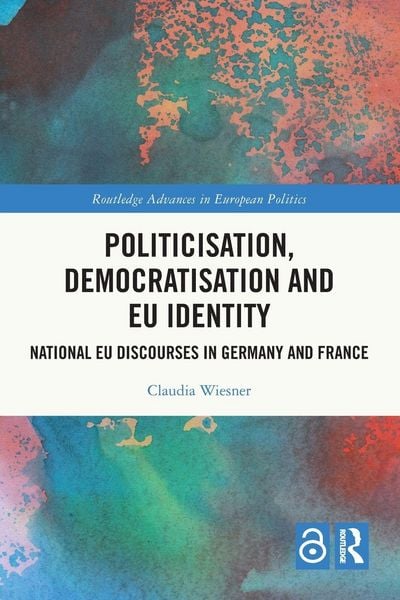
  • Produktbild: Politicisation, Democratisation and EU Identity
  • Produktbild: Politicisation, Democratisation and EU Identity

Politicisation, Democratisation and EU Identity National EU Discourses in Germany and France

Fr. 79.90

inkl. gesetzl. MwSt., Versandkostenfrei


Beschreibung

Produktdetails

Einband

Taschenbuch

Erscheinungsdatum

31.03.2026

Abbildungen

schwarz-weiss Illustrationen, Zeichnungen, schwarz-weiss

Verlag

Taylor & Francis

Seitenzahl

328

Maße (L/B/H)

23.4/15.6/1.8 cm

Gewicht

503 g

Sprache

Englisch

ISBN

978-1-03-252846-5

Beschreibung

Rezension

"The volume develops a sophisticated analysis of the partly contradictory processes of politicisation, democratisation and identity formation in the EU. It provides a new research perspective to the discourses related to the ratification of the EU Consitutitonal Treaty in 2005, showing how national discourses shape European identity. It is a must read to anyone interested in EU politics and the democratisation of the EU."
Niilo Kauppi, University of Helsinki and CNRS

"Wiesner's historically informed and theoretically stimulating account of European identity construction has a good potential to advance to a new master framework for the study of European integration and its intrinsic relationship to state and democracy transformation in Europe and beyond. Drawing principally on case studies from France and Germany, the book argues for a multi-level analysis of European identity formation that unites studies on political mobilisation and politicisation of the EU in the member states with studies of democratisation and constitutionaliastion of EU institutions and decision-making. Despite recent backsliding such as the case of Brexit or the salience of Euroscepticism, such a longitudinal analysis is helpful to outline the contours of a new type of political entity, where micro dynamics of bottom-up mobilisation in support and opposition of European integration meet with macro-dynamics of democratic identity formation."
Hans-Jörg Trenz, Scuola Normale Superiore di Pisa

Produktdetails

Einband

Taschenbuch

Erscheinungsdatum

31.03.2026

Abbildungen

schwarz-weiss Illustrationen, Zeichnungen, schwarz-weiss

Verlag

Taylor & Francis

Seitenzahl

328

Maße (L/B/H)

23.4/15.6/1.8 cm

Gewicht

503 g

Sprache

Englisch

ISBN

978-1-03-252846-5

EU-Ansprechpartner

Taylor & Francis Verlag GmbH
Kaufingerstraße 24|80331|München|DE
GPSR@taylorandfrancis.com

Herstelleradresse

Taylor & Francis Group
5 Howick Place|SW1P 1WG|London|UK
GPSR@taylorandfrancis.com

Kundinnen und Kunden meinen

0 Bewertungen

Informationen zu Bewertungen

Zur Abgabe einer Bewertung ist eine Anmeldung im Konto notwendig. Die Authentizität der Bewertungen wird von uns nicht überprüft. Wir behalten uns vor, Bewertungstexte, die unseren Richtlinien widersprechen, entsprechend zu kürzen oder zu löschen.

Die Bewertungen sind nach Format, Anzahl Sterne und Datum sortiert.

Verfassen Sie die erste Bewertung zu diesem Artikel

Helfen Sie anderen Kund*innen durch Ihre Meinung

Kundinnen und Kunden meinen

0 Bewertungen filtern

Die Leseprobe wird geladen.
  • Produktbild: Politicisation, Democratisation and EU Identity
  • Produktbild: Politicisation, Democratisation and EU Identity
  • 1. Introduction: EU politicisation, EU democratisation, EU identity and national EU discourses
    2. The Democratisation of the EU, European Identity and National EU Discourses
    3. Methodology and Research Design
    4. France: The Discourse
    5 Germany: The Discourse
    6. The discourses in comparison
    7. The Contexts in comparison
    8. EU politicisation, EU democratisation, and EU identity: What to learn from the 2005 discourses?