Gutscheinbedingungen

*Gültig bis 07.06.2026 auf (fast) alles. Ausgeschlossen sind Smartboxen, Zeitschriften, Tickets, Lebensmittel, Gaming-Elektroartikel, Tinte/Toner, Gutscheine, Geschenkkarten, Blumen und Abos | Einlösbar in allen Buchhandlungen von Orell Füssli, Barth Bücher, Buchladen Rapunzel, Schuler Orell Füssli, Stauffacher und ZAP unter Vorweisung des Gutscheins, auf www.orellfüssli.ch durch Eingabe des Gutscheincodes. Beim Service „eBooks verschenken“ und bei eBook-Käufen via eReader nicht einlösbar | Mindesteinkaufswert: Fr. 100.- | Nicht mit anderen Rabatten kumulierbar.

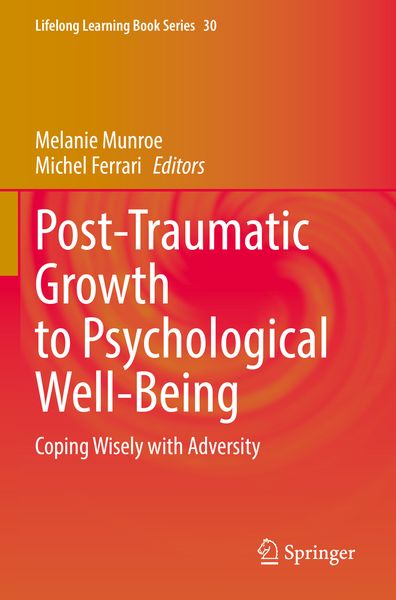
  • Produktbild: Post-Traumatic Growth to Psychological Well-Being
  • Produktbild: Post-Traumatic Growth to Psychological Well-Being

Post-Traumatic Growth to Psychological Well-Being Coping Wisely with Adversity

Fr. 218.00

inkl. gesetzl. MwSt., Versandkostenfrei


Beschreibung

Produktdetails

Einband

Taschenbuch

Erscheinungsdatum

27.10.2023

Herausgeber

Melanie Munroe + weitere

Verlag

Springer

Seitenzahl

310

Maße (L/B/H)

23.5/15.5/1.8 cm

Gewicht

499 g

Auflage

1st ed. 2022

Sprache

Englisch

ISBN

978-3-031-15292-4

Beschreibung

Portrait

MELANIE MUNROE recently received her PhD from the Ontario Institute for Studies in Education at the University of Toronto for her thesis on wisdom and adversity. Melanie’s research focuses on how individuals cope with traumatic events and how to improve long-term outcomes and well-being in trauma survivors. 

MICHEL FERRARI is a professor in the Department of Applied Psychology and Human Development at the Ontario Institute for Studies in Education (OISE) of the University of Toronto.  He leads the Wisdom and Identity Lab, which explores understandings and teaching of personal wisdom in people of different ages (from children to the elderly) in different countries around the world. He has edited or co-edited 11 books, most recently Child and Adolescent Resilience within Medical Contexts (Springer, 2016, with Carrie DeMichelis). He is currently leading a study of how wise life management can help Muslim immigrants and refugees acculturate more easily life into Toronto; in applied practice, he and his students are studying the experience of wisdom and personal identity in marginalized populations, such as those diagnosed with autism.

Produktdetails

Einband

Taschenbuch

Erscheinungsdatum

27.10.2023

Herausgeber

Verlag

Springer

Seitenzahl

310

Maße (L/B/H)

23.5/15.5/1.8 cm

Gewicht

499 g

Auflage

1st ed. 2022

Sprache

Englisch

ISBN

978-3-031-15292-4

Herstelleradresse

Springer-Verlag GmbH
Tiergartenstr. 17
69121 Heidelberg
DE

Email: ProductSafety@springernature.com

Kundinnen und Kunden meinen

0 Bewertungen

Informationen zu Bewertungen

Zur Abgabe einer Bewertung ist eine Anmeldung im Konto notwendig. Die Authentizität der Bewertungen wird von uns nicht überprüft. Wir behalten uns vor, Bewertungstexte, die unseren Richtlinien widersprechen, entsprechend zu kürzen oder zu löschen.

Die Bewertungen sind nach Format, Anzahl Sterne und Datum sortiert.

Verfassen Sie die erste Bewertung zu diesem Artikel

Helfen Sie anderen Kund*innen durch Ihre Meinung

Kundinnen und Kunden meinen

0 Bewertungen filtern

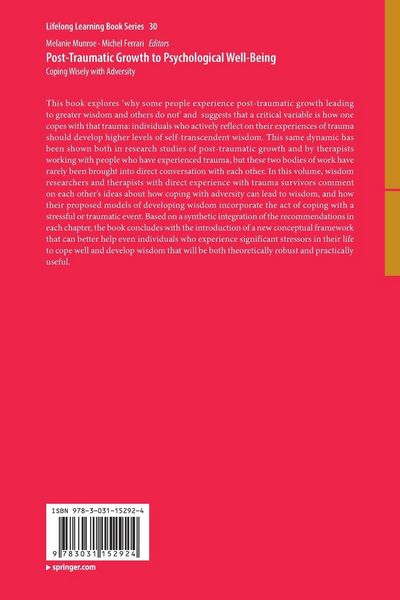
  • Produktbild: Post-Traumatic Growth to Psychological Well-Being
  • Produktbild: Post-Traumatic Growth to Psychological Well-Being
  • Chapter  1. Introduction.- Part 1: Theoretical Approaches.- Chapter 2. Posttraumatic Growth & Wisdom: Processes and Clinical Applications.- Chapter 3. Perceived Growth and Wisdom: Unanswered Questions.- Chapter 4. Adversity Constitute an Epistemic Injustice?.- Chapter 5. PTG as Personality Change: A Straw-Man Argument.- Chapter 6. The Interplay of Adversity and Wisdom Development: The H.E.R.O.E. model.- Chapter 7. The H.E.R.O.E. Model and Self-injury Recovery: A Commentary.- Chapter 8. Coping with Adversity through Metaconscious Wisdom.- Chapter 9. Commentary on “Coping with Adversity through Metaconscious Wisdom” by Michel Ferrari & Melanie Munroe.- Chapter 10. The Co-Evolution of Meaning-making and Wisdom in Processing and Developmental Time.- Chapter 11. Commentary on Mansfield’s “The Co-Evolution of Meaning-making and Wisdom in Processing and Developmental Time”.- Chapter 12. Self-compassion as a Protective Factor for Adolescents Experiencing Adversity.- Chapter 13. Commentaryon “Self-compassion as a Protective Factor for Adolescents Experiencing Adversity” by Bluth, Lathren, and Park.- Chapter 14. How MORE Life Experience Fosters Wise Coping.- Chapter 15. Commentary on Glück’s .- Chapter : How MORE Life Experience Fosters Wise Coping.- Part 2: Case Studies of Wisdom and Adversity in Real-Life Contexts.- Chapter 16. Wise Coping during the Great Depression Years.- Chapter 17. Comments on “Wise Coping during the Great Depression Years (Monika Ardelt, PhD, and Jared Kingsbury, MA).- Chapter 18. Coping Wisely Through Self-injury.- Chapter 19. Recovery from NSSI and the H.E.R.O.E. Model of Wisdom.- Part 3: Wisdom in Therapy.- Chapter 20. Wisdom Therapy in Overcoming Trauma and Burdens of Life.- Chapter 21. Commentary on “Wisdom Therapy in Overcoming Trauma and Burdens of Life” by Arnold and Linden.- Chapter 22. Existential empathy: A necessary condition for posttraumatic growth and wisdom in clients and therapists.- Chapter 23. The Similarities and Differencesbetween Existential Empathy in Therapeutic Practice and Wise Coping during the Great Depression Years.- Part 4: Institutional and Political Changes.- Chapter 24. Wisdom in Medicine: Growing and changing in the wake of an error.- Chapter 25. Learning from Mistakes: An Understudied Path to Wisdom.- Chapter 26. Colonial Adversity and Decolonial Wisdom: Radical Resurgence with Indigenous Youth.- Chapter 27. Commentary: The Vital Role of Indigenous Revitalization and Connectedness in Decolonial Healing.- Chapter 28. Conclusion.