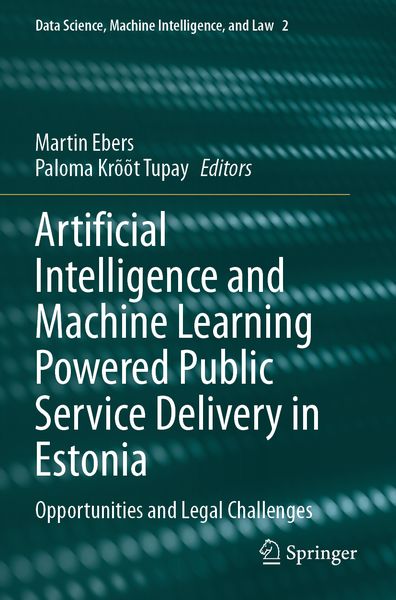
• Produktbild: Artificial Intelligence and Machine Learning Powered Public Service Delivery in Estonia
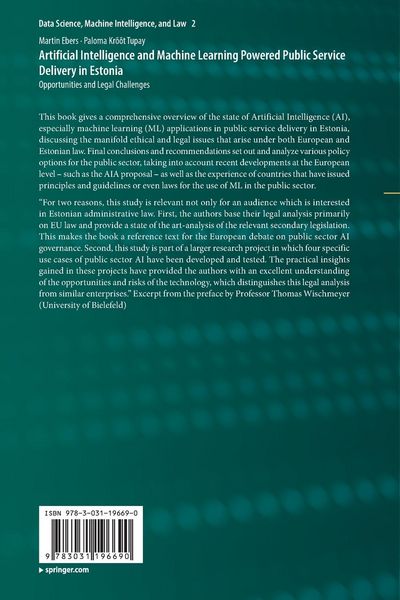
  • Produktbild: Artificial Intelligence and Machine Learning Powered Public Service Delivery in Estonia
Band 2

Artificial Intelligence and Machine Learning Powered Public Service Delivery in Estonia Opportunities and Legal Challenges

Fr. 112.00

inkl. gesetzl. MwSt., Versandkostenfrei


Beschreibung

Produktdetails

Einband

Taschenbuch

Erscheinungsdatum

15.01.2024

Herausgeber

Martin Ebers + weitere

Verlag

Springer

Seitenzahl

237

Maße (L/B/H)

23.5/15.5/1.5 cm

Gewicht

406 g

Sprache

Englisch

ISBN

978-3-031-19669-0

Beschreibung

Portrait

Martin Ebers is co-founder and president of the Robotics & AI Law Society (RAILS), Associate Professor of IT Law at the University of Tartu (Estonia) and as “Privatdozent” permanent member of the law faculty of the Humboldt University of Berlin (Germany). In addition, he is co-director of the German Institute for Energy and Competition Law in the Public Sector. Martin taught and presented at more than 100 international conferences, is a member of several national and international research networks and published 16 books and over 120 articles in the field of Law & Technology, esp. Artificial Intelligence, as well as in Commercial, Private, European, Comparative and International Law. His latest books are amongst others Algorithms and Law (Cambridge University Press, 2020); Algorithmic Governance and Governance of Algorithms (Springer Nature, 2021); and Contracting and Contract Law in the Age of Artificial Intelligence (Hart Publishing, 2022). In addition to research and teaching, Martin has been active in the field of legal consulting for many years. He is actively involved in the rapidly growing legal technology industry, as an advisor of legal tech companies and an organizer of the “Tech & Law Camps” offered by RAILS.

Paloma Krõõt Tupay teaches constitutional law at the University of Tartu in Estonia. In addition to questions of democratic state architecture, she focuses her research activities on issues of data protection, e-government and digital constitutionalism. She has co-authored a legal evaluation on questions of possibilities for the use of artificial intelligence in e-government and been part of a study on the impact of Artificial intelligence and big data on the fundamental rights in the EU requested by the European Union Agency for Fundamental Rights. Currently, she is working on the completion of a constitutional law textbook. Previously, she has worked as a legal advisor to the Estonian President and also to the Minister of Interior. Recentpublications include: Is European data protection toxic for innovative AI? – An Estonian perspective. Juridica International 2021, 99−110 (together with Martin Ebers; Jakob Juksaar; Kea Kohv); Estonia, the Digital Nation: Reflections on a Digital Citizen’s Rights in the European Union in: European Data Protection Law Review, 6 (2) 2020, 294−300.

Produktdetails

Einband

Taschenbuch

Erscheinungsdatum

15.01.2024

Herausgeber

Verlag

Springer

Seitenzahl

237

Maße (L/B/H)

23.5/15.5/1.5 cm

Gewicht

406 g

Sprache

Englisch

ISBN

978-3-031-19669-0

Herstelleradresse

Springer-Verlag GmbH
Tiergartenstr. 17
69121 Heidelberg
DE

Email: ProductSafety@springernature.com

Kundinnen und Kunden meinen

0 Bewertungen

Informationen zu Bewertungen

Zur Abgabe einer Bewertung ist eine Anmeldung im Konto notwendig. Die Authentizität der Bewertungen wird von uns nicht überprüft. Wir behalten uns vor, Bewertungstexte, die unseren Richtlinien widersprechen, entsprechend zu kürzen oder zu löschen.

Die Bewertungen sind nach Format, Anzahl Sterne und Datum sortiert.

Verfassen Sie die erste Bewertung zu diesem Artikel

Helfen Sie anderen Kund*innen durch Ihre Meinung

Kundinnen und Kunden meinen

0 Bewertungen filtern

  • Produktbild: Artificial Intelligence and Machine Learning Powered Public Service Delivery in Estonia
  • Produktbild: Artificial Intelligence and Machine Learning Powered Public Service Delivery in Estonia
  • 1. Introduction.- 2. The Promise and Perils of AI and ML in Public Administration.- 3.The Regulatory Framework in Overview.- 4. Privacy Issues: Processing Personal Data, Monitoring, and Profiling Citizens.- 5. Delegation of Administrative Powers to AI Systems.- 6. Due Process, Fair Trial, Transparency, and Explainability.- 7. Fairness and Equal Treatment.- 8. Safety and Security.- 9. Accountability and Liability.- 10. Intellectual Property Rights and Data Ownership.- 11. Final Conclusions and Recommendations.