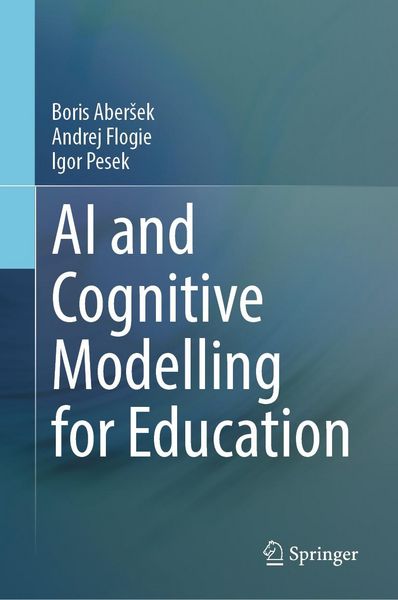
AI and Cognitive Modelling for Education
-
- Hardcover
- Taschenbuch
- eBook ausgewählt
-
Form:Einzelkauf Download
-
Sprache:Englisch
Fr. 213.90
inkl. gesetzl. MwSt.Beschreibung
Produktdetails
Format
Kopierschutz
Nein
Family Sharing
Nein
Text-to-Speech
Nein
Erscheinungsdatum
30.07.2023
Verlag
SpringerSeitenzahl
229 (Printausgabe)
Dateigröße
9579 KB
Sprache
Englisch
EAN
9783031353314
This book offers a groundbreaking approach to bridging the gap between various disciplines involved in cognitive modeling in education. By drawing on the fields of learning, neuro science, cognitive science, neurobiology, and computer science, it provides a new perspective on how we can integrate these disciplines with education to create more effective learning environments. The main objective of this book is to delve into the ethical, sociological, and technological questions surrounding the introduction of intelligent and smart learning environments in education. By analyzing these issues, this book aims to bridge the gap between the various disciplines involved in cognitive modeling and education, while highlighting the benefits and risks associated with these advancements. With the emergence of AI-based tutors, coaches, and learning environments, students now have access to a new type of self-learning and self-training that was previously unavailable. Distance learning has become increasingly popular in recent years, and the use of computer-assisted learning tools has revolutionized the way we think about education.
The goal of education must be to instill in students a desire to learn for themselves, and this can only be achieved through active, self-directed, and reflective learning. With intelligent tutoring systems, students are empowered to take an active role in their own education, rather than simply being passive recipients of information. This book offers practical strategies for teachers to facilitate this transition, enabling them to act as facilitators and guides rather than one-way communicators. By embracing this new approach to education, we can help students become lifelong learners who are equipped with the skills they need to succeed in the 21st century.
As we cannot predict the future with certainty, the true effects of education may only be revealed in the long run, making it critical to understand the potential consequencesof introducing these new learning tools. By exploring these complex topics, this book offers valuable insights for educators, policymakers, and anyone interested in the future of education.Noch keine Bewertungen vorhanden
Verfassen Sie die erste Bewertung zu diesem Artikel
Helfen Sie anderen Kundinnen und Kunden durch Ihre Meinung.