
• Produktbild: Convergence of East-West Poetics
  • Produktbild: Convergence of East-West Poetics

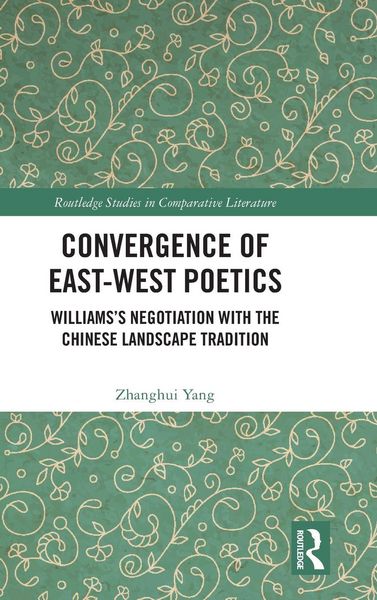
Convergence of East-West Poetics Williams's Negotiation with the Chinese Landscape Tradition

Fr. 245.00

inkl. gesetzl. MwSt., Versandkostenfrei


Beschreibung

Produktdetails

Einband

Gebundene Ausgabe

Erscheinungsdatum

23.07.2024

Abbildungen

2 schwarzweisse Abbildungen, 2 schwarzweisse Fotos

Verlag

Taylor & Francis

Seitenzahl

226

Maße (L/B/H)

23.5/15.7/1.7 cm

Gewicht

453 g

Sprache

Englisch

ISBN

978-1-03-257840-8

Beschreibung

Rezension

Zhanghui Yang's new book points a deep-focused lens at a hitherto, largely ignored relationship between Chinese landscape poetry and Modernism. While Pound's indebtedness to the practice of Rihaku, Mei Sheng and others has already been explored intricately by scholars like Qian and Saussy, a full examination of the impress of Chinese landscape poetry on the work of William Carlos Williams is long overdue. Yang's analysis is simultaneously deft and wide-ranging, as well as highly convincing, and marks a fresh and exciting beginning in Williams scholarship.

Matthew Gibson, Associate professor, University of Macau, China

Zhangui Yang's monograph is a compelling reconceptualization of Williams's engagement with Chinese culture. Through carefully targeted but adventurous scholarship on landscape aesthetics, Yang brings a fresh perspective to the venerable theme of place in Williams's oeuvre. This tack sets the book apart from other important studies of Williams, and is supported by a wealth of contextual information on Chinese landscape tradition - as well as its complex intersections with Imagism and American modernist thought. In doing so, Yang helps connect crucial moments across the arc of William's career where the poet's relentless dialectics are illuminated by his intellectual encounters with China.

Eric White, Reader in American Literature, Oxford Brookes University, UK

Produktdetails

Einband

Gebundene Ausgabe

Erscheinungsdatum

23.07.2024

Abbildungen

2 schwarzweisse Abbildungen, 2 schwarzweisse Fotos

Verlag

Taylor & Francis

Seitenzahl

226

Maße (L/B/H)

23.5/15.7/1.7 cm

Gewicht

453 g

Sprache

Englisch

ISBN

978-1-03-257840-8

EU-Ansprechpartner

Taylor & Francis Verlag GmbH
Kaufingerstraße 24
80331 München
DE
GPSR@taylorandfrancis.com

Herstelleradresse

Taylor & Francis Group
5 Howick Place
SW1P 1WG London
UK
GPSR@taylorandfrancis.com

Kundinnen und Kunden meinen

0 Bewertungen

Informationen zu Bewertungen

Zur Abgabe einer Bewertung ist eine Anmeldung im Konto notwendig. Die Authentizität der Bewertungen wird von uns nicht überprüft. Wir behalten uns vor, Bewertungstexte, die unseren Richtlinien widersprechen, entsprechend zu kürzen oder zu löschen.

Die Bewertungen sind nach Format, Anzahl Sterne und Datum sortiert.

Verfassen Sie die erste Bewertung zu diesem Artikel

Helfen Sie anderen Kund*innen durch Ihre Meinung

Kundinnen und Kunden meinen

0 Bewertungen filtern

Die Leseprobe wird geladen.
  • Produktbild: Convergence of East-West Poetics
  • Produktbild: Convergence of East-West Poetics
  • Acknowledgments

    Introduction

    1. Williams's Encounter with China and the Chinese Landscape Tradition

    1.1 "the material I knew": Williams's Knowledge of China and Chinese Landscape tradition

    1.2 Williams's Early Engagement with Chinese Landscape Aesthetics: 1915-1923

    1.3 Chinese Landscape Aesthetics in Williams's Late Works

    2. Chinese Landscape Tradition and Its Journey to the American Modernism

    2.1 Chinese shanshui Tradition: An Introduction

    2.2 Fenollosa: the Forerunner of Introducing Chinese Landscape Aesthetics

    2.3 Pound: the Inheritor Carrying Forward the Legacy of Fenollosa

    2.4 Convergence of Pound's Imagist Aesthetics and Chinese Landscape Tradition

    3. Inheritance and Innovation: Self and Landscape in Williams Poetry

    3.1 "with the material I had, I was lyrical": Landscape Aesthetics of the West and Williams's Inheritance

    3.2 The Lyrical Self in Williams's Poetry and Prose

    3.3 Self and Landscape in Chinese Landscape Discourse

    3.4 Landscape with Self in Williams's Early Poetry

    4. The Chinese Interfusion of Emotion and Scene in Williams's Landscape Writing

    4.1 Williams's Modernist Aesthetic Stance in His Poetry and Prose

    4.2 The Interfusion of Emotion and Scene in Chinese Landscape Discourse

    4.3 The Interfusion of Self and Landscape in Williams's Poetry

    5. Landscape and Seeing in Williams's Poetry: A Chinese Perspective

    5.1 "no ideas but in things" and the Idea of Seeing

    5.2 Williams's Blending of the Chinese Idea of Seeing into His Own Poetics

    5.3 Landscape and Seeing in Chinese Critical Discourse

    5.4 Williams's Experiment with the Idea of Seeing in Landscape Writing

    6. Landscape and the Poetic Space in Williams's Poetry

    6.1 Landscape, Seeing, and Space: a Critical Review

    6.2 The Space of Frustration in Paterson

    6.3 The Space of Completion in Williams's Landscape Writing

    Conclusion

    Bibliography

    Index