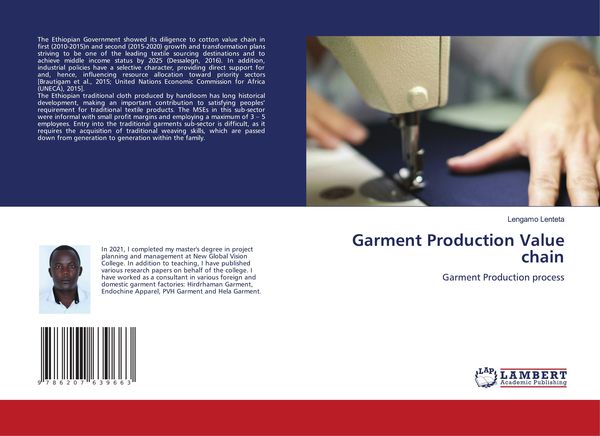
Garment Production Value chain Garment Production process. DE
-
- Englisch ausgewählt
Fr. 81.90
inkl. gesetzl. MwSt.,
Beschreibung
Produktdetails
Einband
Taschenbuch
Erscheinungsdatum
14.05.2024
Verlag
LAP LAMBERT Academic PublishingSeitenzahl
104
Maße (L/B/H)
22/15/0.7 cm
Gewicht
173 g
Sprache
Englisch
ISBN
978-620-7-63966-3
The Ethiopian Government showed its diligence to cotton value chain in first (2010-2015)n and second (2015-2020) growth and transformation plans striving to be one of the leading textile sourcing destinations and to achieve middle income status by 2025 (Dessalegn, 2016). In addition, industrial policies have a selective character, providing direct support for and, hence, influencing resource allocation toward priority sectors [Brautigam et al., 2015; United Nations Economic Commission for Africa (UNECA), 2015].The Ethiopian traditional cloth produced by handloom has long historical development, making an important contribution to satisfying peoples' requirement for traditional textile products. The MSEs in this sub-sector were informal with small profit margins and employing a maximum of 3 - 5 employees. Entry into the traditional garments sub-sector is difficult, as it requires the acquisition of traditional weaving skills, which are passed down from generation to generation within the family.
Noch keine Bewertungen vorhanden
Verfassen Sie die erste Bewertung zu diesem Artikel
Helfen Sie anderen Kundinnen und Kunden durch Ihre Meinung.