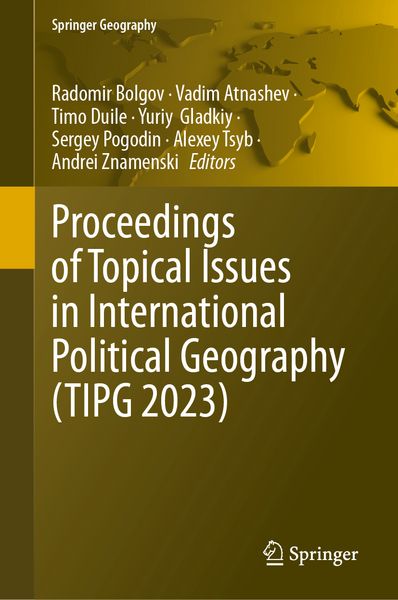
Produktbild: Proceedings of Topical Issues in International Political Geography (TIPG 2023)

Proceedings of Topical Issues in International Political Geography (TIPG 2023)

Aus der Reihe Springer Geography

Fr. 337.00

inkl. gesetzl. MwSt., Versandkostenfrei


Beschreibung

Produktdetails

Einband

Gebundene Ausgabe

Erscheinungsdatum

24.12.2024

Abbildungen

XV, 50 illus., 30 illus. in color., schwarz-weiss Illustrationen, farbige Illustrationen

Herausgeber

Radomir Bolgov + weitere

Verlag

Springer

Seitenzahl

602

Maße (L/B/H)

24.1/16/3.7 cm

Gewicht

1196 g

Sprache

Englisch

ISBN

978-3-031-70885-5

Beschreibung

Portrait

Radomir Bolgov. Associate professor at the School of International Relations, St. Petersburg State University, Russia. His current studies focus on the Internet public discourse and digital policies of post-Soviet countries. Program Committee member of the International Conference “Internet and Modern Society” (IMS), International Conference on Theory and Practice of Electronic Governance (ICEGOV), etc. Editor of the journal “Vestnik of Saint Petersburg University. International Relations”.


Vadim Atnashev. Associate Professor, School of International Relations, St. Petersburg State University. Research interests: Ethnic and Political Conflicts, International law, Human rights, Eastern countries, Countering Extremism and Terrorism. Editor of the Proceedings of International Conference “Topical Issues of International Political Geography”.


Timo Duile. Dr. habil., Post-Doc Researcher at the Department of Southeast Asian Studies, University of Bonn, Germany. His research interests are Asia/Orient, Center/Periphery, Global South, Indigenous Communities/Source Communities, Postcolonialism.


Yury Gladkiy. Professor, Chair of the Department of Economic Geography, Herzen State Pedagogical University of Russia. Corresponding Member for the Department of Professional Education at Russian Academy of Education. His research interests include humanitarian geography, regional economics, social ecology, and political geography. The author of school and university textbooks on humanitarian geography, regional studies, regional politics.


Sergey Pogodin, Professor, Chair of High School of International Relations at Peter the Great St. Petersburg Polytechnic University, Russia. He is a PC member of many international conferences and member of editorial board of academic journals on historical science, international relations and regional studies. Editor of the Proceedings of Topical Issues in International Political Geography.


Alexey Tsyb. Associate Professor of the High School of International Relations, Peter the Great St. Petersburg Polytechnic University, Russia. Editor-in-chief of the almanac “AKADHMEIA: materials and research on the history of Platonism”. Editor of the Proceedings of Topical Issues in International Political Geography.


Andrei A. Znamenski. Professor of the University of Memphis, USA. Fields of interest: Russia/Europe, Eurasia, Siberia, Religion, Modernity, Socialism, Nationalism, Western Esotericism. He also serves on the editorial advisory board of such journals as Ante Portas: Security Studies (Poland), Siberica, and Alaska History.

Produktdetails

Einband

Gebundene Ausgabe

Erscheinungsdatum

24.12.2024

Abbildungen

XV, 50 illus., 30 illus. in color., schwarz-weiss Illustrationen, farbige Illustrationen

Herausgeber

Verlag

Springer

Seitenzahl

602

Maße (L/B/H)

24.1/16/3.7 cm

Gewicht

1196 g

Sprache

Englisch

ISBN

978-3-031-70885-5

Herstelleradresse

Springer-Verlag KG
Sachsenplatz 4-6
1201 Wien
AT

Email: GPSR Kontakt

Noch keine Bewertungen vorhanden

Verfassen Sie die erste Bewertung zu diesem Artikel

Helfen Sie anderen Kundinnen und Kunden durch Ihre Meinung.

Kundinnen und Kunden meinen

Bewertungen (0)

  • Produktbild: Proceedings of Topical Issues in International Political Geography (TIPG 2023)
  • Chapter 1: New dichotomy non-Western world vs the West: the place and role of Russia in the new configuration of the world order.- Chapter 2: Latin American integration and the multipolar world: strategies and problematic issues of participation.- Chapter 3: Transforming Roles of Small States in World Politics at the Beginning of the 21st Century: in Search of Systematic and Comprehensive Approach.- Chapter 4: The Indian Ocean Rim Association: Opportunities and Prospects.- Chapter 5: Dong-A Ilbo's perception of Zhou Enlai (China) in South Korea.- Chapter 6: China-Russia Economic and Trade Cooperation within the BRICS: 2019-2022.- Chapter 7: Russia and China: Cooperation in the Field of Regional Security in Central Asia (2001–2023).- Chapter 8: Russo-Chinese Counterterrorism Partnership within the Shanghai Cooperation Organization.- Chapter 9: New Trends, Challenges and Responses of Sino-Russian Agricultural Cooperation under the Background of the Belt and Road Initiative.- Chapter 10: Kazakhstan and China: new trends in international cooperation.- Chapter 11: Vietnam’s policy towards the South China Sea and the development of China-Vietnam relations.- Chapter 12: Some aspects of China's investment policy in Oceania.- Chapter 13: Grand Prix d’Afrique. Russian and French policy in Equatorial Africa on the example of the Republic of Congo: from efficiency to effectiveness.- Chapter 14: Expert and analytical centers (Think tanks) in the development of cooperation between the EAEU partner states.- Chapter 15: Transport corridors of the post-Soviet space as a road to the future.- Chapter 16: Generative Artificial Intelligence in the System of International Relations: Risks, Opportunities, Regulation.- Chapter 17: Is Populism an ideology? A critique of the “thin ideology” concept.- Chapter 18: The Ideas of Resurrections in Ancient Polytheism, Early Christian Theology and Cambridge Platonism.- Chapter 19: Henry More: Introduction to the “Politology” of the Demon State.- Chapter 20: Cultural and Historical Foundations of the Community of “Common Future”.- Chapter 21: History and historical memory as victims of political correctness (according to the materials of the Internet portal InoSMI).- Chapter 22: The Cham as Indigenous People: Issues of Survival, Resistance, and (In)Visibility.- Chapter 23: Cultural Fennomania of the 1830s.- Chapter 24: Finland as the Battlefield as Viewed by the Officers of the General Headquarters.- Chapter 25: History and the Specific Foreign Entrepreneurship Development Features in St. Petersburg during the XVIII Century.- Chapter 26: The Baltic Tatars: Historical and Ethnic Connections in the Modern World.- Chapter 27: Legislative basis for feminism in Finland at the present time.- Chapter 28: Presidential elections in a parliamentary republic (case of Finland).- Chapter 29: German "People's parties" decline: analysis of Bundestag and Landtag elections in 2021-2023.- Chapter 30: Approaches to Evaluating Digital Services of Public Administration and Public Service Delivery: Experience of the European Union and the People's Republic of China.- Chapter 31: Introductory Words as a Means of Expressing Indirect Evidentiality in the Chinese-language Political Media Discourse.- Chapter 32: Russia’s cybersecurity policy for atomic energy sector.- Chapter 33: The Impact of Geopolitics on the Development of International Tourism in Macroregions and Countries of the World.- Chapter 34: Can Nature-based Tourism Empower Women and Foster Gender Equality?.- Chapter 35: National Brand in the system of international relations.- Chapter 36: Cooperation in the field of preservation of cultural heritage as a new dimension of BRICS policy.- Chapter 37: Eastern vector of Russia in the development of international humanitarian relations.- Chapter 38: Digital Evolution of Universities: Neural Networks in Education.- Chapter 39: SWOT analysis and performance evaluation within universities.- Chapter 40: Social adaptation of migrants in the context of German migration policy.- Chapter 41: Revisiting the issue of migration processes in China.- Chapter 42: Migrants from Post-Soviet States and the Field of Legal Interpreting in Contemporary Russia.- Chapter 43: China-Neighboring Countries' Humanistic Exchanges and the Building of a Community with a Shared Future for Mankind Diplomacy: Cases of China-Myanmar and China-Nepal Buddhist Cultural Exchanges.- Chapter 44: Political Ecology vs Political Geography: BRICS’ Peculiarities.- Chapter 45: The Northern Sea Route as a Driver of Russia’s Arctic ‘Blue Economy’.- Chapter 46: Analysis of the environmental policy of the non-Arctic states in the Polar Region: the case of Baltic states.- Chapter 47: The Group of the Least Developed Countries (LDCs) in the International Climate Policy: Evolution, Achievements, Prospects.- Chapter 48: Formation of environmental culture in the context of sustainable development: analysis of the components of responsible behavior.