• Produktbild: Mathematical Meditations
  • Produktbild: Mathematical Meditations

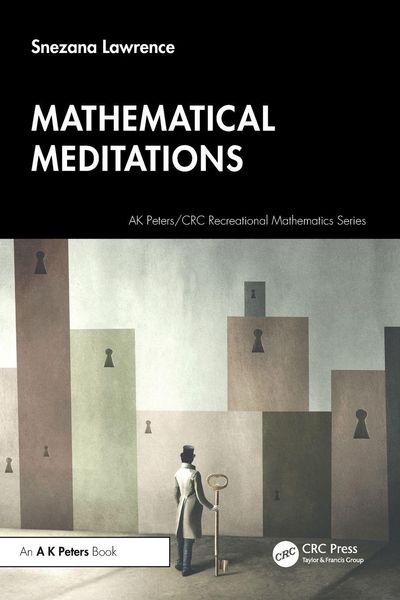
Mathematical Meditations

Fr. 47.90

inkl. gesetzl. MwSt., Versandkostenfrei


Beschreibung

Produktdetails

Einband

Taschenbuch

Erscheinungsdatum

24.02.2025

Abbildungen

schwarz-weiss Illustrationen, farbige Illustrationen, Zeichnungen, schwarz-weiss, Zeichnungen, farbig

Verlag

Taylor & Francis

Seitenzahl

206

Maße (L/B/H)

23.4/15.6/1.1 cm

Gewicht

322 g

Sprache

Englisch

ISBN

978-1-03-224906-3

Beschreibung

Produktdetails

Einband

Taschenbuch

Erscheinungsdatum

24.02.2025

Abbildungen

schwarz-weiss Illustrationen, farbige Illustrationen, Zeichnungen, schwarz-weiss, Zeichnungen, farbig

Verlag

Taylor & Francis

Seitenzahl

206

Maße (L/B/H)

23.4/15.6/1.1 cm

Gewicht

322 g

Sprache

Englisch

ISBN

978-1-03-224906-3

Herstelleradresse

Libri GmbH
Europaallee 1
36244 Bad Hersfeld
DE

Email: gpsr@libri.de

Kundinnen und Kunden meinen

0 Bewertungen

Informationen zu Bewertungen

Zur Abgabe einer Bewertung ist eine Anmeldung im Konto notwendig. Die Authentizität der Bewertungen wird von uns nicht überprüft. Wir behalten uns vor, Bewertungstexte, die unseren Richtlinien widersprechen, entsprechend zu kürzen oder zu löschen.

Die Bewertungen sind nach Format, Anzahl Sterne und Datum sortiert.

Verfassen Sie die erste Bewertung zu diesem Artikel

Helfen Sie anderen Kund*innen durch Ihre Meinung

Kundinnen und Kunden meinen

0 Bewertungen filtern

Die Leseprobe wird geladen.
  • Produktbild: Mathematical Meditations
  • Produktbild: Mathematical Meditations
  • 1. Labyrinth: From Minotaur to Chartres. The Cretan labyrinth. The Labyrinth of the Notre Dame de Chartres. Further exploration. 2. Pathways and bridges. The famous seven bridges. Further doodling with pathways. The Inspector General. Closing of the pathways with Hamilton. Further exploration. 3. Diagrams to contemplate upon. The right angled triangle with an inscribed square. The mean proportional. Now for the circles. Signs by the roadside on a Shintu pilgrimage. Little meditative question from Dyson. Further reading. 4. Music for your mind. Bach, the art of fugue, and group theory. Our tool set – group theory. Applying group theory to music. The musical clock. Further exploration. 5. Friendships: mathematicians and musicians. Gersonides and the free will question. Further exploration. 6. Presence and transience. Crome or Chrome, Huxley’s Yellow. Sketching with the chrome yellow. The numbers that keep coming up. Further exploration. 7. Prussian blue and the blue waves. The Wave and the fractals. A group of mathematicians of order three. What does B in Benoit B Mandelbroth stand for?. Fractal making. The ideal library. Further exploration. 8. Que sera, sera (what will be will be). The Dreams and Dreamers. Harmony of the world. Beautiful solids. Further exploration. 9. Questions and Answers. Goldbach conjecture. Twin prime conjecture. 196 algorithm. Is 10 a solitary number?. Further investigations. 10. The Centre of Action. It is elementary, my dear Miss Watson. A few other circles. The excircles. Some points on (all) circles. Further explorations. 11. Mathematical objects. Arithmetica by Diophantus. Hilbert’s Hotel. Möbius Band. Piero della Francesca’s master-piece?. Further reading. 12. Tracing the movement. Imagine a trace you leave behind. Hyperbolas and ellipses in motion. Dandelin’s ice-cream. Further explorations. Instead of chapter 13. Mathematicians mentioned (in alphabetical order). Alicia Boole Stott (1860-1940). Viggo Brun (1885-1978). Germinal Dandelin (1794-1847). Diophantus (date of birth unknown? – 284 AD). Freeman Dyson (1923-2020). Euclid. Leonhard Euler (1707-1783). Pierre Fatou (1878 – 1928). Pierre de Fermat (1601-1665). Karl Wilhelm Feuerbach (1800-1834). Rene Maurice Fréchet (1878-1973). Gersonides (1288-1344). Christian Goldbach (1690-1764). Alexander Grothendieck (1928-2014). William Rowan Hamilton (1805-1865). David Hilbert (1862-1943). Hypatia (c.350-415). Iamblichus (c. 245-c.325). Gaston Julia (1893-1978). Fuijita Sadasuke Kagen (1734-1807). Johannes Kepler (1571-1630). Felix Christian Klein (1849-1925). Gottfried Wilhelm Leibniz (1646-1716). Paul Pierre Lévy (1886-1971). Benoit B. Mandelbrot (1924-2010). Marin Mersenne (1588-1648). August Ferdinand Möbius (1790-1868). Gaspard Monge (1746-1818). Nicomachus (c.60-c. 120). Nicole Oresme (1325-1382). Blaise Pascal (1623-1662). Louis Poinsot (1777-1859). Pythagoras of Samos (c. 570 BCE – c. 495 BCE). Bertrand Russell (later Lord Russell, 3rd Earl Russell, 1872-1970). Theon of Smyrna (flourished around 100). Ernst Zermelo (1871-1953). Post-scriptum and all that.